NEET UG 2026 Is Over: How NTA Evaluates 26 Lakh OMR Sheets in 45 Days
NEET UG 2026 concluded on May 3 with 26 lakh candidates. Here is a detailed breakdown of the evaluation pipeline — from OMR scanning to final result — and what the model offers for university exam systems.
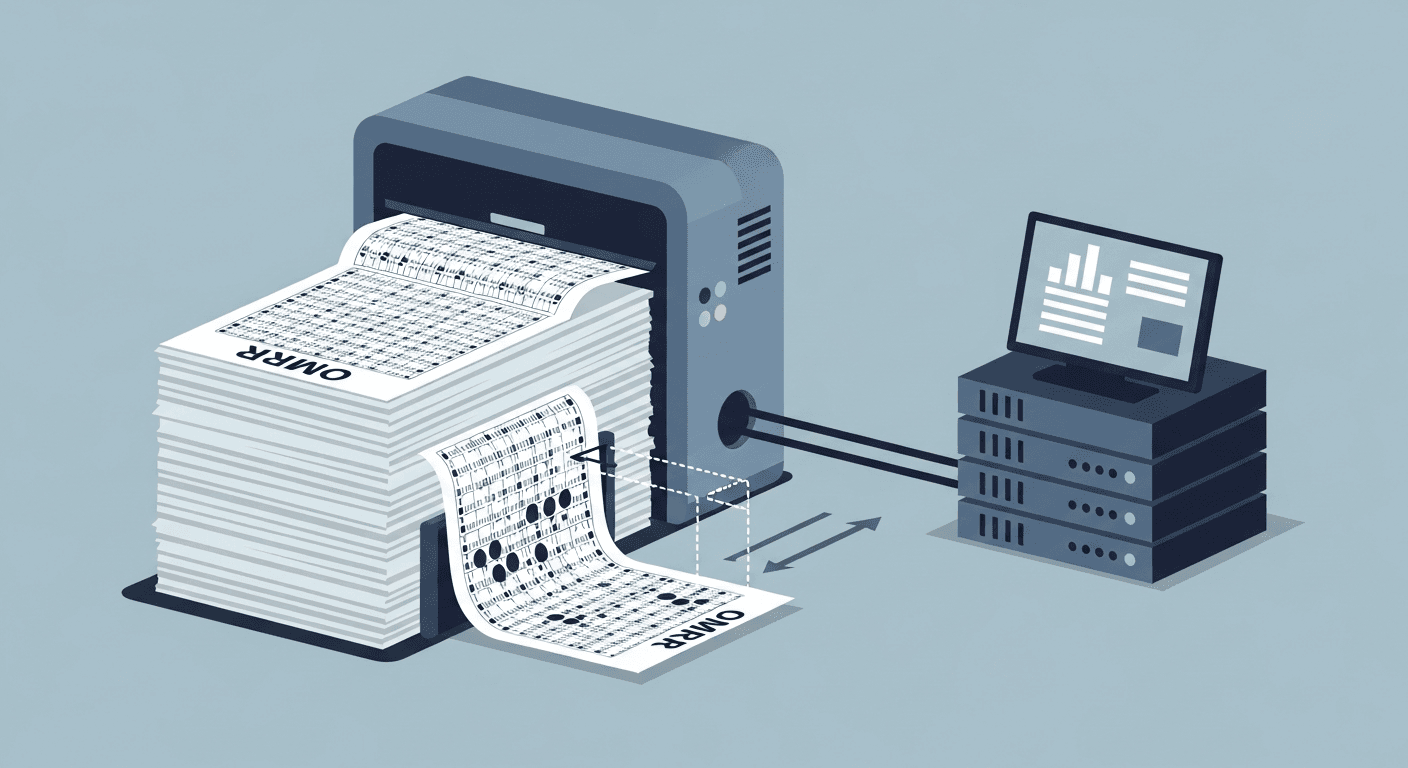
May 3, 2026: The Exam Ends, the Evaluation Begins
At 5:00 PM on May 3, 2026, NEET UG came to a close. Over 26 lakh candidates had answered 180 questions across Physics, Chemistry, and Biology in the three-hour window. The answer booklets — hand-filled OMR sheets — were sealed, accounted for, and dispatched from 557 examination cities and 14 international centres.
For most candidates, the exam is now behind them. For the National Testing Agency, the work is only beginning.
Between May 3 and the expected result date in the second or third week of June 2026, NTA must scan every OMR sheet, publish provisional answers, accept and adjudicate challenges from lakhs of candidates, release a finalised answer key, compute scores, and declare results — all while maintaining a chain of custody that can withstand judicial scrutiny.
This document traces that pipeline in detail, because the model NTA has built to handle NEET evaluation at scale contains lessons that are directly applicable to university and state board examination systems across India.
Stage 1: OMR Collection and Custody
NEET is conducted in offline (pen-and-paper) mode. Each candidate fills a machine-readable OMR response sheet, marking their answers by darkening circles corresponding to options A, B, C, or D for each of the 180 questions.
After the exam, OMR sheets at each centre are sealed in tamper-evident envelopes in the presence of invigilators and city-level observers. The sealed envelopes travel through a verified logistics chain — GPS-tracked, with CCTV coverage at handover points — to regional NTA processing centres.
The 2026 examination incorporated additional integrity measures introduced after the controversies of prior years: biometric authentication at entry, AI-monitored CCTV, 5G jammers active during the exam window, and Aadhaar-linked candidate verification. By the time the OMR sheet reaches the processing centre, its provenance has been documented at multiple checkpoints.
Stage 2: High-Speed Scanning and Digital Capture
At processing centres, OMR sheets are fed through industrial optical scanners that capture high-resolution images of each sheet. The scanning process does not just read bubble fills — it captures the entire sheet as a digital image that can be audited, enlarged, and re-examined at any stage.
Scanning software then reads the darkened bubbles automatically, converting each sheet into a numerical response record: 180 question-answer pairs, one for each candidate. The software flags ambiguous fills — partially darkened bubbles, double-marked answers — for human review.
This automated capture is the first point at which errors can enter the evaluation chain. NTA's quality control protocol at this stage involves:
The digital record created at this stage is what all subsequent evaluation is based on. No marks are computed from physical sheets after this point.
Stage 3: Provisional Answer Key Release
Within 7 to 10 days of the exam — typically around May 10–13, 2026 — NTA publishes the provisional NEET UG answer key on the official portal.
Along with the provisional key, NTA also releases:
Publishing the OMR sheet alongside the provisional answer key is a transparency mechanism of considerable importance. A candidate can compare what the scanner recorded with what they believe they marked. Discrepancies at this level — rather than during answer key challenges — can be escalated through a separate representation process.
Stage 4: The Challenge Window
For a period of approximately two to three days after the provisional answer key is released, any candidate may challenge any answer by paying a fee of ₹200 per question challenged. The fee is non-refundable unless the challenge is upheld.
In a cohort of 26 lakh candidates, the challenge window generates thousands of objections. For a question that many candidates feel is incorrectly keyed or has multiple defensible answers, the number of challenges for a single item can run into tens of thousands.
The fee structure serves two functions. First, it filters out frivolous challenges — candidates who are not confident in their objection have a financial disincentive to submit it. Second, it creates a documented log of every challenge, with the candidate's identity, the question number, and the proposed alternative answer.
This challenge log becomes the input to the next stage.
Stage 5: Expert Committee Adjudication
Every challenged question goes before a subject expert committee. For NEET, these committees are drawn from faculty at recognised medical and science institutions. The committees are convened by NTA and operate independently from the initial key-setting team.
For each challenged question, the committee reviews:
Where the committee finds that the original key was incorrect, or that multiple options are scientifically defensible, the question is marked for key amendment. In cases where a question is found to be ambiguous or defective beyond resolution, it is sometimes deleted from evaluation entirely — with marks awarded to all candidates or the question excluded from scoring.
The committee's decisions are final and are incorporated into the final answer key.
Stage 6: Score Computation and Result
With the final answer key published, scores are computed according to the established formula: four marks for each correct response, one mark deducted for each incorrect response, and zero for unanswered questions. The maximum possible score is 720.
Scores are ranked nationally and by category. Merit lists are generated for the general, OBC-NCL, SC, ST, and EWS categories, as well as for state-level quotas and special categories including PwD and NRI seats.
The result, expected in the second or third week of June 2026, is published on the official portal and also pushed to DigiLocker for permanent credentialed storage. Candidates can access their scorecards digitally without any physical document requirement.
The Timeline in Numbers
| Stage | Expected Date |
|---|---|
| NEET UG 2026 Exam | May 3, 2026 |
| Provisional Answer Key | ~May 10–13, 2026 |
| Challenge Window | ~May 13–16, 2026 |
| Final Answer Key | ~May 25–June 5, 2026 |
| Result Declaration | June 2nd–3rd week, 2026 |
From exam day to result: approximately 45 days.
What University Systems Can Learn From This Model
Transparency at Every Stage Reduces Litigation
NEET's challenge mechanism and OMR publication policy have significantly reduced the volume of post-result litigation compared to the era when answer keys were opaque and results were final by default. When candidates can see exactly what was recorded for them and contest specific answers through a formal process, disputes are resolved upstream.
Universities that face revaluation petition volumes in the thousands each semester are experiencing the same problem that NEET solved: candidates have no visibility into the evaluation process, so they contest outcomes through the only channel available — legal challenge.
Automated Score Computation Eliminates a Specific Class of Errors
One of the most persistent failure modes in traditional university examinations is totalling error: marks correctly awarded at the question level but incorrectly summed onto the cover page or into the university's records. This class of error is entirely absent in automated OMR evaluation, because computation is algorithmic and auditable.
For universities that still manually compile marks from individual scripts onto result sheets, the case for automation rests heavily on eliminating totalling errors.
Scale Does Not Have to Mean Compromised Integrity
NEET 2026 evaluated 26 lakh candidates across 14 countries in under 45 days without compromising the integrity of the process. The mechanisms that made this possible — biometric identity verification, GPS-tracked paper logistics, digital OMR capture, transparent challenge windows, expert adjudication — are not proprietary to NTA. They are design choices that any well-resourced examination body can replicate.
State boards and universities managing student populations in the lakhs have the same operational challenge NTA faces. The same design principles apply.
---
Related Reading
Ready to digitize your evaluation process?
See how MAPLES OSM can transform exam evaluation at your institution.