NEET UG 2026: How NTA Evaluates 24 Lakh Answer Sheets and Resolves One Lakh Disputes
With NEET UG 2026 scheduled for May 3, the National Testing Agency will process over 24 lakh OMR answer sheets digitally and run a structured answer key challenge mechanism — one of the largest digital evaluation operations conducted annually in the world.
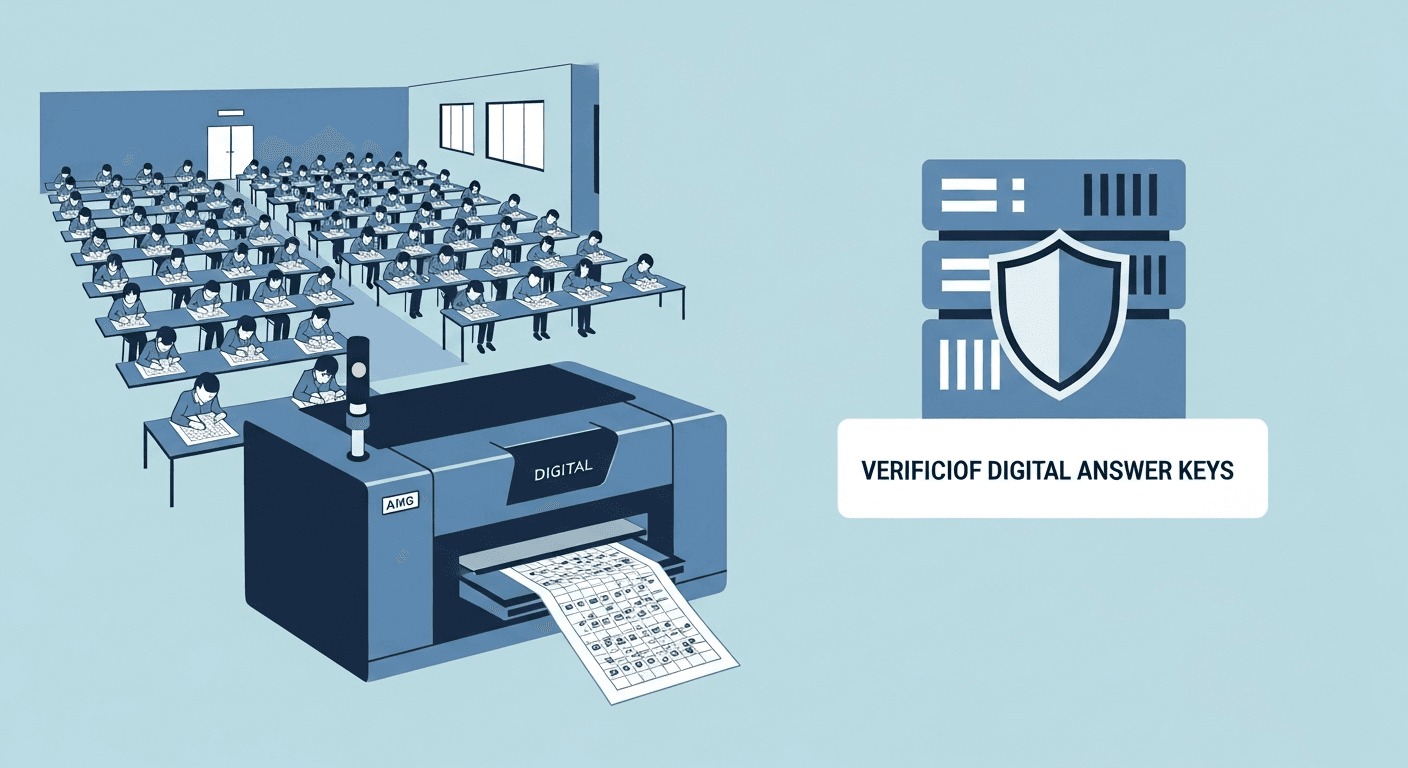
The Examination You See and the Evaluation You Don't
On May 3, 2026, approximately 24 lakh students across India and abroad will sit for NEET UG 2026 — the undergraduate medical entrance examination that determines admission to MBBS, BDS, and allied health programmes. Examination centres, travel logistics, and the weight of preparation receive intense public attention.
What follows the exam — how NTA evaluates 24 lakh answer sheets, releases an answer key, processes hundreds of thousands of individual disputes, and arrives at a defensible final score for each candidate — is rarely examined in detail. That process is one of the largest digital evaluation operations conducted annually anywhere in the world, and the infrastructure it requires holds direct lessons for university and college examination systems.
OMR Evaluation at Scale: What Actually Happens
NEET UG uses an Optical Mark Recognition (OMR) sheet format. Unlike descriptive examinations where human evaluators read and interpret written answers, OMR evaluation is machine-driven. Candidates mark responses on standardised bubble sheets, which are then scanned and processed algorithmically.
The end-to-end process works as follows:
The Scale of the Dispute Resolution Process
The answer key challenge mechanism is one of the most important and least understood features of India's national examination ecosystem. In recent NEET cycles, NTA has received between 50,000 and 1,20,000 individual question challenges from candidates — each requiring review by subject experts.
When a challenge is upheld, every candidate who selected the newly validated answer benefits. When a question is dropped entirely — because no single option is defensible — marks are awarded universally. In both cases, the re-scoring affects the rank of every candidate in the pool.
This is the distinction that matters: NEET's challenge process is not an administrative courtesy to individual complainants. It is a systematic quality control mechanism for the examination itself. A single valid challenge can alter the rank order of thousands of candidates simultaneously, because the algorithmic re-scoring is applied to the entire 24-lakh dataset.
Security Architecture for 2026
NEET UG 2024 resulted in widespread scrutiny of examination security, a Supreme Court review, and structural reforms at NTA. The 2025 and 2026 cycles incorporated several significant changes.
Biometric authentication at centres: Candidates are verified against pre-registered biometric data (fingerprint and facial recognition) at examination hall entry. This prevents impersonation at the centre level.
Encrypted digital question paper delivery: Question papers are delivered to centre superintendents in encrypted form. Decryption keys are released to authorised personnel only at the designated start time on examination day, making advance access to question content operationally difficult.
Enhanced OMR chain of custody: Every OMR sheet carries a unique barcode tied to the candidate's admit card. The sheet is tracked from distribution at the centre through collection, transport, scanning, and archiving. Any break in the barcode chain triggers an audit.
Restructured NTA governance: Following the K. Radhakrishnan committee recommendations, NTA now operates under tighter internal controls, with separate functional units for examination design, logistics, evaluation, and grievance management. These units are intended to prevent concentration of access to both question content and evaluation data in the same personnel.
The Fake Paper Leak Ecosystem
In the weeks before NEET UG 2026, NTA identified and reported over 120 Telegram and Instagram channels claiming to offer original NEET question papers in exchange for payments ranging from Rs 10,000 to Rs 40,000. NTA confirmed that no verified paper leak occurred.
These scams exploit a specific vulnerability: candidates under intense preparation pressure are susceptible to paying for fraudulent assurances of certainty. The persistence of the ecosystem — despite multiple enforcement actions — reflects how profitable the fraud is at scale.
The response has three components:
What OMR Evaluation Architecture Means for Universities
NEET's digital evaluation infrastructure is not achievable only at NTA's scale. The core principles — machine-readable answer capture, structured dispute resolution, expert review panels with defined criteria, algorithmic re-scoring, and audit-grade OMR chains of custody — are directly applicable to university and college examination systems.
Several Indian universities now use OMR-based formats for objective components of internal and end-semester examinations. What NEET demonstrates is the complete operational architecture: from secure paper delivery through scanning, expert key validation, dispute resolution, and final scoring. Each stage is documented, each decision is traceable.
For subjective examinations — descriptive answers, essays, long-form problem-solving — the equivalent system is on-screen marking (OSM), now used by CBSE for Class 12 board examinations and by an increasing number of affiliating universities. OSM brings the same principles as OMR evaluation: structured evaluator workflow, automated totalling, moderation mechanisms, and audit trails for every mark awarded.
Together, OMR for objective and OSM for descriptive define the two tracks of digital examination evaluation available to Indian educational institutions today. The architecture of NEET and CBSE's Class 12 evaluation are the most visible demonstrations at scale of what each system looks like in operation.
The 2026 Context: Results Before June
Following the examination on May 3, NTA is expected to:
For 24 lakh candidates, the quality of the evaluation process — accuracy of scanning, fairness of the challenge review, correctness of the final key — determines admission outcomes to approximately 1.08 lakh MBBS seats and 28,000 BDS seats across government and private medical colleges.
At that scale, the difference between a well-designed digital evaluation system and an ad hoc one is not a technical matter. It is a matter of institutional justice.
---
Related Reading
Ready to digitize your evaluation process?
See how MAPLES OSM can transform exam evaluation at your institution.