AI Cameras, Signal Jammers, and GPS Tracking: Inside NEET 2026's Security Stack
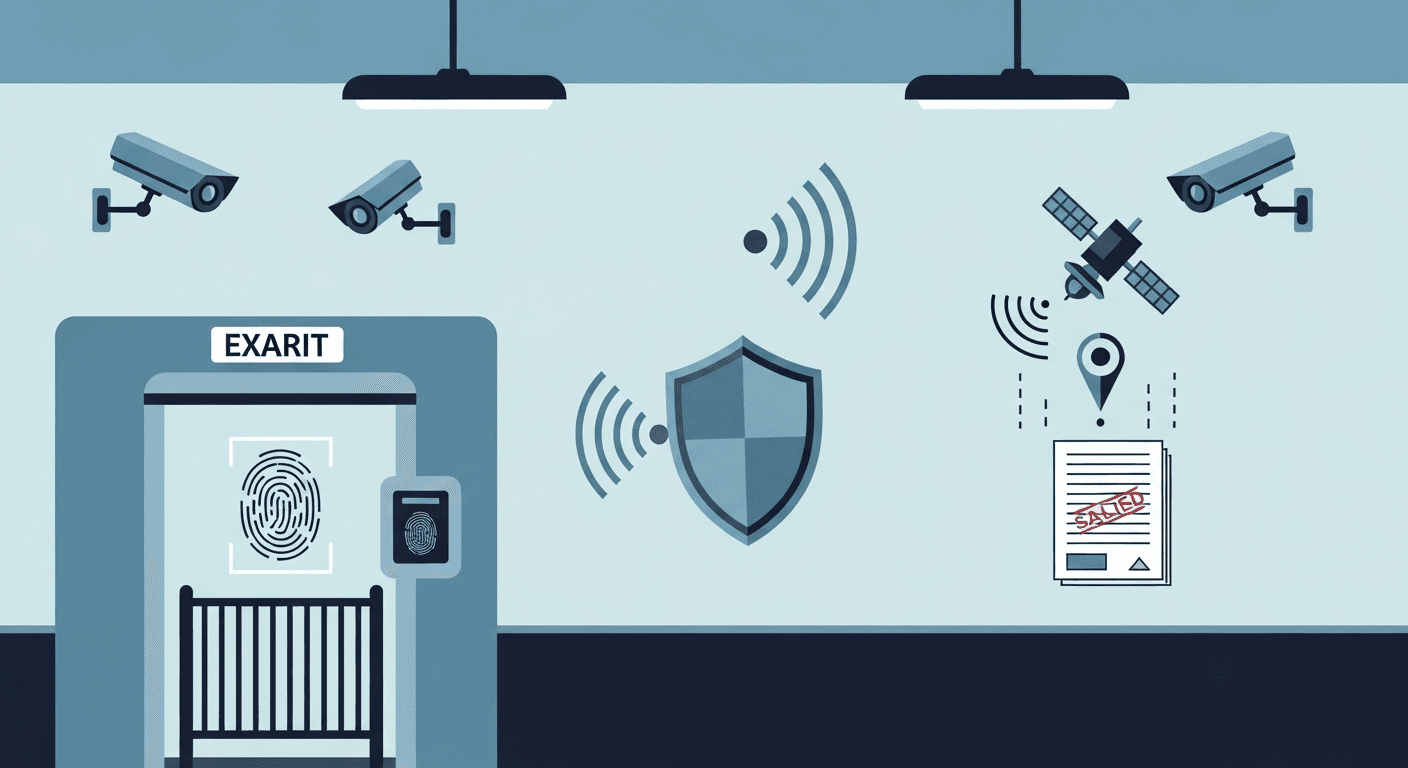
NTA deployed AI-powered surveillance, 5G signal jammers, GPS-tracked paper delivery, and facial recognition at NEET 2026 — the most comprehensive anti-malpractice overhaul in Indian exam history.
The Stakes Behind the Security
NEET-UG 2026 is India's highest-stakes competitive entrance exam. Over 22 lakh candidates competed for roughly 1,08,940 MBBS seats across government and private medical colleges. A single leaked question, a single case of impersonation, can derail careers, fuel legal battles, and reshape the political landscape of Indian education.
That is the backdrop against which the National Testing Agency (NTA) deployed what experts are calling the most comprehensive anti-malpractice technology architecture ever fielded in an Indian examination. Understanding each layer — and what it does — is instructive for every institution running high-stakes assessments.
What Failed Before: The 2025 Flashpoint
The NEET-UG 2025 controversy exposed systemic vulnerabilities. Organised malpractice rings — some operating through proxy-candidate networks, others through coordinated answer-key distribution — demonstrated that isolated security measures could be defeated one layer at a time.
A High-Level Expert Committee review identified five critical gaps: identity verification at entry, communication inside exam halls, paper logistics in transit, surveillance coverage, and post-exam answer-sheet chain of custody. NTA's 2026 overhaul directly addresses each one.
Layer 1: Biometric Identity Verification at Entry
The first security checkpoint combines facial recognition with live photograph capture. Candidates registered with a recent photograph; at the exam centre, a live capture is matched against that registration image before the admit card is validated.
This integration of Aadhaar-based facial authentication, piloted at select NEET 2025 centres in Delhi, was scaled to all exam centres for 2026. The system creates a timestamped, auditable identity log — not just a pass/fail gate, but documentary evidence against impersonation claims filed months later. NTA's implementation also cross-references a candidate's live biometric against their JEE and CUET records where available, closing the multi-exam impersonation gap.
Layer 2: AI-Enabled Surveillance Cameras Inside Exam Halls
Standard CCTV is passive — it records and humans review footage after the fact. AI-enabled cameras are active: they detect micro-behaviours associated with cheating in real time.
The algorithms deployed at NEET 2026 centres monitor eye-movement patterns, body orientation, inter-candidate proximity, and object detection (flagging items that should not be present on a desk). Anomalous events generate alerts that reach exam superintendents' dashboards immediately, rather than appearing in a retrospective footage review.
For an exam running across more than 3,000 centres simultaneously, this fundamentally changes the scale of real-time oversight possible with a finite human workforce. A team of supervisors cannot watch every hall at once; AI-flagged alerts direct human attention to where it is most needed.
Layer 3: 5G Signal Jammers in Every Hall
Organised cheating rings rely on communication. Answers transmitted via Bluetooth earpieces, smartphones, or encrypted messaging apps have been documented in multiple state board and entrance exam scandals. The Public Examinations (Prevention of Unfair Means) Act 2024, which came into force in mid-2024, criminalised the possession of such devices in exam halls — but criminalisation without detection is insufficient.
For NEET 2026, every exam hall was equipped with high-frequency signal jammers capable of blocking 4G and 5G networks. Communication channels are completely severed from the moment the exam begins. Jammers are technically complex to operate — they must be calibrated to avoid interfering with emergency services frequencies — and their coordinated deployment at thousands of centres represents a significant logistical achievement.
The result is that a candidate sitting NEET 2026 had no reliable channel for communicating with external accomplices during the exam, regardless of the device used.
Layer 4: GPS-Tracked Question Paper Logistics
Paper leaks in previous years often happened not in exam halls but in transit — during printing, packaging, or the final-mile delivery to district centres. For NEET 2026, NTA implemented GPS-enabled digital tracking of all question paper consignments.
Each sealed consignment carried a tracking device. Movement was monitored against pre-approved routes and time windows. Any deviation — a delayed delivery, an unscheduled stop, a route that did not match the registered logistics plan — triggered an immediate alert to the central monitoring team.
The system does not eliminate human error in logistics, but it makes unauthorised access far harder to conceal and far easier to trace after the fact. It also creates a documented chain of custody that can be presented in court when malpractice is alleged.
Layer 5: Physical and Procedural Hardening
Technology layers are supported by procedural ones. Candidates at NEET 2026 faced stricter dress code enforcement: transparent water bottles only, specific footwear guidelines, no accessories that could conceal electronic devices. Invigilator duty allocations were randomised at the last minute to reduce the predictability that organised rings exploit when they attempt to bribe or plant insiders.
Taken together, these physical measures remove the low-tech attack surface that technology alone cannot close. AI cameras cannot detect a device concealed in a shoe unless the shoe is first inspected.
What the Architecture Means for Answer-Sheet Evaluation
These security layers protect the exam as it is administered. The second attack surface — answer-sheet evaluation — requires its own controls. Once papers are collected, the chain of custody must be maintained through evaluation, and the marks assigned must be accurate, consistent, and tamper-free.
NEET-UG uses OMR multiple-choice evaluation, where optical scanning handles marking automatically. But the principles of digital chain-of-custody and tamper-evident processing apply directly to descriptive answer-sheet evaluation in university and board exams: scanned answer sheets with QR codes and watermarks, blind allocation of scripts to evaluators, automated totalling, complete audit trails, and double valuation with moderation thresholds.
The security architecture for delivery and the security architecture for evaluation are not separate concerns — they are two phases of the same integrity mandate.
What Institutions Can Learn from the NEET Model
Most institutions cannot deploy 5G jammers or AI camera networks. But the underlying design principle — defence in depth — is universally applicable, and most of its elements are accessible at much smaller scale.
Each layer in the NEET model assumes that the layer before it might fail. Biometric entry does not eliminate the need for in-hall surveillance. Surveillance does not eliminate the need for signal jamming. Signal jamming does not eliminate the need for GPS-tracked delivery. No single strong measure is treated as sufficient.
For institutions running semester exams, the equivalent layered model looks like this:
| Security Phase | NEET 2026 Measure | Institutional Equivalent |
|---|---|---|
| Identity at entry | Facial recognition + Aadhaar match | Photo ID verification + admit card |
| In-hall communication | 5G signal jammers | No-device policy + handheld scanner check |
| In-hall behaviour | AI surveillance cameras | Adequate invigilator-to-student ratio |
| Paper logistics | GPS-tracked consignments | Sealed packs opened in hall, witnessed |
| Evaluation phase | OMR optical scanning | Digital on-screen marking with audit trail |
The Broader Signal for Indian Education
NTA's 2026 overhaul signals a convergence: high-stakes exams in India are moving toward a technology-first, multi-layer security model. The Public Examinations Act 2024 provides the legal framework; the NTA architecture provides the operational reference.
Boards and universities that have not yet mapped their own evaluation chain-of-custody against this model face a growing credibility gap. Accreditation bodies, courts, and students increasingly expect documented, technology-backed evidence of evaluation integrity — not just assurances that processes were followed.
The question for any institution designing or upgrading its exam security is not which technology to deploy first. It is which layer is currently absent, and what that absence exposes.
Related Reading
Ready to digitize your evaluation process?
See how MAPLES OSM can transform exam evaluation at your institution.