NEET 2026: How India's Most Scrutinised Exam Ran Clean for 22.79 Lakh Students
After the 2024 NEET scandal reshaped India's exam governance, the May 3 2026 conduct marks a turning point — and the technology stack behind it holds lessons for every university evaluation system.
From Scandal to Scale: The NEET 2026 Turnaround
On May 3, 2026, the National Testing Agency conducted the NEET UG examination across 551 cities in India and 14 cities abroad. Over 22.79 lakh candidates appeared for approximately 1,08,000 undergraduate medical and dental seats. No confirmed paper leak emerged. The provisional answer key reached candidates' dashboards on May 6 — just three days after the exam concluded — marking the fastest post-exam disclosure in NEET's recent history.
That speed and cleanliness did not happen by accident. It was the direct output of a two-year institutional rebuilding effort triggered by the 2024 NEET crisis, which had led to Supreme Court scrutiny, the dissolution of the NTA's leadership, and a parliamentary debate about the credibility of India's national examination infrastructure.
Understanding what changed — and why it worked — is relevant not just for competitive entrance exam administrators but for every institution running large-scale evaluation at the university level.
The 2024 Crisis in Brief
In June 2024, allegations of paper leaks, grace marks irregularities, and centre-level malpractice in NEET UG shook public confidence in India's largest single-day examination. The Supreme Court took suo motu cognisance. The NTA Director General was removed. A high-level committee chaired by former ISRO chief K. Radhakrishnan was constituted to recommend structural reforms.
The committee's findings identified three systemic vulnerabilities: inadequate physical security in the paper distribution chain, insufficient real-time monitoring at examination centres, and a lack of transparency in post-exam result processing. Each of these became a target for the 2026 overhaul.
The 2026 Security Architecture
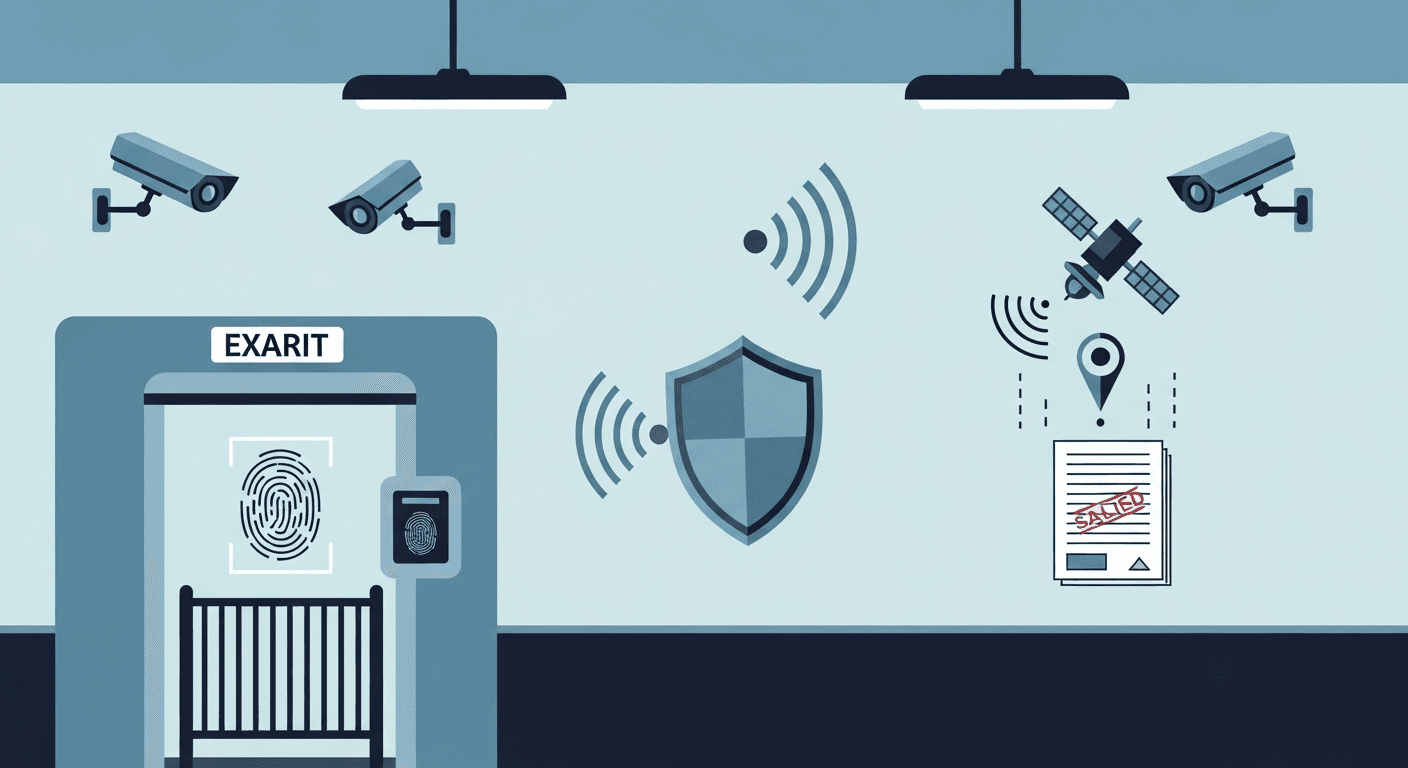
Biometric and identity verification: Every candidate underwent Aadhaar-based biometric authentication at the examination centre. Fingerprint and facial scans were matched against application-time records to eliminate impersonation. The system was integrated with the NTA's central database in real time.
AI-enabled CCTV surveillance: Examination halls were monitored by AI-augmented CCTV systems capable of flagging suspicious movement patterns, unusual device activity, and crowding around invigilators. Recordings were retained for post-exam verification.
5G jamming infrastructure: All 4,750+ examination centres were equipped with signal jammers, blocking mobile communication during the examination window. This closed the channel most exploited in the 2024 allegations — real-time transmission of questions via smartphone.
GPS-tracked question paper distribution: Question papers were transported under GPS monitoring, with the movement chain visible to a centralised control room. Papers were printed in a digital-to-print format at the last possible stage, reducing the window during which physical papers could be intercepted.
Personnel deployment at scale: Approximately 2 lakh examination personnel — invigilators, observers, flying squad members, and coordination officers — were deployed nationally. Central observers were stationed at high-sensitivity centres identified by the 2024 committee.
Pre-emptive social media action: The NTA coordinated with the Indian Cyber Crime Coordination Centre (I4C) under the Ministry of Home Affairs to flag and take down accounts spreading fake paper leak claims. Over 120 Telegram and Instagram accounts were reported before the examination date. The NTA also launched a Suspicious Claims Reporting Portal, which received more than 1,500 complaints in the lead-up to May 3.
What Happened on Exam Day
State-level authorities across Odisha, Haryana, Jharkhand, and other states confirmed largely smooth examination conduct. Minor isolated incidents — typical at the margins of a 22-lakh-candidate operation — were contained at centre level without escalation. No state or city reported systemic disruption, impersonation raids, or paper-leak interception requiring examination cancellation.
The question paper, described by students as moderately difficult with a lengthy biology section, circulated on social media within minutes of the examination concluding — as is inevitable at this scale — but the papers matched the official answer key released three days later, confirming there had been no prior circulation.
The Answer Key Process: A New Standard for Transparency
The provisional answer key release on May 6 opened a formal challenge window. Candidates who dispute any answer can raise an objection by paying a non-refundable fee of Rs 200 per question challenged. The fee is returned if the challenge is upheld.
This challenge-and-review mechanism is standard practice for competitive examinations globally, but its credibility depends entirely on speed and visibility. A key released within 72 hours of the examination allows students to compare while memory is fresh and coaching analysis is hot. The final answer key — incorporating upheld challenges reviewed by subject experts — will be published before the result, expected by around May 20.
This is a meaningful departure from the opacity that characterised the 2024 process, where timeline ambiguity fuelled rumour.
The Evaluation Chain After the Exam
NEET UG uses OMR (optical mark recognition) answer sheets. Machine evaluation at this scale proceeds as follows: scanned images of all OMR sheets are uploaded to the NTA portal; candidates can download their own scanned OMR and compare against the published answer key; the NTA's scoring algorithm applies the final key to all sheets simultaneously; the result — including raw scores, percentile ranks, and state-merit lists — is generated in a single computational pass.
There are no human evaluators in the NEET scoring chain. This eliminates inter-rater variation, calculation error, and the geographic bottleneck of distributing physical answer sheets to evaluators spread across the country. For 22.79 lakh candidates, manual evaluation of the kind used in university examinations would require thousands of evaluators working for weeks. Machine evaluation compresses the post-exam window to days.
Lessons for University Examination Systems
The NEET 2026 conduct illustrates a technology-first approach that is increasingly relevant for university-level examinations, which remain largely dependent on physical answer books and manual checking.
Several patterns from the NEET infrastructure translate directly:
The Credibility Gap That Technology Closes
India's examination ecosystem has spent years recovering credibility on multiple fronts simultaneously: competitive entrance exams, board evaluations, and university semester results. The NEET 2026 outcome does not resolve every challenge — the result cycle is still in progress, cut-offs and seat allocation remain highly contested, and the underlying mismatch between 22 lakh aspirants and 1 lakh seats is a policy problem no examination system can solve.
What the conduct does confirm is that a sufficiently well-resourced and structurally reformed digital examination infrastructure can process India's largest exams cleanly, quickly, and at a level of transparency that withstands immediate public scrutiny.
That benchmark now exists. For university examination administrators, the question is how much of it applies at their scale — and which elements of the stack can be adopted incrementally.
Related Reading
Ready to digitize your evaluation process?
See how MAPLES OSM can transform exam evaluation at your institution.