India's First Board to Go Semester-Based: What WBCHSE's Reform Means for Digital Evaluation
West Bengal became India's first education board to replace annual exams with a four-semester system for Classes XI and XII — and the change is already reshaping how answer sheets are scanned, evaluated, and published.
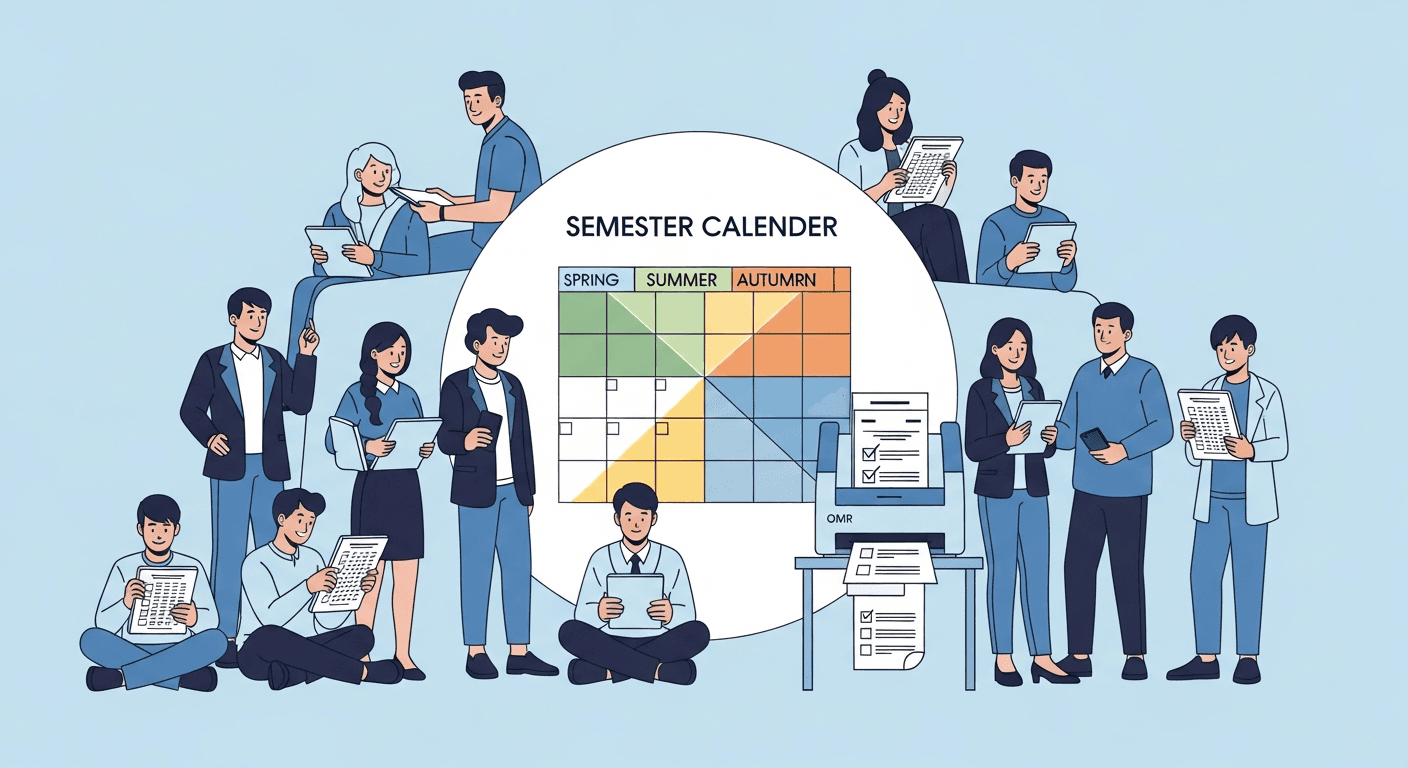
A Board That Broke With Tradition
In May 2025, the West Bengal Council of Higher Secondary Education (WBCHSE) quietly made history. It became the first education board in India to fully replace the annual examination model for Classes XI and XII with a structured four-semester system. The shift, effective from the 2024–25 academic session, affects nearly 7,000 council-affiliated schools and roughly 8 lakh students each year.
Most boards have talked about semester-based assessment for years. WBCHSE implemented it. What followed was not just a calendar change — it was a rethinking of how answer sheets are created, distributed, evaluated, and published at scale.
The Four-Semester Architecture
The WBCHSE framework is built around two exams per academic year for each class:
| Semester | Class | Format | Approximate Schedule |
|---|---|---|---|
| Semester 1 | XI | MCQ (OMR-based) | October–November |
| Semester 2 | XI | Descriptive | March–April |
| Semester 3 | XII | MCQ (OMR-based) | September |
| Semester 4 | XII | Descriptive | February–March |
Semesters 1 and 3 are conducted in offline mode with Multiple Choice Questions answered on Optical Mark Recognition (OMR) sheets. Semesters 2 and 4 use the familiar descriptive format. Final grades are determined by cumulative performance across all four semesters.
For the 2025–26 academic year, third-semester exams were scheduled for September 8–22, 2025, and fourth-semester exams ran from February 12–27, 2026.
Digital Infrastructure as a Necessary Consequence
When WBCHSE introduced the semester system, it also had to solve a new operational problem: how do you publish, verify, and address grievances across four separate evaluation windows — not one — every year?
The answer was digital infrastructure. WBCHSE announced that scanned OMR sheets from third-semester examinations would be published on the official website (wbchse.wb.gov.in) shortly after exams conclude. This is a significant transparency step: students can review their own OMR sheets online rather than waiting for physical copies through slow administrative channels.
The council simultaneously launched a revamped online portal covering Higher Secondary registration, results queries, and grievance submission — all routed through a single digital gateway. Schools upload data to this portal; students access their information through it. The system is now processing four exam cycles per year instead of one.
What This Demands of Evaluation Systems
The transition from one annual evaluation cycle to four semester cycles per year changes the mathematics of examination management dramatically. Consider what a board-level evaluation coordinator now faces:
Annual evaluation workflows — built for one big event per year — simply cannot stretch to meet these demands without significant process changes.
Why OMR Scanning and Public Disclosure Matter
WBCHSE's decision to publish scanned OMR sheets is not purely a goodwill gesture. It is a structural response to a legitimate governance problem. With four exam cycles per year, the volume of mark-dispute requests would become unmanageable through manual processes.
By publishing scanned OMR sheets online, WBCHSE achieves three things simultaneously:
This model — scan once, use many times — is the same principle that underlies university-level onscreen marking systems. The WBCHSE experiment at the board level demonstrates that the approach scales across diverse institution types and exam formats.
Implications for Universities and Autonomous Colleges
WBCHSE's reform carries a direct message for affiliated universities and autonomous colleges navigating similar transitions under the National Education Policy 2020.
NEP 2020 mandates a shift from rote-based annual examinations to continuous, competency-based assessment. The Four-Year Undergraduate Programme (FYUGP) adopted by central universities introduces multiple assessment points per year. UGC's minimum standards guidelines for affiliated colleges increasingly require documented, trackable assessment records.
The WBCHSE experience shows what happens when a large institution actually makes this shift:
Accreditation Implications
For NAAC accreditation, Criterion 2 (Teaching-Learning and Evaluation) specifically asks institutions to document their examination systems, grievance mechanisms, and moderation processes. Under the new Binary Accreditation and Maturity-Based Graded Levels (MBGL) framework rolling out in 2025–26, digital documentation of evaluation processes is a measurable requirement — not optional evidence.
Institutions that move to semester-based assessment without building digital evaluation infrastructure will find themselves in an operational bind: more frequent exams, more grievances, more audit requirements, and less time to handle any of them manually.
The Broader Significance
WBCHSE's reform is significant not because West Bengal is unique, but because it is early. The pressures that led WBCHSE to adopt a semester system — NEP 2020 alignment, continuous assessment mandates, student expectations for faster results and greater transparency — are the same pressures facing every major education board and university in India.
What West Bengal's experiment shows is that structural reform and digital infrastructure are not sequential steps. They are simultaneous requirements. You cannot build a semester system on paper-based evaluation processes; the throughput simply does not work.
The boards and universities watching WBCHSE now have data they did not have before. A semester system is operational at scale. OMR scanning with public disclosure is working. Grievance volumes are being managed digitally. The template exists.
The question for every examination authority in India is no longer whether to adopt digital evaluation infrastructure, but how quickly they can build it before the next policy mandate makes it unavoidable.
---
Related Reading
Ready to digitize your evaluation process?
See how MAPLES OSM can transform exam evaluation at your institution.