CBSE Introduces On-Screen Marking for Class 12: What It Means for Digital Evaluation in India
CBSE's February 2026 announcement brings on-screen marking to 46 lakh Class 12 students. Here's what the move means, what challenges emerged during mock evaluations, and what it signals for digital evaluation across India.
The Announcement
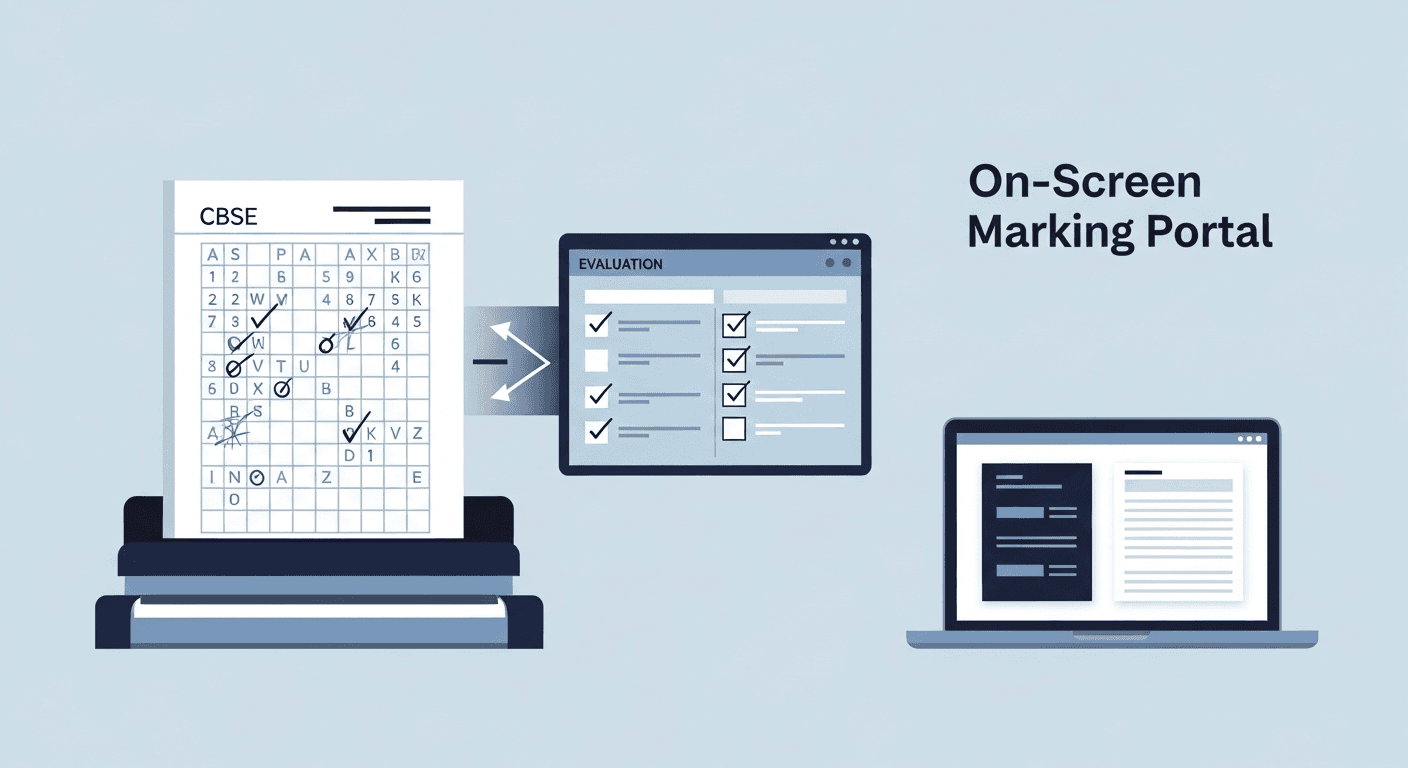
On February 9, 2026, CBSE issued a circular (CBSEICOORD/OSM/2026) announcing that Class 12 board examination answer sheets would be evaluated through On-Screen Marking (OSM) starting with the 2026 session. Exams began on February 17, 2026 — just eight days after the announcement.
This is not a pilot. It is not optional. Every Class 12 answer sheet from the 2026 CBSE board examinations will be scanned, digitized, and evaluated on screen by teachers across India. Class 10 answer sheets will continue with traditional physical evaluation for now.
The scale is staggering: approximately 46 lakh students across India and 26 countries, making this one of the largest single deployments of on-screen marking in the world.
How CBSE's OSM System Works
The workflow CBSE has implemented follows the standard digital evaluation model:
Teachers no longer need to travel to evaluation camps. They can mark answer sheets from their own school's computer lab, continuing their regular duties alongside evaluation work.
What CBSE Gets Right
The rationale behind CBSE's move is sound and aligns with what every institution that has adopted digital evaluation has experienced:
Zero totalling errors. Manual mark totalling in paper evaluation produces errors in 2-5% of answer booklets. At CBSE's scale (46 lakh students), that means 90,000 to 2,30,000 students could have received incorrect totals under the old system. Automatic computation eliminates this entirely.
No post-result verification needed. CBSE has announced that students will no longer be able to apply for post-result verification of marks — because the automated system makes manual totalling errors impossible. This saves both the board and students significant time and cost.
Remote evaluation. Teachers can evaluate from their own schools rather than attending centralized evaluation camps. This saves travel time, reduces logistics costs, and allows schools to continue regular operations during the evaluation period.
Faster results. Digital workflows compress the evaluation timeline significantly. More teachers can participate simultaneously since they don't need to physically gather at specific locations.
The Challenges That Emerged
CBSE's rollout has not been without problems — and the challenges are instructive for any institution planning a similar transition.
Technical Glitches During Mock Evaluations
CBSE conducted mandatory mass mock evaluations before the actual evaluation began. Reports from schools indicate significant technical issues:
Insufficient Training
The training window was extremely tight. Schools were asked to ensure technical readiness and train teachers on the OSM platform in a matter of days. Reports from teachers indicate:
Screen Fatigue and Workload Concerns
Evaluating answer sheets on screen is physically different from marking on paper. Teachers have reported:
Teachers Asked for Phased Rollout
Delhi government school teachers formally asked CBSE to suspend the on-screen marking system for the current year and implement it through a phased rollout instead. Their concerns centered on insufficient preparation time, inadequate infrastructure in many schools, and the risk of errors affecting student outcomes at this scale.
What This Signals for Digital Evaluation in India
CBSE's move is a watershed moment, regardless of the implementation challenges. Here's why:
The Direction Is Set
When CBSE — the largest board in India — adopts on-screen marking, it sends an unambiguous signal to every state board, university, and examination body: digital evaluation is the future standard, not an experimental option. The 74% of examination boards that have already adopted or are piloting OSM systems will accelerate their rollouts. The remaining 26% now face increasing pressure to follow.
Scale Validates the Concept
Previous large-scale OSM deployments in India (by state technical education directorates, autonomous universities, and state boards) processed hundreds of thousands of scripts. CBSE is operating at 46 lakh — an order of magnitude larger. Successfully completing this evaluation cycle (even with challenges) proves that on-screen marking works at national scale.
Implementation Matters More Than the Decision
The challenges CBSE faced are not arguments against digital evaluation — they are arguments for better implementation. Every issue that emerged (server capacity, training, image quality, teacher readiness) has been solved by institutions that have run digital evaluation for multiple cycles. The technology works. The challenge is change management at scale.
Lessons for Institutions Planning the Transition
CBSE's experience offers clear lessons for other exam boards and universities considering digital evaluation:
1. Start Earlier Than You Think
CBSE announced OSM eight days before exams began. This left almost no time for infrastructure preparation, teacher training, or troubleshooting. Institutions that have successfully transitioned typically begin preparation 3-6 months before the first digital evaluation cycle — including infrastructure setup, multiple training sessions, and pilot evaluations with smaller batches.
2. Invest in Training
One-week training is insufficient for teachers who may not be comfortable with technology. Effective training programs include hands-on practice with the actual evaluation interface, mock evaluation sessions with sample answer sheets, dedicated support during the first live evaluation cycle, and ongoing help resources (documentation, support hotlines, on-site technical staff).
3. Infrastructure Must Be Ready Before Launch
CBSE specified minimum requirements (Windows 8+, 4GB RAM, 2 Mbps internet, Adobe Reader), but many schools struggled to meet these standards consistently. The scanning infrastructure, server capacity, and network bandwidth must all be tested under load before the first live evaluation.
4. Plan for Server Capacity at Peak Load
When thousands of teachers log in simultaneously at 9 AM on the first day of evaluation, the system must handle that load without degradation. This is a solvable engineering problem, but it requires proper capacity planning based on the actual number of concurrent users expected.
5. Scanning Quality Is Critical
Poor scan quality propagates through the entire evaluation chain. If a teacher cannot clearly read a student's handwriting in the scanned image, the evaluation quality suffers regardless of how good the marking interface is. Scanning stations need quality control checkpoints before images enter the evaluation pipeline.
The Bigger Picture
CBSE's adoption of OSM is part of a broader transformation driven by NEP 2020's emphasis on technology integration and competency-based assessment. The 2026 board exams also introduce 50% competency-based questions, moving away from rote memorization toward application-oriented assessment.
Combined with digital evaluation, these changes represent the most significant reform of India's examination system in decades. The 46 lakh students affected by CBSE's OSM rollout in 2026 are the first cohort of what will eventually be the standard for all board examinations across India.
The institutions that prepare now — building scanning infrastructure, training evaluators, and establishing digital evaluation workflows — will be ready when their turn comes. Those that wait will face the same implementation challenges CBSE is working through, but with the added pressure of student and parent expectations set by CBSE's precedent.
Related Reading
Ready to digitize your evaluation process?
See how MAPLES OSM can transform exam evaluation at your institution.