Two Right Answers, No Credit: What the Allahabad HC's UPTET 2026 Ruling Means for Universities
The Allahabad High Court excluded two disputed UPTET 2026 questions rather than awarding full marks — a legal precedent with direct implications for how universities design objective exams and handle bulk score recalculations.
The October 28 Ruling
On October 28, 2026, Justice Vinod Diwakar of the Allahabad High Court passed a ruling in Vijay Sonkar & 3 Ors. v. State of U.P. & 2 Ors. (WRIT-A No. 16959 of 2026) that ordered the Uttar Pradesh Examination Regulatory Authority (UPESSC) to remove two questions from the UPTET 2026 evaluation and recalculate scores for all candidates.
Questions 36 and 37 in the UPTET 2026 examination had each admitted two acceptable answers. UPESSC had initially awarded marks only to candidates who selected one of the two accepted options. The court held that this approach was legally untenable.
The ruling reduced the examination from 150 to 148 questions for scoring purposes. The qualifying threshold — set at prescribed percentages under UP's teacher eligibility framework — was recomputed accordingly. The relief was explicitly extended to all candidates in the same position, not limited to the petitioners.
The Legal Principle
The court's reasoning draws on a 2026 Supreme Court precedent that set aside a High Court direction to award full marks to candidates who selected either of two accepted answers. The logic runs as follows: a multiple-choice question is designed to test whether a candidate can identify one correct response from a set of alternatives. When an examining authority accepts two answers as correct, it is effectively acknowledging that the question failed to test that discrimination. A question that cannot determine whether a candidate has the relevant knowledge cannot serve as a valid evaluation instrument.
If the question is not a valid instrument, awarding marks based on it — whether to everyone who answered, to those who chose one of the two accepted options, or to no one — introduces an arbitrary element into a consequential examination. The court's solution is to remove the question entirely and recompute results on the remaining valid questions.
This is not an unprecedented approach in Indian examination jurisprudence. Courts have repeatedly held that defective questions should be excluded rather than treated as bonus marks, particularly in competitive examinations where rank or qualifying status is at stake. The UPTET 2026 judgment reinforces this position and provides a fresh authority that counsel for examining bodies will need to account for going forward.
Why This Matters for University Examinations
UPTET is a teacher eligibility test administered at the state level. But the legal principle the Allahabad HC applied is not limited to competitive examinations. It reflects a broader standard for examination integrity that applies across any institution using objective-type questions in university examinations.
Consider the scenario that is routine in Indian university end-semester examinations: an MCQ or objective paper of 50 or 100 questions, set by subject matter faculty, reviewed internally, and distributed to candidates. Post-examination review by students, faculty, or external experts identifies one or more questions where the answer key is incorrect or where multiple options are defensible.
Universities face a choice:
Each choice has institutional and legal consequences. The UPTET ruling makes option 3 — exclusion with proportional rescaling — the approach most defensible under judicial scrutiny, particularly because it removes the arbitrary element of which answer version candidates happened to submit.
The practical challenge is execution. In a traditional paper-based examination system, recalculating scores for every candidate based on a reduced question set requires manually re-processing hundreds or thousands of mark sheets. This is time-consuming, error-prone, and creates a gap between when the dispute is identified and when corrected results can be published — a gap that breeds student grievance, social media pressure, and further litigation.
The Recalculation Gap: Why Digital Systems Change the Equation
A university running digital evaluation through an OSM platform has a fundamentally different capability when a question exclusion is ordered or decided.
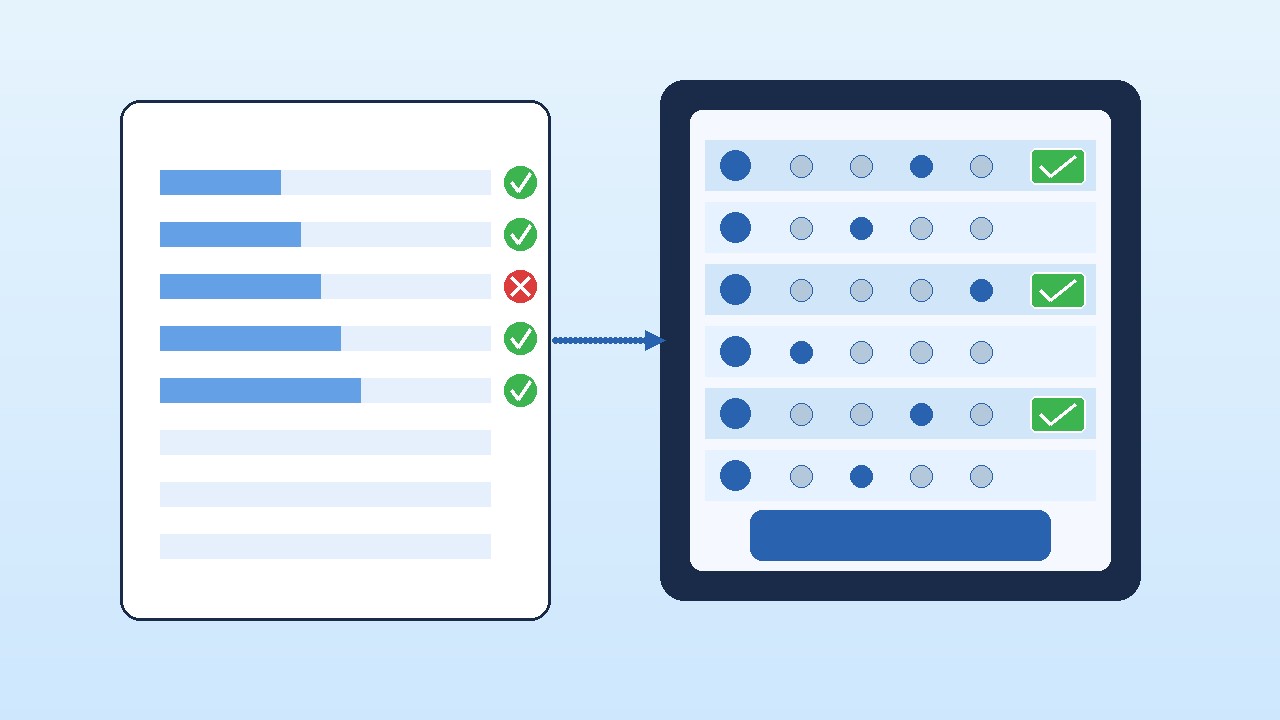
In a digital system, marks are stored as structured data. Each candidate's score for each question is a discrete record. Excluding a question is a database operation: flag the question as invalid, remove its contribution from each candidate's total, recompute totals, recompute percentage, check each candidate against the qualifying threshold. For a 50,000-candidate examination, this takes minutes rather than weeks.
The resulting corrected score list is complete, consistent, and auditable. The system maintains the original mark records alongside the corrected records, so any subsequent judicial review can verify exactly what was changed, when, and according to what logic.
This is not merely a question of speed. Courts examining examination disputes look for evidence of consistent treatment across all candidates. A digital recalculation by definition applies the same rule to every record simultaneously. A manual recalculation introduces the possibility of differential error rates across batches, regions, or institutions — which creates fresh grounds for challenge.
Three Actions University Exam Controllers Should Take
Include question exclusion provisions in examination statutes and ordinances. Most university examination regulations describe the process for paper setting, evaluation, and results. Few explicitly address what happens when post-examination review identifies a defective question. Adding a clause that follows the exclusion-and-rescale approach — consistent with judicial precedent — removes the ambiguity that leads to ad hoc decisions and subsequent litigation.
Establish a post-examination question review mechanism. A structured process for receiving and reviewing objections to question paper answers — with defined timelines, subject expert review, and a formal decision record — reduces the risk that disputed questions remain unaddressed until a court orders recalculation. Several university systems have implemented digital answer key challenge portals (UPTET itself uses one). The UPTET 2026 case arose despite this portal, but the portal record forms part of the administrative trail.
Verify that your evaluation platform supports question-level mark adjustment and mass recalculation. Not all digital evaluation platforms expose this functionality to administrators. If your platform stores marks as finalised totals rather than question-by-question records, a court-ordered recalculation will require manual intervention regardless of whether the initial evaluation was digital. When selecting or upgrading evaluation software, the ability to adjust scoring parameters and recompute results for the full candidate pool should be a specified requirement.
A Pattern Worth Tracking
The UPTET 2026 ruling is one of several judicial decisions in 2025–2026 that have tightened the standards expected of examining bodies in India. The Supreme Court's engagement with CBSE's on-screen marking system, the Madhya Pradesh High Court's conditional upholding of digital evaluation at medical universities, and the proliferation of writ petitions challenging evaluation methodology collectively signal that courts are paying closer attention to examination processes.
For universities, this attention creates both risk and opportunity. The risk is that examination practices that were previously unchallenged will face judicial scrutiny as more students and their advocates are aware of litigation pathways. The opportunity is that institutions with documented, auditable, structured digital evaluation systems will find it substantially easier to defend their processes — and to demonstrate compliance when recalculation or correction is required.
Related Reading
Ready to digitize your evaluation process?
See how MAPLES OSM can transform exam evaluation at your institution.