From Paper to Pixels: NEET's Last Pen-Paper Exam and India's CBT Transition Week
With NEET-UG 2026 retest on June 21 marking the end of pen-paper high-stakes exams and UGC NET running fully in CBT mode from June 22, India's two largest examination formats are crossing a historical threshold in the same seven days.
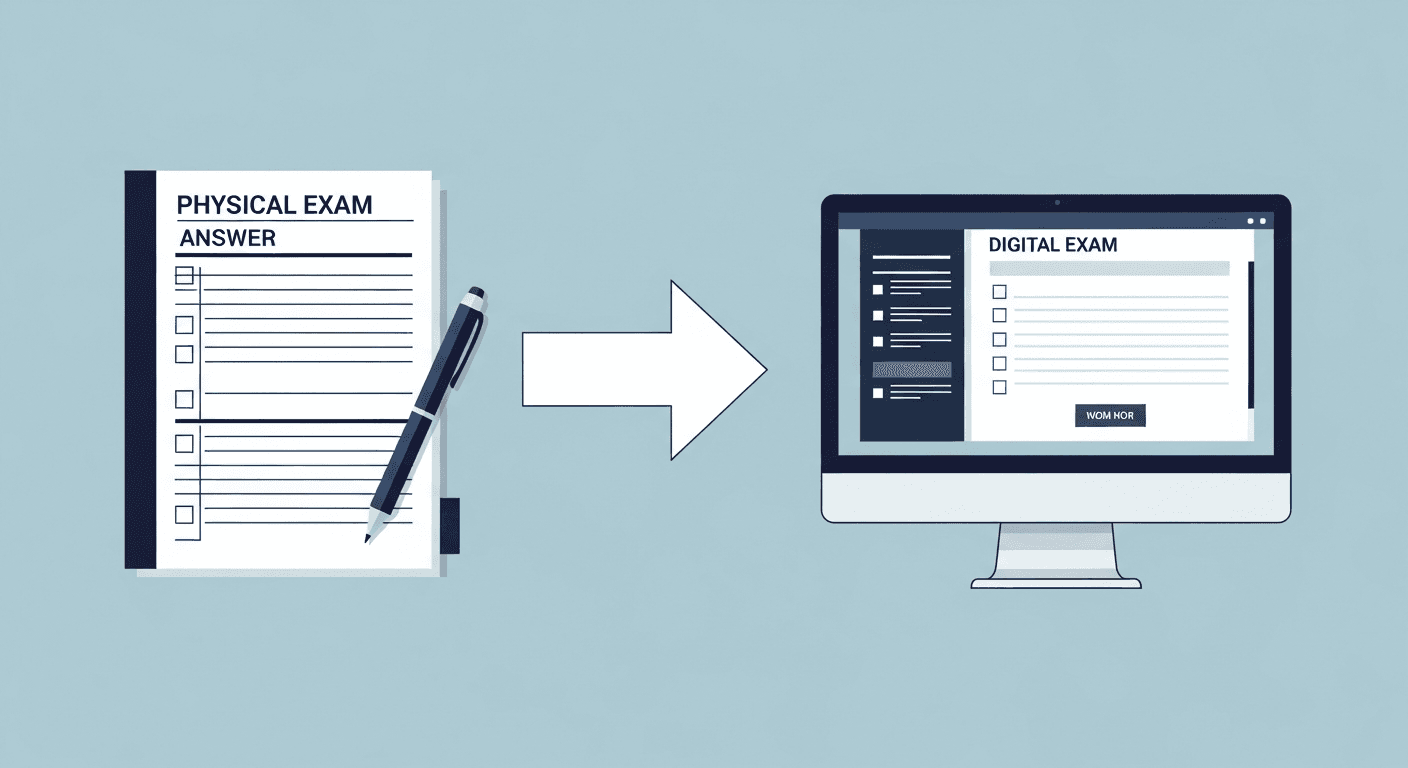
Six Days That End Forty Years
On June 21, 2026, approximately 22 lakh candidates will sit for the NEET-UG retest — writing answers by hand on OMR sheets, filling question booklets with pen, sealing papers in physical covers. Every step of that process has been part of India's high-stakes medical entrance ritual since the exam's predecessors were established.
It will be the last time.
Union Education Minister Dharmendra Pradhan confirmed in June 2026 that NEET-UG 2027 will be conducted as a Computer-Based Test. The June 21 retest — necessitated by the May 2026 paper leak in which over 140 questions were allegedly circulated in Rajasthan before the examination began — is the final sitting of the pen-paper format for India's most consequential national entrance exam.
One day later, on June 22, the UGC-NET 2026 June session begins across 85 subjects in CBT mode, running through June 30. Two of India's largest examination formats, separated by 24 hours, at opposite ends of the pen-paper and digital spectrum. The same week marks both the last chapter of one era and the opening week of another.
Why the May 2026 Paper Leak Made CBT Inevitable
The NEET-UG 2026 paper that reached Rajasthan authorities before the exam was not a file exfiltrated from a server. It was a physical document — printed, photographed, translated, and distributed through a human network involving paper setters, intermediaries, and examination centre contacts.
The Radhakrishnan Committee, which submitted its recommendations to the Ministry of Education in late 2025, had identified exactly this architecture as the structural vulnerability of India's pen-paper national examinations. When question papers are printed weeks in advance and physically transported to thousands of examination centres across the country, every node in that supply chain is a potential compromise point. The larger the candidate pool, the more centres, the more nodes, the more exposure.
Computer-based testing removes that architecture. In a CBT, questions are drawn dynamically from a question bank or delivered from encrypted central servers in the hours before the examination begins. There are no physical question papers to photograph, no human carriers to bribe, no paper copies to translate and circulate via WhatsApp.
The comparison with JEE Main is instructive. JEE Main moved to CBT format in 2018. In the eight years since, there has been no documented JEE Main paper leak of the kind that has repeatedly compromised pen-paper examinations. The CBT architecture is not impervious — question bank integrity and server security are genuine concerns — but it eliminates an entire category of physical supply-chain leak risk.
NEET's paper leak history — 2024, then again in 2026 — made the committee's recommendation essentially non-controversial once the political will existed to act on it.
What the UGC NET CBT Week Demonstrates
While NEET retest coverage has dominated media attention in June 2026, the UGC NET cycle running from June 22 to June 30 is proceeding, based on available information, without disruption.
The June session covers 85 subjects in two daily shifts: Paper I from 9:00 AM to 12:00 PM and Paper II from 3:00 PM to 6:00 PM, each running 180 minutes with no break between papers. Hundreds of thousands of candidates across India will determine their eligibility for Junior Research Fellowships, assistant professor appointments, and PhD admissions through a fully digital examination — admit cards, hall tickets, and city intimation all released digitally.
It is worth noting that UGC NET did experience a paper leak in December 2024, which led to that session being postponed and ultimately cancelled. The cause of that leak was not the CBT format itself — it was compromised question bank management and insider access during question preparation. The subsequent system overhaul addressed those specific vulnerabilities in question sourcing and pre-exam handling.
The June 2026 cycle is the first major UGC NET sitting since that overhaul. Its proceeding without reported incident, at the time of writing, matters for the broader debate about India's examination infrastructure: CBT failed once because of question-bank security failures, not because of the CBT interface itself. The fixes were applied to the right layer.
The Evaluation Infrastructure Consequence
For universities and affiliated colleges, the shift from pen-paper to CBT in major national examinations has a direct — and often overlooked — consequence for answer-sheet evaluation pipelines.
NEET-UG 2026 generated approximately 24 lakh OMR sheets requiring physical handling, verification, and processing by the National Testing Agency. Each sheet had to be scanned, checked for bubbling errors, and matched against candidate identity records. The post-exam evaluation pipeline for a pen-paper examination at this scale is a substantial operational undertaking requiring weeks of processing time.
In a CBT, candidate responses are captured digitally at the point of entry. There is no scanning step, no bubbling error to correct, no physical OMR to handle. Evaluation collapses to automated scoring against an answer key — a process measurable in hours rather than weeks.
This speed differential has a downstream consequence for universities. When national examination results arrive faster, the gap between national result declaration and affiliated college internal examination result declaration becomes increasingly visible and increasingly consequential for students.
Consider the timeline a student navigates:
If a student's national examination result arrives in two weeks but their university internal result takes three months, the efficiency gained at the national level delivers no net calendar benefit to the student. The last-mile problem is the affiliated college and university evaluation system — and it is a problem that CBT at the national level makes more visible, not less.
What the NEET Transition Means for Evaluation Volume
The practical scale implications of NEET moving to CBT are significant for the broader evaluation ecosystem.
NEET 2026 involved approximately 24 lakh candidates and 24 lakh OMR sheets — each a physical artefact requiring storage, scanning, and handling for the period of any legal challenge. Storage facilities, scanning infrastructure, and physical security for those sheets represent a substantial logistical cost at the NTA level.
Under CBT, that volume of physical documentation disappears. Response logs are digital, stored server-side, and available for query without physical retrieval. The audit trail for each candidate's responses exists in the system immediately upon exam completion.
The evaluation model changes accordingly. In a pen-paper OMR exam, evaluation is essentially a physical process: scan the sheet, run optical character recognition on the bubbles, compare against the answer key. In a CBT, the candidate's responses are already digital, already structured, already matched against the answer key in real time. The question of "evaluation" in the traditional sense does not arise for objective-answer national examinations.
This matters for how universities think about their own evaluation pipelines. National examinations are moving toward instant automated evaluation. University examinations — involving subjective written responses — cannot move to instant automated evaluation in the same way. But the comparison creates a reference point that will shape student and parent expectations.
State Boards Watching the Transition
Several state boards have been watching CBSE's OSM rollout — and its controversies — as a proxy for evaluating whether digital evaluation is ready for their own cycles. The NEET CBT transition offers a complementary data point.
The argument for CBT is different from the argument for OSM in subjective written examinations. CBT addresses the physical paper supply-chain vulnerability that enables pre-exam question paper leaks. OSM addresses the accuracy and transparency of post-exam answer-sheet evaluation. Both are digital solutions, but they solve different problems.
State boards facing their own paper leak exposure — Chhattisgarh's 2026 Hindi paper leak, Maharashtra's WhatsApp incident — have an incentive to move toward CBT for objective-answer examinations even if subjective written examinations continue on paper and are evaluated through OSM-type systems.
The logical architecture for India's examination system, as it emerges from the current transition period, is two tracks:
Both tracks remove physical paper from the most sensitive parts of the process — distribution for CBT, evaluation for OSM.
What Universities Need to Build Before 2027
NEET 2027 will be CBT. JEE Main is already CBT. CUET has been CBT since launch. UGC NET is CBT. The national examination ecosystem is, within this decade, becoming predominantly digital.
Universities need to align their internal systems with this reality across several dimensions before the full transition takes effect.
Result-processing integration. CBT results from national examinations will arrive faster and in structured digital formats. Universities whose internal systems require manual re-entry of national exam scores will create delays and introduce error. API-based integration with NTA result systems, where available, reduces this risk.
Evaluation speed. When national examination results arrive in days, the gap between national declaration and university internal result declaration becomes the visible bottleneck in a student's academic timeline. Universities that can close that gap through digital evaluation of internal examinations retain competitive and reputational advantage.
Audit trail readiness. The Public Examinations Act 2024 creates legal requirements for examination record maintenance. NAAC's digital evidence framework requires documentation of assessment processes. The shift of national examinations to CBT raises the contrast between institutions that have complete digital evaluation records and those that do not.
Faculty digital evaluation literacy. Students arriving from NEET 2027 will have written their medical entrance examination on a computer. UGC NET candidates are already CBT-experienced. The expectation of digital interfaces in assessment settings is becoming baseline across India's student population. Faculty evaluating internal examination answer scripts — still handwritten for most university examinations — increasingly need to be fluent with digital marking platforms.
The week of June 21-28, 2026 will not be remembered as the week India made a decision. The decision was made through committee recommendations, ministerial confirmations, and court processes over the preceding years. This week is when the decision becomes visible — in the same seven days that India's most-watched pen-paper examination runs for the last time and its largest post-graduate eligibility examination runs entirely on computers.
Related Reading
Ready to digitize your evaluation process?
See how MAPLES OSM can transform exam evaluation at your institution.