Why JEE Advanced Papers Don't Leak While NEET's Did: What the Architecture Gap Tells Us
JEE Advanced has run clean in its CBT era while NEET-UG suffered confirmed leaks in 2024 and 2026. The difference is not oversight quality — it is examination architecture. Here is what that gap reveals.
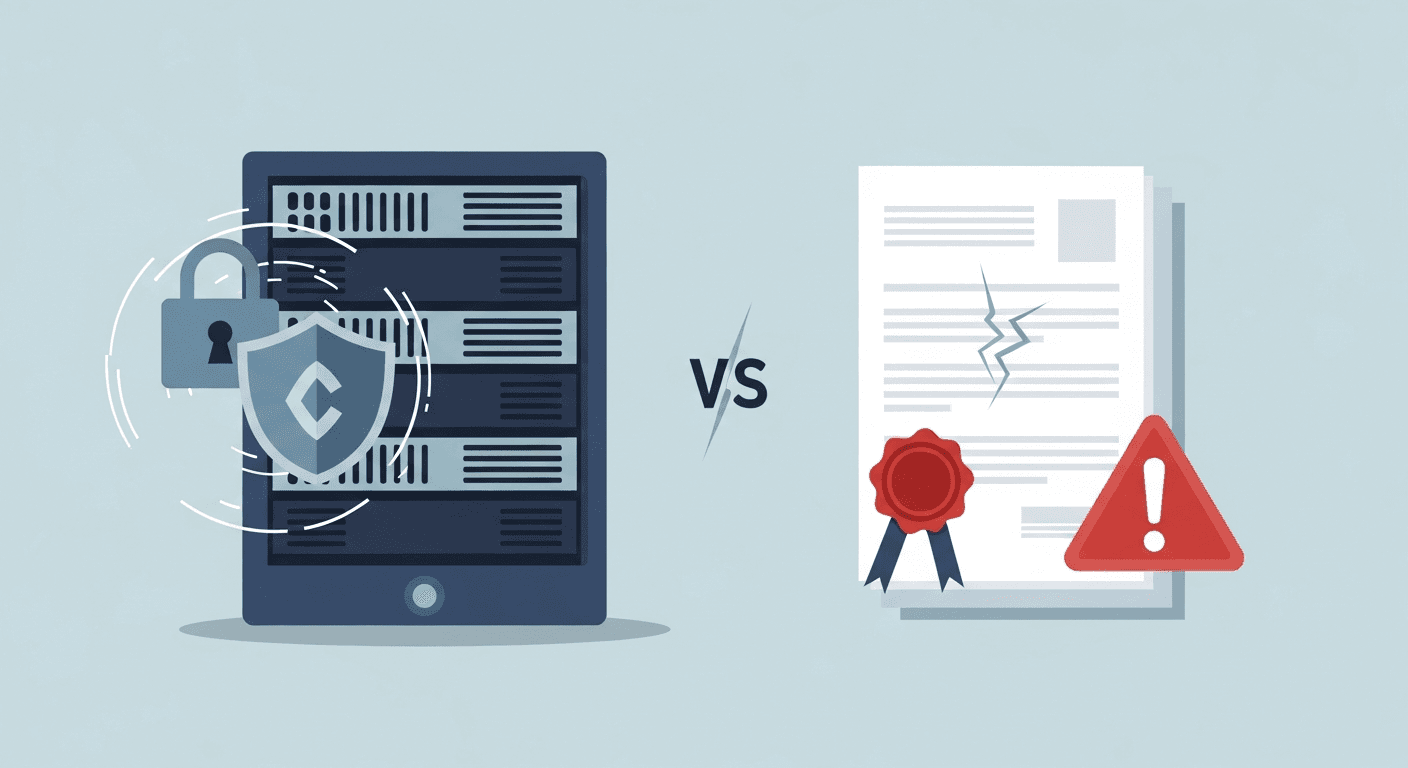
The Same Regulator, Two Very Different Outcomes
When NEET-UG 2026 was cancelled on May 12 following confirmation of a paper leak before the May 3 examination, India's education system faced a question it had effectively answered for at least one exam: how do you run a high-stakes national examination without the paper leaking?
JEE Advanced — India's most selective engineering entrance, determining approximately 17,000 seats from among 1.8 lakh qualified applicants — has not experienced a confirmed paper leak in its computer-based test era. JEE Main, which conducts multiple sessions in CBT mode, similarly avoided the cascading failures that affected NEET-UG in 2024 and again in 2026.
The examinations share a common governmental context: both fall within the Union Ministry of Education's oversight. The NTA administers both. And yet one has remained structurally secure while the other has failed in consecutive years.
The difference is not oversight quality or examiner calibre. It is architecture.
How a Pen-and-Paper Leak Happens
A paper leak in a pen-and-paper examination follows a predictable chain:
Each step is a physical handoff. Each handoff is a potential access point. In NEET 2026, CBI investigation traced the breach to a coaching institute founder in Pune — indicating that the access point was well inside the logistics chain, not at the student end. A "guess paper" containing questions that reportedly matched over 100 of the exam's actual questions had circulated via Telegram and WhatsApp groups 42 hours before the examination. By the time candidates sat down to write, some had reviewed the material.
The core vulnerability is not the people involved. It is the existence of a physical, transportable document containing the complete question paper before the examination begins. Once that document exists in physical form and enters a logistics chain spanning multiple cities and multiple hands, the opportunities for interception are numerous.
How JEE's Architecture Closes These Access Points
JEE Main and JEE Advanced operate on a fundamentally different model.
Question papers do not exist as physical documents before the exam. Questions are stored in encrypted form on central secure servers. The paper a candidate sees is assembled from this encrypted question bank after the secure session begins at the examination centre.
Each shift has a unique paper. JEE Main conducts multiple shifts across multiple days, and the system selects questions from a sufficiently large bank that candidates across different sessions see materially different papers. Even if a session's questions are reverse-engineered by candidates immediately after appearing, they provide no reliable advantage to future sessions.
Transmission is encrypted end-to-end. At JEE Advanced's examination centres, question content arrives as an encrypted package and is decrypted only at the start of the session, on a Local Area Network, at the moment the first candidate logs in. No single individual has access to the complete question set in unencrypted form before that moment.
There is no physical printing and transportation chain. The longest vulnerability in pen-and-paper examinations is the logistics of physical papers — days or weeks of transit through multiple custody points. CBT eliminates this entirely. There is no paper to steal because there is no paper until the exam starts, and by then it exists only as rendered text on candidates' screens within a secured session.
The "Equity" Counterargument and Its Limits
Critics of converting NEET to CBT raise a valid concern: India has examination centres spanning urban metros to rural mandals, and computer literacy and familiarity with keyboard-based answering are not uniformly distributed. A candidate in a village in Rajasthan may be disadvantaged by an interface that their counterpart in Bengaluru navigates fluently.
This concern is real. It is not, however, a permanent barrier.
JEE Main — which conducts approximately 12 lakh examinations across more than 200 cities and examination centres including non-metro locations — demonstrates that scale is not prohibitive for CBT. The equity gap can be addressed through:
The government confirmed after NEET-UG 2026's cancellation that the examination will shift to computer-based testing from 2027. The transition will happen — the question is how well it is managed, not whether it is the right direction.
What CBT Does Not Solve: The Evaluation Side
The shift to CBT resolves question paper delivery security for objective-format examinations. But India's examination ecosystem extends well beyond JEE and NEET.
State board examinations, university end-semester papers, and professional assessments that include descriptive written responses cannot be fully converted to objective CBT. Physical or digitised written answers still require human evaluation. And the evaluation side of India's examination system has its own structural vulnerabilities — distinct from question paper leaks, but equally consequential.
Manual evaluation of paper-based answer scripts carries risks: totalling errors, transcription errors in result registers, informal handling of borderline cases, and physical loss or misidentification of scripts. These are not rare edge cases — they are common enough that every state board maintains a revaluation and scrutiny process as a permanent feature of its academic calendar.
For the non-CBT segment of India's examination ecosystem — which includes every state board Class 12 examination and the vast majority of university semester assessments — on-screen marking (OSM) provides the evaluation-side equivalent of what CBT provides for question delivery. Instead of eliminating paper from question distribution, OSM eliminates unsecured physical handling from the answer evaluation chain:
CBSE's 2026 OSM deployment across nearly 98 lakh Class 12 answer scripts is the largest-scale demonstration of this approach in India. The board eliminated the post-result verification fee process entirely, because digital evaluation made that process redundant — marks were verifiable within the system itself.
The Institutional Lesson
For universities and affiliated colleges conducting their own end-semester examinations, the JEE versus NEET contrast offers a precise design principle: the number of human access points in the examination chain directly determines the risk of both compromise and error.
This applies symmetrically to question papers and to answer scripts. Reducing the physical handling chain for answer books, digitising early in the evaluation process rather than late, and enforcing structured evaluation workflows reduces both inadvertent error and deliberate manipulation.
The lesson from JEE Advanced is not that only the NTA can run clean examinations. It is that secure, accurate examinations are the product of deliberate architectural choices that any institution can make. The question is whether the institutional will exists to make them before a failure forces the issue.
Related Reading
Ready to digitize your evaluation process?
See how MAPLES OSM can transform exam evaluation at your institution.