CBSE's 9.8-Million Answer Sheet Milestone: What Every Affiliating University Should Learn
CBSE evaluated nearly 10 million Class 12 answer scripts through on-screen marking for the first time in 2026 — India's largest digital evaluation deployment. Five lessons affiliating universities and state boards can apply starting this academic year.
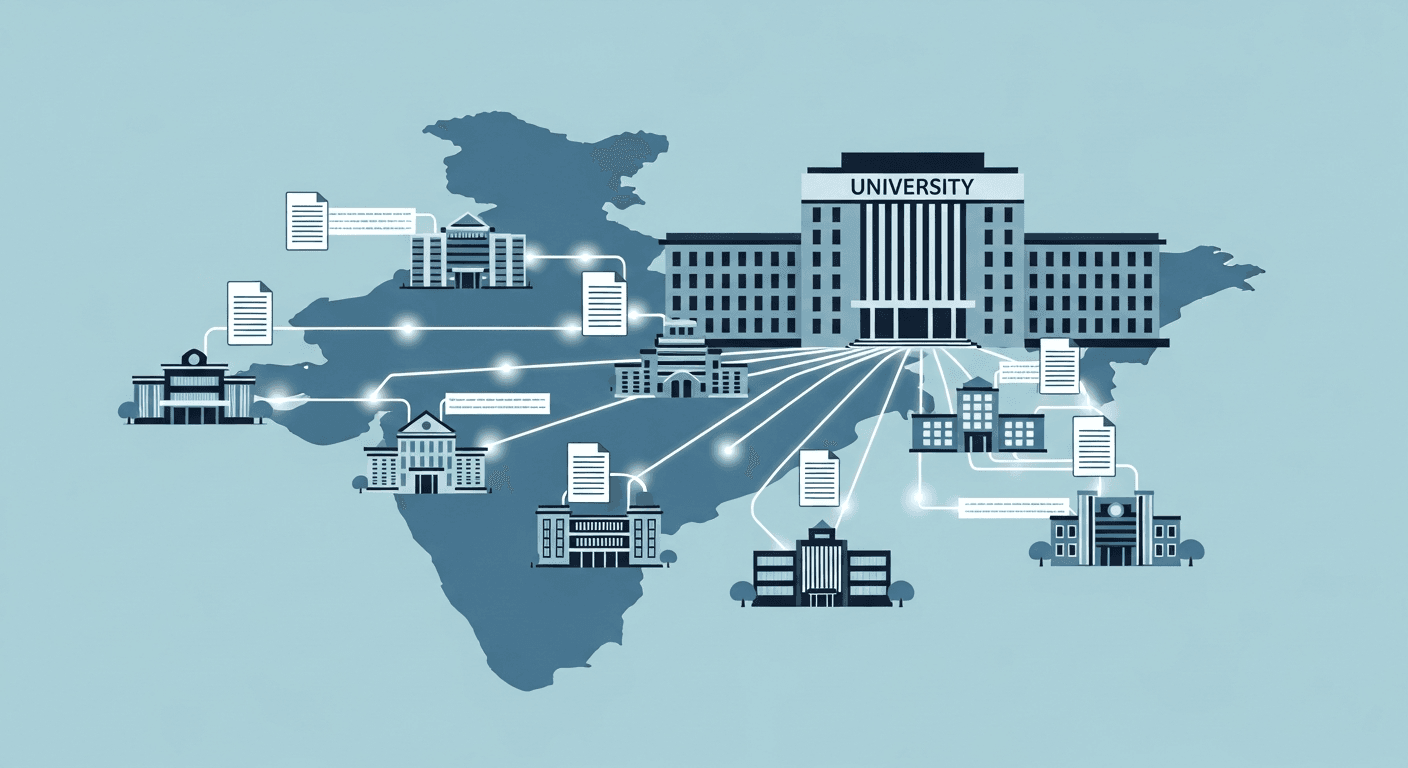
The Scale of What CBSE Just Did
Between March and May 2026, CBSE completed the evaluation of approximately 9.8 million Class 12 answer scripts through On-Screen Marking — the first time a board examination at this scale in India had been evaluated entirely through a digital platform. No physical answer book was manually totalled. No script left its scanning centre for a distant evaluation camp. Every mark was logged in a system that captured the evaluator identifier, timestamp, and score against a randomised script reference.
Results were declared on 13 May 2026 with a complete digital audit trail for every answer sheet. Evaluators worked from their designated evaluation centres on calibrated screens. Questions were distributed as masked batches, so no single evaluator marked the same candidate's entire answer book. Divergences between double-valuation scores triggered automatic moderation flags — no human supervisor needed to notice.
This is the most significant proof of concept for digital examination evaluation in India's history. And its lessons apply directly to the 800-plus affiliating universities that collectively process a far larger volume of answer scripts than CBSE, with fewer resources, more complex federated structures, and higher institutional exposure when evaluation processes fail.
Why the CBSE Milestone Matters to Universities More Than to CBSE
CBSE's 9.8 million answer sheets is an impressive number. But India's affiliating university system operates at a different order of magnitude in aggregate. A mid-size affiliating university in Maharashtra, Uttar Pradesh, or Tamil Nadu may process 5 to 10 lakh answer books per exam season across its affiliated colleges. Universities like Mumbai, Pune, Osmania, and Anna serve 600 to 900 colleges each. The combined annual answer script volume of India's top 50 affiliating universities likely exceeds 100 million.
The structural difference is that CBSE operates a unified evaluation chain with central authority over evaluation centres, standardised infrastructure, and a dedicated budget for technology investment. Affiliating universities manage federated evaluation across dozens of camps, with faculty deputed from hundreds of affiliated colleges, college-level logistics coordination, and political pressures that CBSE is largely insulated from.
This is why the CBSE result matters so much for affiliating universities: the proof of concept is now irrefutable at a scale no critic can dismiss. If CBSE can evaluate 9.8 million scripts through OSM in its first full-scale deployment, the question for affiliating universities is no longer whether digital evaluation works — it is whether they can afford to be the last institutions that have not adopted it.
Five Lessons from CBSE's 2026 Rollout
1. Phased Deployment Is Not Optional — It Is the Strategy
CBSE spent multiple years piloting OSM in select subjects before the 2026 full-scale rollout. The phased approach allowed the board to identify software performance issues, calibrate scanner-monitor configurations, and build evaluator familiarity before committing every answer script to the digital channel.
Affiliating universities that attempt to digitise evaluation across all faculties and programmes in a single cycle face compounded risk. A failure in the Science faculty's evaluation does not stay contained — it creates pressure to revert the entire deployment, including in faculties where it was working well.
The recommended approach: identify one faculty with contained scale (typically Engineering, Commerce, or BBA/MBA programmes), run a parallel evaluation for the first cycle where both manual totalling and OSM marks are generated and compared, and expand to adjacent faculties after the gap analysis is complete. The parallel cycle costs more in the first year. It protects the university's credibility in all subsequent years.
2. Scanning Infrastructure Is the Critical Bottleneck
The OSM chain begins with physical answer scripts being scanned. Scan quality — resolution, legibility, correct page orientation, complete capture of all pages — determines whether evaluators can accurately review the digital script. CBSE's 2026 rollout received some criticism from evaluators about scan legibility on certain script types.
Affiliating universities typically collect answer scripts from affiliated college examination halls spread across a district or region. A scanning bottleneck at a single central facility creates delays that ripple through the entire evaluation timeline. Distributed scanning — at each evaluation camp or collection zone, not only at the university headquarters — is essential for maintaining the result declaration timeline.
Practical planning benchmark: for every 10,000 answer books processed per day, budget for at least two dedicated scanning stations with trained operators and a spot-quality-check step before upload. Under-investing in scanner hardware and operator training is the most common cause of first-deployment delays in university OSM rollouts.
3. Evaluator Training Is a Different Investment from Platform Procurement
Procuring an OSM platform is a technology procurement decision. Evaluator training is a change management investment. They require different budgets, different timelines, and different ownership.
Reading handwritten responses on a calibrated monitor is cognitively different from reading them on physical paper. Evaluators trained in the physical medium tend to adopt compensatory behaviours on screen — scrolling too quickly, missing annotations, or spending more time per page than the timeline allows — unless they have practised the digital format specifically.
CBSE's 2026 rollout included mandatory pre-deployment training modules. Despite this, reports from multiple states indicated evaluator discomfort in the first evaluation sessions. This is normal for a first deployment. The lesson is that training must include actual marking practice on sample scripts using the live platform, not just orientation lectures. Three-phase training works well in practice: platform navigation, screen-reading ergonomics, and marking scheme application in OSM format. Each phase should end with a mock evaluation session where marks are compared to a moderated key.
4. Student Communication Needs to Happen Before Results, Not After
Following CBSE's May 13 result declaration, students across India protested that OSM had caused their marks to drop. Some of this protest reflected genuine confusion about what digital evaluation changes — and what it does not. Some reflected legitimate concerns about transition-year evaluation quality. The mix was difficult to disentangle because the communication gap meant students had no framework for interpreting their results.
Affiliating universities adopting OSM should communicate proactively and specifically: what OSM is, what changes in the evaluation process, what does not change (marking criteria, subject content, assessment standards), how disputes will be handled, and what the fees and timeline for grievance resolution are. This communication should reach students before results are declared, through principals, department heads, and student notice boards — not only through a press release or website update that most students encounter only after they are already upset.
A clear grievance portal with digital submission, real-time tracking, and defined response timelines is worth investing in alongside the OSM platform itself. Student trust in the result is built or broken in the 72 hours after declaration.
5. OSM Data Feeds NAAC and NIRF Evidence Automatically
This is the lesson that receives the least attention in the OSM conversation — and is likely the most financially significant for universities under accreditation and ranking pressure.
CBSE's OSM system generates operational data the board never previously had at this granularity: average evaluation time per script, inter-evaluator agreement rates by subject, moderation frequency, and result declaration turnaround time from exam date to declaration. This data has direct accreditation and ranking value.
Under NIRF's Graduation Outcomes parameter, result declaration speed and pass rates directly affect institutional scores. Under NAAC's Criterion 2 (Teaching-Learning and Evaluation), sub-criterion 2.5 specifically assesses the quality, transparency, and rigour of examination processes. A digital audit trail showing timestamped double-valuation, evaluator performance records, and automated moderation is far stronger NAAC evidence than a camp attendance register and a hand-signed evaluation completion certificate.
Universities that adopt OSM in the 2026-27 cycle will be generating NAAC Criterion 2 evidence from day one of deployment. The data is a by-product of the process. Institutions that wait will be explaining to peer teams and NIRF assessors in 2028 and 2029 why their examination processes remain undigitised after CBSE demonstrated the model at national scale.
What the Numbers Say About Implementation Feasibility
| Metric | CBSE Class 12 2026 | Typical Mid-Size Affiliating University |
|---|---|---|
| Answer scripts per season | ~9.8 million | 3–8 lakh |
| Evaluation camps | Multiple regional hubs | 10–30 camps |
| Evaluators per season | Tens of thousands | 500–2,000 |
| Result turnaround target | ~45 days post-exam | 60–90 days |
| Digital audit trail availability | Complete | Partial or absent |
An affiliating university at the lower end of this table is implementing a smaller, less complex version of what CBSE achieved in 2026. The proportional infrastructure investment is lower. The evaluator training cohort is more manageable. The first-deployment risk is lower precisely because the scale is lower. Yet many affiliating universities treat the digital transition as a large-scale, high-risk project when the CBSE comparison suggests it is a tractable, mid-scale initiative — if planned and sequenced correctly.
The Three-Year Accreditation Window
NAAC assessment cycles typically examine three years of evidence. Institutions that adopt OSM and begin generating digital evaluation records in 2026-27 will have a complete three-year evidence window in time for NAAC assessments scheduled in 2029-30. Institutions that delay adoption by even one year begin arriving at that assessment with a partial record.
For universities already in a NAAC accreditation cycle or approaching an NBA or NIRF submission deadline, the decision timeline is tighter than it appears from the outside. The infrastructure installation, evaluator training, and first-cycle parallel run together require 6 to 12 months of lead time before the system can be used for an official result cycle.
CBSE's 9.8-million milestone removed the primary objection to large-scale digital evaluation in India: that it had never been done here before. That objection is gone. What remains is implementation planning — and the decision window for universities that want to be ahead of the accreditation cycle, not behind it.
Related Reading
Ready to digitize your evaluation process?
See how MAPLES OSM can transform exam evaluation at your institution.