HTET July 2026: Broken Seals, Wrong Papers, and OMR Chaos
On July 4, 2026, the Haryana Teacher Eligibility Test descended into chaos — broken sealed packets, wrong question papers, and mismatched OMR sheets. Here is what went wrong and why the fix is structural.
A Friday That Exposed Old Wounds
On July 4, 2026, more than one lakh candidates sat down to write the Haryana Teacher Eligibility Test (HTET) Level-3 examination for Post Graduate Teacher (PGT) posts at 238 centres across the state. Within the first hour, centres in Rewari, Charkhi Dadri, and Kaithal were in chaos.
Sealed question paper packets arrived broken. Candidates received OMR sheets printed with a different candidate's roll number. English PGT examinees in Rewari were handed Economics question papers before the error was caught and replaced. A passage was missing entirely from questions 141 to 150. The Hindi grammar section had a question without the required sentence. The English paper had spelling mistakes. The Commerce paper had incorrect question numbering. One particularly embarrassing error involved the incorrect Hindi translation of the word "urine" as "wine."
Senior Congress leader Randeep Singh Surjewala alleged large-scale irregularities, demanded a fresh examination, and called for an FIR against officials of the Haryana Board of School Education (HBSE) over the broken seals. By the weekend, the episode was national news.
This Is Not a New Story
The HTET 2026 fiasco did not emerge in isolation. In June 2026, the Maharashtra Teachers Eligibility Test was postponed after allegations surfaced that the question paper had been leaked nearly a day before the scheduled examination. In 2025, multiple state TET exams saw cancelled sittings, court-ordered re-tests, and CBI-level investigations into organised paper leak networks.
Teacher eligibility tests occupy a peculiarly vulnerable position in India's examination ecosystem. They are high-stakes for candidates — passing a TET is mandatory for government teaching appointments — but they are administered at the state level with significantly fewer resources and oversight mechanisms than national-level examinations like NEET or JEE. The combination of high demand, local administration, and variable infrastructure creates conditions where failure is not accidental but structural.
The HTET 2026 incident had at least three distinct failure modes operating simultaneously:
Supply chain failure. Sealed question paper packets arrived broken at multiple centres. This indicates a failure somewhere in the custody chain — printing, packing, transport, or storage — and the absence of tamper-evident verification systems that would have caught the breach before papers were distributed.
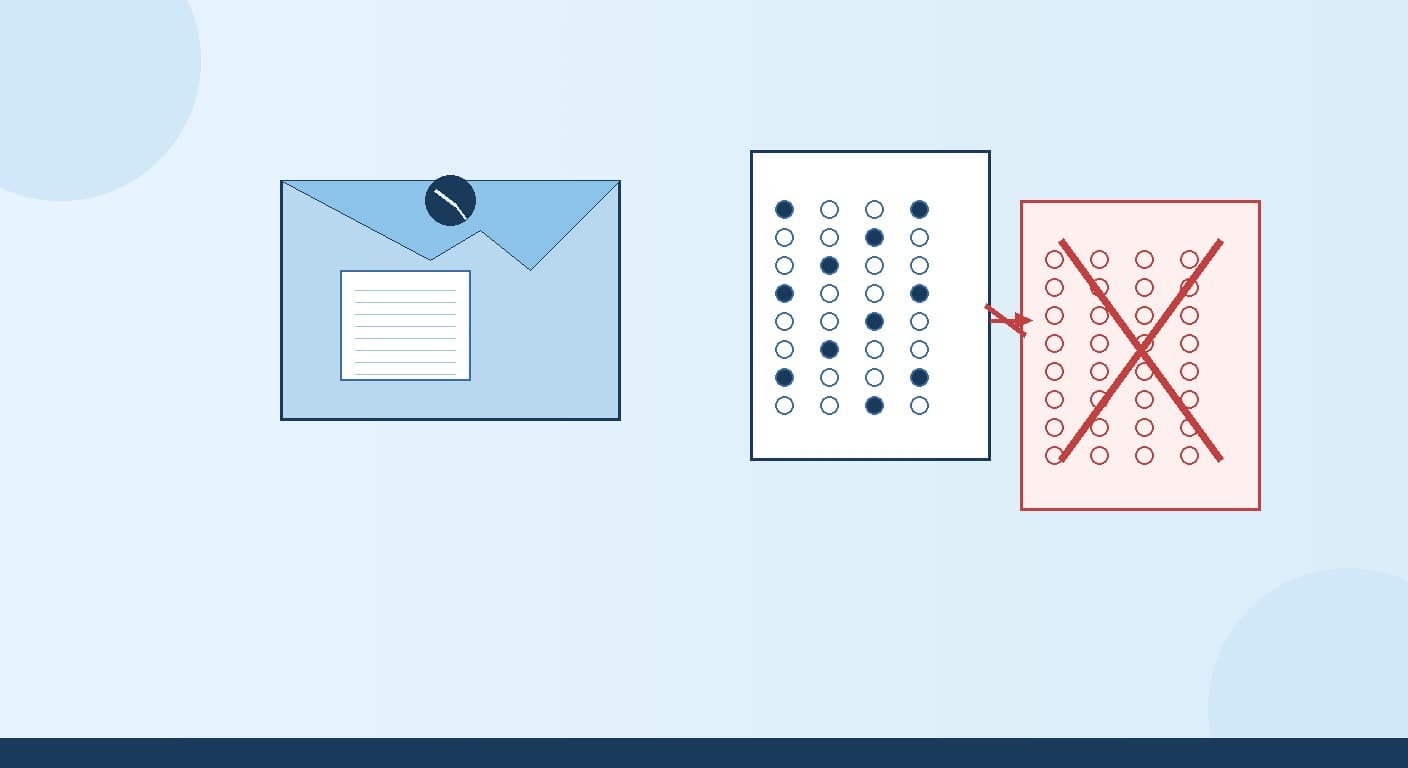
OMR identity mismatch. Serial numbers on OMR sheets did not match the corresponding question papers at centres in Rewari and Kaithal. In at least some cases, candidates received OMR sheets bearing another candidate's roll number entirely. When a candidate's answer sheet is linked to the wrong identity, it creates downstream errors in score reporting that can survive the initial evaluation and only surface at the revaluation or court stage.
Question paper quality failure. Missing passages, absent sentences, typographical errors, and subject mismatches at the point of distribution are print-and-logistics failures, but they also point to an absent quality assurance layer. At HBSE's scale, question papers are set by a committee and printed at a contracted facility. Without a digital proof verification step before final printing, errors pass through unchecked.
What Digital Evaluation Addresses — and What It Does Not
It is important to be precise about where digital evaluation tools are relevant to a situation like HTET 2026.
The broken seals, wrong question papers, and OMR mismatches are pre-evaluation failures. They occur during question paper distribution and OMR issuance — stages that happen before a single mark is assigned. A digital evaluation platform operating downstream of these failures would not have prevented them.
However, digital examination infrastructure creates accountability signals at each handoff that expose vulnerabilities before they become crises.
When question papers are delivered digitally to examination centres — even as encrypted files to be printed on-site under supervision — the chain of custody is logged. Each centre's delivery acknowledgement is timestamped. Broken seals cannot exist because there is no physical seal. The question paper a candidate receives is generated from a verified digital master.
When OMR sheets are replaced by digital answer scripts, each script is bound to the candidate's biometric or system-verified identity at the time of submission. The mismatch between a paper OMR's serial number and a question paper's serial number — the error that caused confusion in Rewari and Kaithal — is architecturally impossible in a system where the answer script is created digitally and linked to the candidate's session ID from the moment of login.
The printing errors — missing passages, wrong translations — are harder to eliminate purely through digital means. They require rigorous content management. But digital delivery makes it significantly easier to push a correction to all centres simultaneously, rather than requiring physical replacement across 238 venues.
The TET Scale Problem
India's teacher recruitment pipeline runs through state TETs, CTET, and equivalent examinations in specialised education systems. The number of candidates sitting these examinations each cycle is enormous. HTET Level-3 alone draws over one lakh candidates. Maharashtra's TET draws several times more. When you aggregate TET examinations across all 28 states and 8 Union Territories, the annual candidate volume runs into tens of millions.
This scale is precisely why the current physical infrastructure fails repeatedly. Printing and packaging question papers for one lakh candidates across 238 centres involves thousands of packets, multiple logistics contractors, and dozens of custodial handoffs. Each handoff is a potential failure point. The mathematical probability of at least one broken seal, one mismatch, or one printing error across that volume is not theoretical — it is near certain in any cycle.
The examination reform conversation in India, energised by the NEET-UG 2026 cancellation and the CBSE OSM controversy, has focused primarily on board examinations and national entrance tests. Teacher eligibility tests have received less attention despite their structural similarity to the problems that made NEET 2026 a national crisis.
What States Need to Evaluate
For state examination boards conducting TETs, the HTET 2026 episode provides a useful diagnostic:
The HTET 2026 candidates who received Economics papers when they had prepared for English, or who were handed OMR sheets with someone else's roll number, were not poorly served by their question paper setter or evaluator. They were failed by an examination logistics system that has not been updated to match the scale and stakes of modern teacher recruitment.
Related Reading
Ready to digitize your evaluation process?
See how MAPLES OSM can transform exam evaluation at your institution.