CBSE's Blurred Answer Sheet Crisis: Seven Scanning Standards Every University Must Meet
Students received unreadable, cropped, and faded scanned copies of their Class 12 answer books in May 2026. The lesson for universities planning digital evaluation is about scanning quality, not technology.
What Happened in the Week of 19 May 2026
When CBSE declared Class 12 results on 13 May 2026 — the first results season to use on-screen marking (OSM) at full scale — the board expected questions about marks. It did not expect questions about whether evaluators had been assessing images that students could not even read.
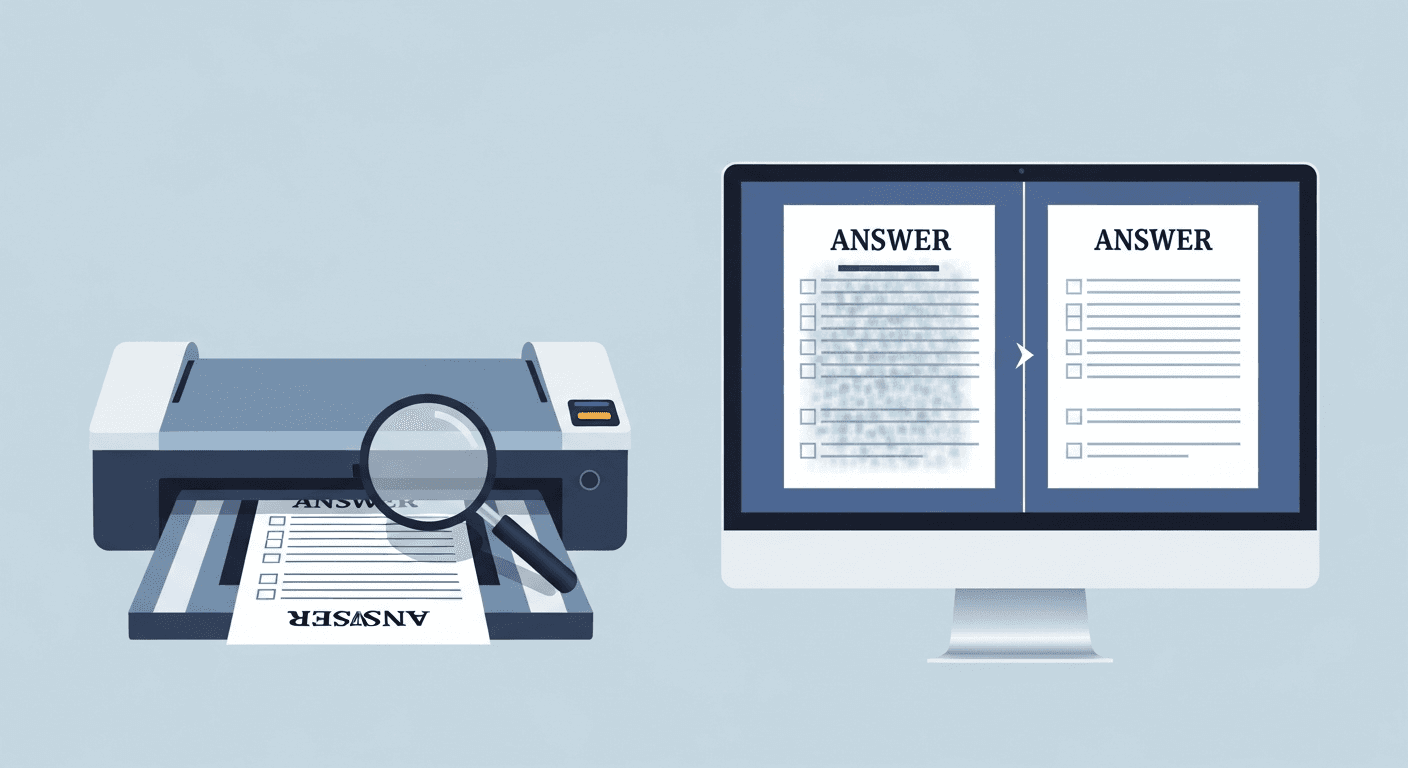
From 19 May, when CBSE opened the photocopy portal for evaluated answer books, students across India began sharing screenshots on X, Reddit, and Instagram. The images were troubling: scanned answer books where handwriting had faded to grey, mathematical equations appeared as unreadable smears, diagrams were cropped at the margin, and entire pages were barely visible against white backgrounds.
Republic World reported students asking: "Can you even READ?" alongside photographs of their own faded answer sheets. Careers360 captured the mood: "'How did you check these copies?' Class 12 students question CBSE OSM after blurred answer sheets surface online."
Compounding the crisis, the portal itself crashed repeatedly during the application window. Students reported seeing fees calculated at ₹69,000 due to system errors. CBSE extended the photocopy application deadline — originally 22 May — to 24 May, the date this article is published. The formal re-evaluation window opens 26 May.
The controversy has become one of the most widely discussed education issues of 2026. It is also, for university exam controllers across India, an instructive case study in what happens when scanning infrastructure does not meet the standard the process demands.
Why Scanning Quality Is an Evaluation Integrity Issue
A distinction is essential before drawing lessons: the on-screen marking methodology itself is sound. The risk in digital evaluation is not in the evaluation step but in the ingestion step — the conversion of a physical answer book into a digital image. If that conversion produces a degraded image, every downstream process is compromised.
Consider what poor scanning quality does to each stakeholder:
For evaluators: A faded or blurred scan forces examiners to interpret handwriting they cannot clearly read. Marks awarded in these conditions may not reflect the actual content of the answer. This is not evaluator error — it is a systemic failure imposed on the evaluation process.
For students in revaluation: When students receive their scanned copy to review before requesting re-evaluation, an unreadable image prevents them from identifying which specific questions to contest. This forecloses a legitimate right and undermines confidence in the entire result.
For institutions in courts and RTI proceedings: Students have a right under information law to access their evaluated answer sheets in readable form. An institution that provides an unreadable scan in response to an RTI application faces legal exposure that no technology investment can protect against after the fact.
What Causes Scanning Degradation at Scale
The technical causes of the CBSE crisis, while not officially disclosed, follow a predictable pattern in large-scale answer book digitisation:
Incorrect resolution settings: Answer book scanning requires a minimum of 200 DPI for standard text and 300 DPI for diagrams, graphs, and equations. Scanning at 72 or 96 DPI — the default for many document scanner configurations — produces thumbnails that look acceptable on a small screen but become unreadable when zoomed for evaluation or revaluation review.
Aggressive file compression: High-volume scanning operations often apply automatic JPEG compression to reduce storage costs. JPEG compression at low quality settings destroys fine-line detail. Handwriting, particularly in light ink or pencil, becomes grey noise. Examiners marking at full screen may still work around this — students receiving compressed thumbnails through a portal cannot.
Misaligned feed in automatic document feeders: Automatic document feeders (ADF) can misalign pages when booklets are physically uneven, folded, or slightly thicker than the feeder expects. The result is content clipped at page edges — margins, footnotes, and diagram borders that were part of the student's answer disappear.
No post-scan quality review: Without a systematic sampling step, degraded images pass into the evaluation queue undetected. The problem is discovered only when students receive their copies — at the worst possible moment.
Seven Scanning Standards Every University Must Implement
Universities planning digital evaluation rollouts should treat scanning quality as a precondition for the entire process, not an afterthought. These seven standards represent the minimum requirement for a defensible system.
Standard 1 — Minimum resolution: 300 DPI for all papers; 400 DPI for science, mathematics, and engineering papers
For papers containing equations, circuit diagrams, structural formulae, or graphs, 300 DPI may still produce borderline-readable images at high zoom. STEM papers require 400 DPI. Resolution settings must be locked at the scanner hardware level and verified before each scanning session, not assumed to carry over from a previous configuration.
Standard 2 — File format: PDF/A-1b or lossless TIFF; no JPEG below quality 95
PDF/A-1b is the ISO archival PDF standard and preserves image quality without lossy compression. TIFF with LZW compression is an acceptable alternative. JPEG is acceptable only at quality 95 or above; at the default quality 75 setting common in scanning software, fine handwriting detail is typically destroyed. Institutions storing answer books in JPEG format at default settings are storing degraded evidence.
Standard 3 — Colour mode: greyscale minimum; colour for diagram-heavy and annotated papers
Black-and-white (bitonal) scanning discards shading information that is critical for reading faint pencil work and light ink. Greyscale scanning at 8-bit depth captures tonal variation with manageable file sizes. Colour scanning should be mandatory for papers where students are permitted or expected to use coloured ink, coloured pencils, or highlight diagrams.
Standard 4 — Margin buffer: verified 5 mm clearance on all four sides
Scanner calibration must ensure that no student-written content falls within 5 mm of any edge in the scanned image. This must be validated against the specific answer book size used by the institution — most scanning software defaults are calibrated for A4 paper, while many Indian university answer books use non-standard dimensions.
Standard 5 — Post-scan QA sampling: 5% review of all batches before upload
Before scanned images are uploaded to the evaluation platform, a designated quality assurance officer must review a random 5% sample per batch for resolution adequacy, margin clearance, contrast, and alignment. Any batch where more than 2% of sampled images are below readability threshold must be re-scanned in full. This step adds approximately 20-30 minutes per batch of 500 scripts — a cost that is trivial compared to the institutional damage of a post-result scanning controversy.
Standard 6 — Physical handling protocol before scanning
Answer books that have been folded, compressed in transit, or stored under weight must be pressed flat for a minimum of 24 hours before scanning. Booklets that are water-damaged, torn, or have pages stuck together must be documented and treated individually before entering the scanner feed. ADF scanning of booklets thicker than 24 pages should use a flatbed scanner to avoid misalignment. Physical condition of the answer book at the time of scanning is the most variable and least controlled factor in digitisation quality.
Standard 7 — Encrypted backup within 2 hours of scanning; original books retained until results declared
Scanned images must be backed up to a geographically separate server within two hours of scanning. The physical answer books must be retained in a secure, access-logged facility until results are officially declared and the re-evaluation window has closed. Destroying original books before revaluation is complete — even if digital copies exist — is a governance failure that creates legal risk in any mark dispute.
Building Student Trust Before the Controversy Arrives
The CBSE crisis became a crisis because students received blurred images after results were declared. At that point, every unexpectedly low mark looks as though it might be explained by an evaluator who could not read the answer. The doubt, once planted, is difficult to remove even with subsequent clarification.
Universities can prevent this sequence with three practices:
Publish scanning standards before the examination season begins. Stating publicly that answer books are scanned at 300 DPI, subject to QA review, and stored in PDF/A format communicates institutional seriousness and builds anticipatory trust with students and parents.
Provide a sample scanned image from a previous examination, with all identifying details redacted, when communicating the digital evaluation process to students. A sample image makes the scanning quality claim verifiable and concrete.
Ensure the revaluation copy is identical to the evaluator's copy. If students receive a compressed, lower-resolution version of their answer book while evaluators accessed a higher-quality image, the institution has created a two-tier system. This inconsistency will eventually surface and damage trust in the result more than any mark dispute would have.
What CBSE's Experience Tells the Sector
The on-screen marking methodology did not fail in May 2026. What failed was the scanning infrastructure quality assurance that must precede it.
This distinction matters for university adoption decisions. The lesson is not that digital evaluation is unreliable. The lesson is that scanning quality is a first-order implementation requirement, not a vendor default to be accepted without verification.
Universities that implement OSM with proper scanning protocols — defined resolution standards, validated calibration, mandatory QA sampling, and documented physical handling procedures — will not face the scrutiny CBSE faced this week.
The technology is not the problem. The process discipline around the scanning step is the entire difference between a digital evaluation system that builds trust and one that destroys it.
Related Reading
Ready to digitize your evaluation process?
See how MAPLES OSM can transform exam evaluation at your institution.