Beyond the OMR Sheet: Why Subjective Exam Digitization Is India's Next Education Technology Challenge
India has largely solved objective computer-based testing. The harder problem — digitizing subjective answer script evaluation at scale across 50,000 colleges — is only beginning, and CBSE's 2026 OSM experience shows exactly what it takes.
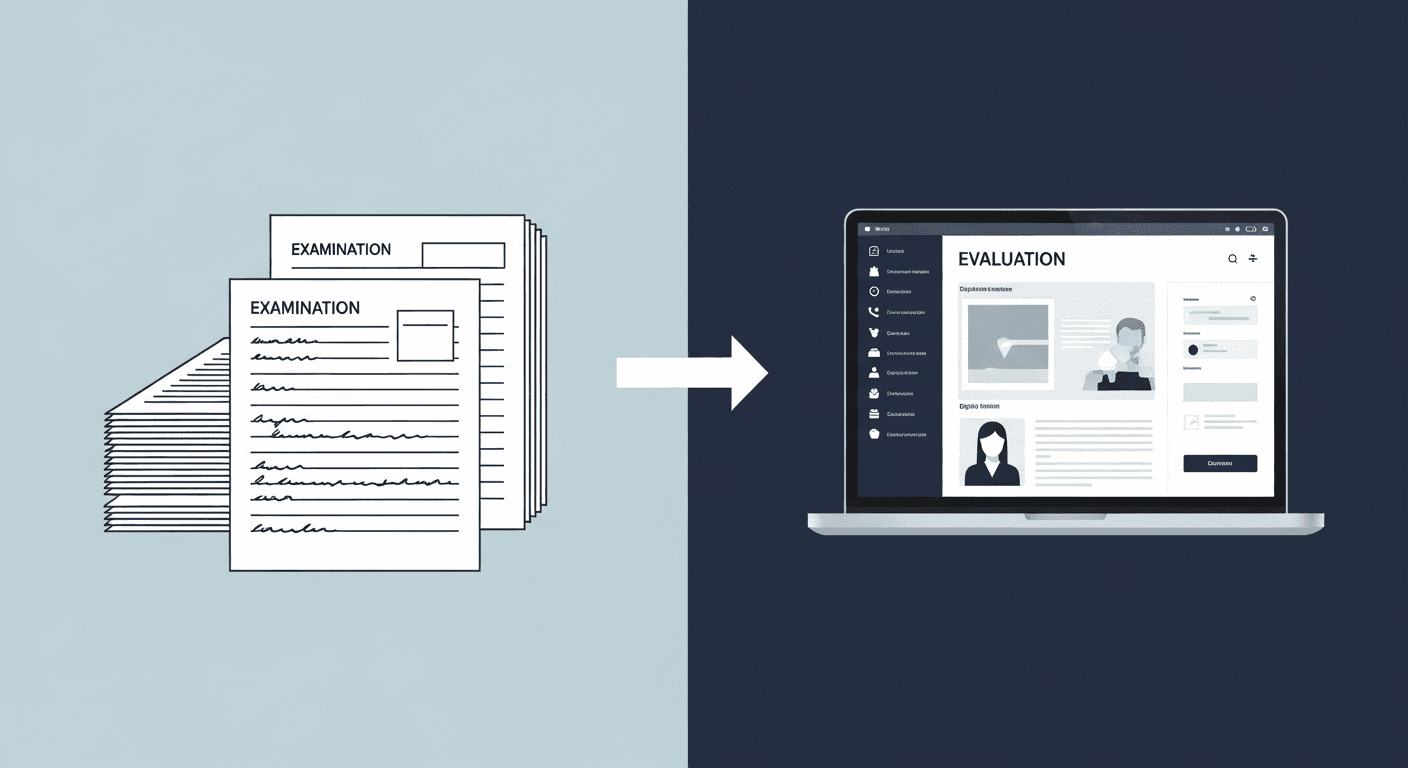
The Solved Problem and the Unsolved One
India's examination ecosystem has made substantial progress on one frontier: objective computer-based testing. JEE Main, CUET, UGC NET, CSIR NET, CLAT, and dozens of other competitive examinations now run on CBT infrastructure. Answer capture is digital. Results arrive within days. The OMR sheet — a piece of paper requiring physical bubbling, optical scanning, and manual error checking — has largely been eliminated from the competitive examination landscape.
But competitive examinations, however high-profile, represent a fraction of India's total examination volume. The larger system — semester examinations across approximately 1,100 universities and 50,000 colleges, evaluated annually in handwritten booklets by over a million teachers — has not moved.
Every year, somewhere between 150 and 200 million handwritten answer scripts are evaluated by teachers working in physical valuation camps, marking against rubrics they may or may not have been given, writing marks in pen on tabulation sheets that are then typed manually into university databases. This is India's dominant examination evaluation infrastructure in 2026, and it is where the next significant technology transition needs to happen.
Why Subjective Evaluation Is a Different Problem
The ease of CBT adoption in competitive examinations owes much to a structural property of MCQ formats: the correct answer is pre-defined and fixed. Evaluation is matching. A server compares a student's response to a key and outputs a score. There is no judgment in the loop, no evaluator fatigue, no anchor bias, no marking scheme ambiguity.
Subjective evaluation is structurally different. Whether a student's interpretation of a literary passage is perceptive, whether their proof of a theorem is logically complete, whether their case history in a medical examination demonstrates clinical reasoning — these require an evaluator to read, comprehend, and exercise professional judgment. No algorithm reliably replaces this at scale for high-stakes assessments in 2026, and no institution that has tried to do so without controversy has succeeded.
Digitization of subjective evaluation therefore does not eliminate the evaluator. It changes what the evaluator receives and what the evaluation system records.
In a digital on-screen marking (OSM) environment, the evaluator sees a scanned image of the answer script on a computer screen, marks by question using a platform interface, and submits marks that are captured directly into the results database. The evaluator's role is unchanged. The logistics, the distribution of scripts, the recording of marks, and the accountability for every decision are fundamentally transformed.
Where India Stands in 2026
| System | Level | Format | Scale | Year Adopted |
|---|---|---|---|---|
| NTA: JEE Main, CUET, UGC NET | National competitive | CBT (MCQ) | 20–50 lakh per exam | 2019–2024 |
| CBSE OSM | Class 12 board (subjective) | Digital evaluation | ~17 lakh students | 2026 (first year) |
| PSEB OSM | Punjab board (subjective) | Digital evaluation | First state board end-to-end | 2026 |
| ICAI | CA Foundation/Intermediate | Hybrid digital | Phased since 2020 | 2020+ |
| Most affiliating universities | UG/PG semester | Physical answer books | 15–30 crore scripts/year | Unchanged |
The gap is stark. For objective competitive examinations, India has built infrastructure that processes tens of millions of responses with results declared in 3–10 days. For subjective university semester examinations — which determine the academic trajectory of the majority of India's 4.3 crore enrolled higher education students — the dominant process is physically the same as it was in 1990.
What CBSE's 2026 Experience Teaches
CBSE's decision to implement OSM for Class 12 in 2026 was, by scale, the most ambitious deployment of subjective evaluation digitization in Indian history. Seventeen lakh students. Thousands of evaluators across the country. A new platform deployed in a high-stakes examination cycle for the first time.
The outcome was instructive on two levels simultaneously.
It demonstrated that subjective evaluation digitization at national scale is operationally possible. Results were declared on schedule. The vast majority of scripts were evaluated correctly. The system handled the distribution, marking, and tabulation of millions of question-level scores without a systemic collapse.
It also showed exactly where the risks concentrate. Physical scanning quality was inconsistent — blurred images, mismatched pages, and cases where a student's answer appeared on the wrong script. Teacher familiarity with the platform varied significantly; evaluators who had not used OSM software before struggled in the first marking window. Edge cases in answer book formatting (students writing across question boundaries, additional sheets not properly barcoded) were not all handled gracefully by the platform.
The aftermath — four lakh students requesting scanned copies of their scripts, a revaluation surge, parliamentary scrutiny, and leadership changes — was disproportionate in its scale relative to the actual error rate. Most students' marks were correct. But in a system affecting 17 lakh students' admissions and futures, a visible error rate that parents and students can discuss on social media generates institutional pressure regardless of the underlying statistical accuracy.
The CBSE experience produces a clear first principle for subjective evaluation digitization: pilot at manageable scale, validate the failure modes, then expand. The risks that emerged in 2026 were knowable in advance. They became crises because the pilot-to-full-scale transition did not include a middle phase.
The Five Technical Building Blocks
A functional subjective evaluation digitization system requires five components working in coordination.
1. Answer Script Scanning
Physical handwritten scripts must be captured digitally at sufficient resolution. The minimum threshold for legible evaluation is approximately 150 DPI; 200 DPI is recommended for scripts with small handwriting or dense diagram content. CBSE's 2026 experience highlighted that scanning quality is not self-managing — scanning operators need training, scanners need calibration, and a quality check before scripts enter the evaluation pipeline prevents downstream problems that are far more costly to correct.
2. Script Segmentation by Question
Once digitized, scripts should not be evaluated as complete booklets. Question-specific segmentation routes each question's answer to evaluators assigned to that specific question, across all students. Evaluator A marks Question 3 responses for the entire batch. Evaluator B marks Question 3 responses for the same batch, independently.
This approach eliminates anchor bias — the tendency to be influenced by prior answers in the same booklet — and enables question-level double evaluation without requiring any evaluator to see the whole script.
3. Evaluation Interface With Embedded Rubric
Evaluators see the answer image alongside the marking scheme. Sub-question marks, expected content, and allocation levels are visible in the interface while the evaluator assesses. Marks entered outside the permitted range are rejected before submission. This structural constraint reduces variance significantly compared to evaluators applying an internally held rubric without external reference.
4. Double Evaluation and Threshold Moderation
Two evaluators independently assess the same answer. If their marks for a specific question differ by more than a preset threshold — typically 15–20 percent of the maximum marks for that question — the platform routes the response to a moderator rather than averaging the discrepant values.
This is the step that distinguishes functional subjective evaluation digitization from a mere transcription exercise. Without threshold moderation, digital evaluation inherits the inconsistency problems of manual evaluation and adds the impression that a technology system validated them.
5. Automated Tabulation With Pre-Declaration Validation
Final marks flow directly from the evaluation platform to the results database. No manual data-entry step. Before results are published, automated validation reports flag anomalous patterns — passing rates outside expected ranges, question-level means significantly outside historical benchmarks, student records with missing question-level marks. These are reviewed and resolved before declaration.
The Institutions That Cannot Afford to Wait
The case for beginning the transition now is strongest for specific categories of institution:
Affiliating universities with recurring manual tabulation failures — where the current system already produces a documented error rate that creates institutional liability and student harm. The transition investment is partially offset by the cost reduction in error resolution.
Medical and professional education institutions — where evaluator inconsistency has the most consequential downstream effects on licensure and professional outcomes. The RGUHS pattern of marks varying from 10 to 70 on the same MBBS paper is structurally preventable with digital double evaluation and moderation.
Engineering colleges pursuing or maintaining NBA accreditation — where Outcome-Based Education requires documented attainment of Course Outcomes (COs) at the individual student level. Digital evaluation captures question-level marks that map directly to CO attainment data, making the evidence that NBA peer teams require trivially available rather than laboriously reconstructed.
Institutions within three years of their next NAAC cycle — where Criterion 2 (Teaching, Learning, and Evaluation) and Criterion 6 (Governance, Leadership, and Management) both incorporate transparency and administrative efficiency in examination management. Beginning the transition now creates evidence that peer teams will see during the inspection window.
The Longer Horizon
India is not alone in facing this transition. Cambridge International Education is conducting pilots of digital examination delivery and evaluation for selected subjects. The IB's digital diploma pilot in May 2026 included schools across India. Australia's ATAR system, the UK's A-Level evaluation infrastructure, and Singapore's national examination boards have all navigated versions of this challenge.
The common pattern across all of these is that subjective examination digitization at national scale requires more institutional preparation time than objective CBT rollouts — more evaluator training, more pilot cycles, more attention to scanning infrastructure quality, and more investment in moderation protocols. It also produces more durable benefits: a complete, recoverable, auditable record of every evaluation decision, for every student, across every examination.
India has 200 million handwritten scripts per year waiting for that infrastructure. The transition will not happen in a single examination cycle. But it will happen, and it is already happening — CBSE's 2026 deployment, PSEB's rollout, individual universities beginning pilots — in ways that will redefine what students, regulators, and accreditation bodies consider the minimum standard for examination accountability.
Related Reading
Ready to digitize your evaluation process?
See how MAPLES OSM can transform exam evaluation at your institution.