What JEE Advanced Gets Right: The Transparency Model Every University Should Study
IIT Roorkee's digital transparency chain — personal response sheets, provisional answer keys, a formal objection window, and a final key — offers a replicable blueprint for exam integrity that any university can adapt.
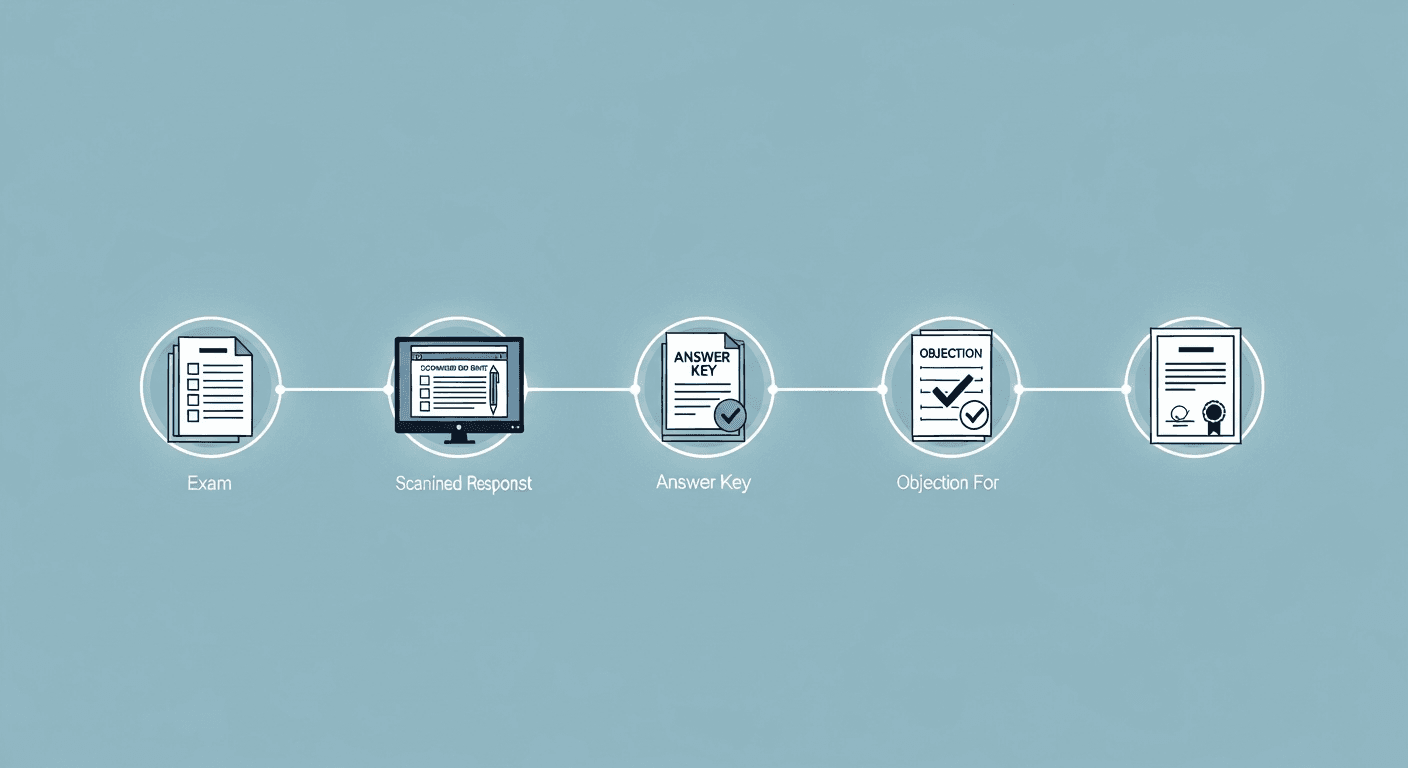
A Transparency Calendar, Not Just a Results Date
When IIT Roorkee announces a JEE Advanced 2026 schedule, it does not simply publish a result date. It publishes a transparency calendar — a sequenced set of milestones between examination day and final result that gives every candidate a verifiable account of how their marks were determined.
For the 2026 cycle, that calendar looks like this:
| Milestone | Date |
|---|---|
| Exam conducted | May 18, 2026 |
| Candidate response sheets published | May 21, 2026 |
| Provisional answer key published | May 25, 2026 |
| Objection window open | May 25–26, 2026 |
| Final answer key published | June 1, 2026 |
This is a structured window between examination and result during which the evaluation process is open to scrutiny at each of its structural joints.
Most Indian university examinations — affiliated colleges, autonomous institutions, state board post-graduate programmes — follow a simpler model: exam, evaluation, result. JEE Advanced inserts three transparency checkpoints between evaluation and result. Understanding why those checkpoints work is the starting point for institutions that want to build comparable credibility into their own examination processes.
What a Response Sheet Actually Is
A response sheet is the digital record of exactly what a candidate submitted during the examination — every answer selected, the order in which questions were attempted, and the final recorded state of each response at the moment the exam ended.
In JEE Advanced's computer-based format, this record is generated automatically by the examination system and is unambiguous: there is no question of a candidate claiming they answered something that the evaluator did not read. The recorded response is the authoritative record.
IIT Roorkee makes each candidate's personal response sheet accessible through the candidate portal at jeeadv.ac.in, authenticated by registration number and date of birth. It is not public — it is candidate-specific — but it is accessible to the candidate before the final result is declared.
This single structural feature eliminates a large category of post-result disputes. A candidate who believes their marks are incorrect can compare their recorded responses against the provisional answer key themselves, identify any specific discrepancy, and submit an evidence-based objection. They are not working from memory. They are working from a verified, timestamped record.
The Objection Mechanism: Quality Control Funded by Candidates
The provisional answer key objection process carries a fee of ₹500 per question challenged. Objections are reviewed by subject matter experts. If an objection is sustained — that is, if an answer key correction is warranted — the ₹500 fee is refunded.
This creates a quality control mechanism with an elegant incentive structure. Any error in the provisional answer key that would affect marks across the entire candidate population is likely to be caught and flagged by candidates who have the domain expertise to identify it. The fee structure filters speculative challenges while keeping the barrier low enough for well-reasoned ones.
For a high-stakes examination where any question error has material consequences for thousands of students, the objection window surfaces these errors before the final key is locked and results computed.
Several attributes of this model are worth isolating:
Why This Model Matters Right Now
The JEE Advanced transparency calendar is worth examining in May 2026 because the contrast with contemporaneous examination controversies is instructive.
CBSE's OSM rollout for Class 12 — also in 2026 — produced widespread student complaints about unexpectedly low marks in STEM subjects. The core problem was not necessarily evaluation error; it was that students had no mechanism to verify their evaluation before results became final, and no accessible reference point for understanding why their marks were what they were.
NEET 2026 was cancelled entirely because a paper circulated before examination day, with no digital traceability of the paper's origin or movement that could have triggered early detection.
Both controversies share an underlying structural gap: the absence of candidate-verifiable evaluation records produced in real time. JEE Advanced's model addresses this directly because the CBT format inherently generates the response data needed to build a transparency chain. Paper-based examinations require deliberate investment to replicate this — but the investment is achievable.
How This Applies to University Examinations
JEE Advanced is a computer-based test. Most university-level examinations — affiliated colleges, autonomous institutions, state-board postgraduate programmes — involve handwritten answer scripts. The response sheet model is not directly portable as-is, but its underlying logic is.
For handwritten examination systems, the digital equivalent of a response sheet is a scanned and digitally stored copy of the evaluated answer book — made accessible to the candidate concurrent with or shortly after result declaration.
Institutions that use on-screen marking (OSM) systems already generate this record as a standard workflow output: answer scripts are scanned, stored digitally, and marked on-screen by evaluators. Making candidate-specific scanned copies accessible through a portal — at a nominal fee, or freely — replicates the transparency function of JEE Advanced's response sheet mechanism.
The provisional-key analogue for essay or long-form answers is a published marking scheme. Most Indian universities publish model answers after examinations. The missing link is the mechanism for candidates to compare their actual evaluated scripts against that marking scheme while the record remains accessible.
A practical upgrade path for any institution:
Step 1: Scan and store every evaluated answer book
This should be part of the evaluation workflow itself — not an optional add-on or a post-result exercise. Scanning before evaluation begins (as OSM systems require) is preferable because it creates the record before evaluation introduces any additional marks.
Step 2: Make scanned copies accessible to candidates
Define a post-result window (for example, 10–21 days after result declaration) during which candidates can apply for their scanned script via an online portal. A nominal fee — ₹100–200 per subject — covers processing costs and signals that access is a right, not a concession.
Step 3: Publish marking schemes simultaneously with results
Students should be able to compare their responses against the marking scheme the moment results are declared. Delayed or incomplete marking scheme publication is the primary reason self-assessment is not available to most university candidates.
Step 4: Establish a structured objection mechanism
A defined window, a defined fee, a defined escalation pathway, and a defined endpoint — these are what convert a grievance into a process. Without them, every dissatisfied candidate's only recourse is informal complaint or legal action.
The NAAC and NIRF Connection
For institutions actively pursuing accreditation, this is not merely a matter of best practice. NAAC's Criterion II (Teaching-Learning and Evaluation) explicitly examines the quality and transparency of examination and evaluation systems. NAAC Criterion VI (Governance, Leadership and Management) looks at grievance redressal systems and their effectiveness.
An institution that can demonstrate:
...is providing verifiable, quantifiable evidence against two NAAC criteria that peer teams increasingly probe in Self-Study Report reviews and physical visits.
NIRF's Teaching, Learning and Resources (TLR) parameter carries 30% of total ranking weight and includes assessment quality components. Institutions with auditable, candidate-accessible evaluation workflows are better positioned to substantiate TLR claims with evidence rather than assertion.
Building Toward a Standard
JEE Advanced does not present its transparency model as exceptional. It is simply what the process looks like when a high-stakes examination is designed with the assumption that every evaluation decision must be defensible to the candidate it affects.
That assumption — that evaluation decisions are defensible, documented, and accessible — is one that every educational institution in India can build toward, regardless of scale. Institutions evaluating 5,000 answer books face the same structural choice as institutions evaluating 5,00,000: whether their evaluation process generates a verifiable record, or only a mark.
The tools to generate that record exist. The regulatory framework — NAAC, NIRF, NBA, UGC minimum standards — now rewards institutions that use them. The question is not whether to build transparent evaluation infrastructure, but how quickly.
---
Related Reading
Ready to digitize your evaluation process?
See how MAPLES OSM can transform exam evaluation at your institution.