UP Mandates AKTU Digital Exam Model Across All State Universities
Uttar Pradesh has directed all state universities to adopt the AKTU digital examination framework, marking one of the largest state-level mandates for digital evaluation reform in India.
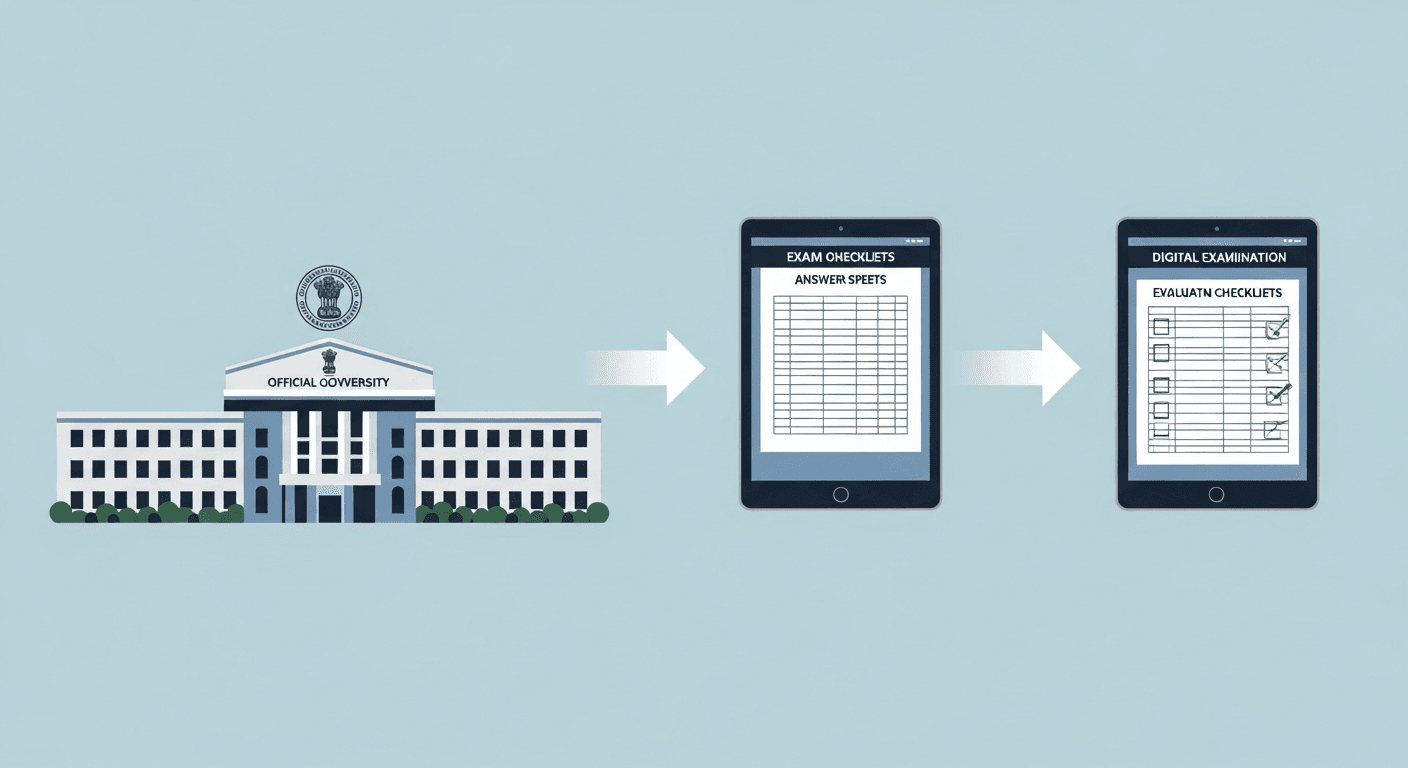
A State-Level Inflection Point for Digital Examinations
In a move that could reshape examination administration for millions of students, the Uttar Pradesh government has approved the rollout of the AKTU (Dr. APJ Abdul Kalam Technical University) examination model across all state universities — excluding agricultural and medical institutions. The directive, which emerged from deliberations in early 2026, introduces mandatory online question paper transmission, digital evaluation of answer scripts, biometric attendance systems, and CCTV surveillance at examination centres.
For a state that routinely conducts examinations for upward of four million university students across more than 70 affiliating and autonomous universities, this is not an incremental update. It is a structural overhaul.
Why AKTU Became the Template
AKTU's examination model was not designed overnight. The university spent several years building a digital evaluation infrastructure that could handle the volume demands of one of India's largest technical universities — over 700 affiliated colleges, roughly 700,000 students, and examination cycles spread across multiple semesters.
The key innovations the AKTU model demonstrated at scale:
By 2025–26, AKTU was declaring results within weeks of examination completion — a benchmark that the UP government cited as evidence that the model was ready for broader deployment.
Scope of the Mandate
The new directive applies to state universities in Uttar Pradesh excluding those under agriculture and medical jurisdiction (which operate under separate regulatory frameworks from the Indian Council of Agricultural Research and the National Medical Commission). The remaining institutions — encompassing arts, science, commerce, engineering, law, and management programmes — are directed to implement the framework in phases.
The phased approach recognises practical constraints: not every affiliated college has the scanning infrastructure, bandwidth, or IT staff to handle the transition simultaneously. However, the direction of travel is unambiguous. State universities are expected to:
The government has indicated that reducing expenditure on physical question paper printing and transport — a cost that runs into crores annually across UP's examination ecosystem — is one of the explicit financial rationales for the transition.
The Paper Leak Imperative
Uttar Pradesh has faced persistent challenges with paper leak incidents. While the scale and specifics vary from year to year, the recurring pattern has been the physical interception of printed question papers during transit or storage. UP Board (UPMSP) and several university examinations have been affected by such incidents over the past decade.
The AKTU framework's approach to this problem is structural rather than procedural: if question papers are never printed centrally and transported physically, the primary opportunity for pre-exam interception disappears. The papers exist as encrypted digital files until they are printed in sealed conditions at the examination centre itself, typically 30–45 minutes before the exam begins.
This architectural shift does not eliminate all security risks — endpoint security at printing stations matters, and insider threats remain a concern — but it substantially reduces the attack surface compared to systems that print centrally and move physical packets through supply chains involving dozens of transit points.
What This Means for Affiliated Colleges
For the thousands of affiliated colleges spread across UP's districts, the mandate creates both obligations and opportunities.
Obligations include investing in scanning equipment, upgrading internet connectivity at examination centres, training faculty in digital evaluation workflows, and coordinating with the parent university's IT systems. For smaller colleges in semi-urban areas, this represents a non-trivial capital and operational commitment.
Opportunities include faster result processing, reduced logistical burden during examination season, cleaner audit trails that can support NAAC accreditation evidence portfolios, and a reputational signal to students and parents that the institution operates transparent, tamper-resistant examination processes.
Colleges that proactively adopt the infrastructure — rather than waiting for enforcement deadlines — position themselves to benefit from the full efficiency gains: shorter evaluation cycles, less paper handling, and fewer post-result grievances arising from transcription or totalling errors.
Lessons From Other Large-Scale Transitions
AKTU's experience mirrors patterns seen in other large-scale digital evaluation transitions across India. The CBSE OSM rollout for Class 12 in 2026 faced initial reports of evaluator unfamiliarity, but the board reported the process was on schedule. Maharashtra's HSC board has progressively expanded digital components to its evaluation. Punjab Board has signalled movement toward CBSE-aligned digital practices.
Each of these transitions has confirmed a consistent finding: the first cycle is the hardest. Faculty need time to build comfort with on-screen marking interfaces. IT teams need to stress-test infrastructure at examination-season load levels. Students need reassurance that digitised scripts are as secure as physical ones — and in fact more so.
Universities that invest in the training and infrastructure upfront, rather than treating digital evaluation as a compliance checkbox, consistently report smoother transitions and stronger downstream benefits including faster results, fewer revaluation requests, and reduced administrative burden on examination departments.
The Broader State-Level Signal
UP's mandate is significant beyond its immediate geography. When a state government — particularly one of India's largest — formally directs all state universities to adopt a specific digital examination framework, it accelerates the national conversation about whether such mandates should become standard practice.
Regulatory bodies including the UGC have been moving toward examination quality requirements in their institutional compliance frameworks. NEP 2020's emphasis on competency-based and continuous assessment models presupposes the kind of granular data that digital evaluation platforms generate naturally. The alignment between state-level directives and central-level policy frameworks is tightening.
For examination administrators and institutional leadership watching from other states, UP's 2026 mandate is a reference point: the question is no longer whether digital examination infrastructure should be built, but how quickly and how well.
What Institutions Should Do Now
For universities and affiliated colleges within the UP system beginning to plan their compliance, the practical priorities are:
The AKTU model's success came from years of iterative implementation. State universities now being asked to adopt it can compress that learning curve significantly by starting with a clear-eyed assessment of where they are and what the transition actually requires.
---
Related Reading
Ready to digitize your evaluation process?
See how MAPLES OSM can transform exam evaluation at your institution.