Re-NEET 2026: How 20 Lakh OMR Sheets Were Evaluated in 29 Days
The re-NEET examination on June 21 involved over 20 lakh candidates across 5,440 centres. With results expected July 20 and MCC counselling opening July 21, the 29-day pipeline reveals what large-scale digital evaluation can deliver under pressure.
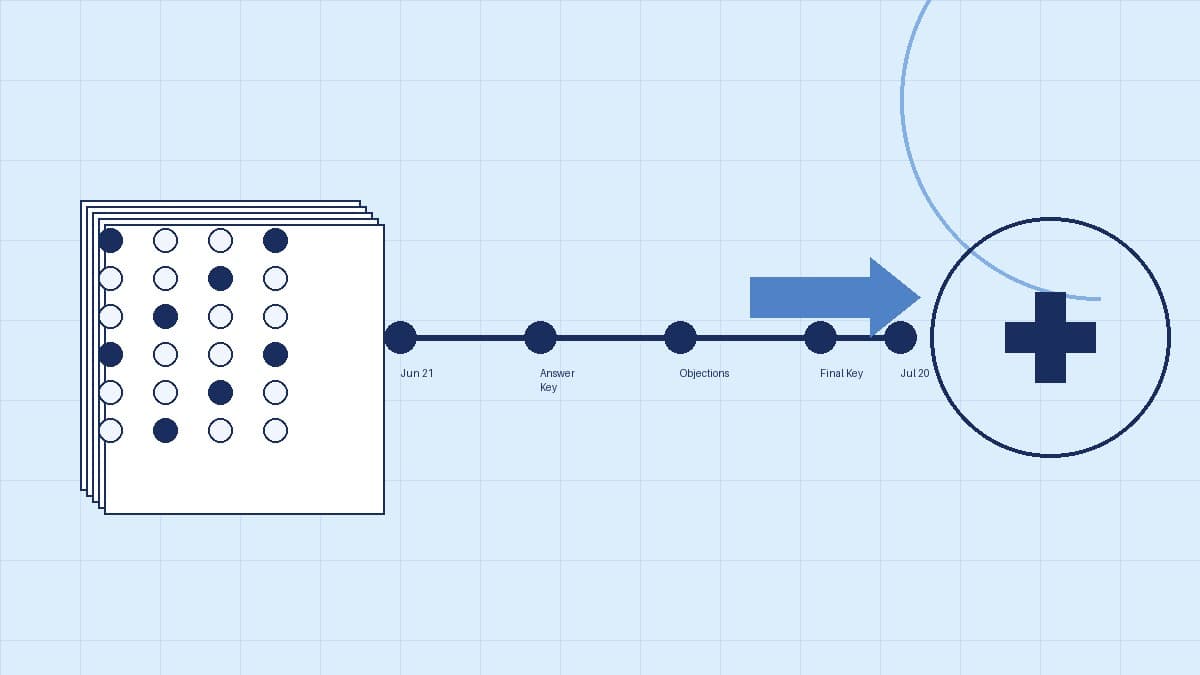
Twenty Lakh Scripts, Twenty-Nine Days
The re-NEET UG examination was conducted on June 21, 2026 — a Sunday — at 5,440 examination centres across India and 14 centres abroad. More than 20 lakh candidates appeared. It was one of the largest single-day examinations ever organised under emergency conditions in the country's history.
The original NEET UG was cancelled hours before it was scheduled to begin on May 4, after intelligence input suggested a paper leak at a printing facility in Jaipur. Over the seven weeks that followed, NTA reorganised the entire examination infrastructure, re-notified candidates, arranged fresh paper printing and logistics under Indian Air Force escort, and conducted the re-examination at centres across all 28 states and 8 union territories. On May 12, the Central Bureau of Investigation took over — its 18th exam fraud investigation since 2015.
The re-examination went ahead without a major incident. The result is expected on or around July 20, 2026. Medical Counselling Committee (MCC) counselling registration is expected to open on or around July 21. From the pen-down moment on June 21 to counselling in 29 days, across 20 lakh candidates — the timeline is compressed, and digital evaluation infrastructure is the enabling variable.
What Happens to 20 Lakh OMR Sheets
NEET UG uses Optical Mark Recognition (OMR) sheets — candidates bubble in answers, and sheets are read by machine rather than assessed by a human evaluator. This is structurally different from subjective answer book evaluation. But at 20+ lakh candidates, even automated OMR processing involves a substantial logistical and technical pipeline.
After the June 21 examination, OMR sheets from 5,440 centres across the country were collected, sealed in tamper-evident packets, and transported to designated regional processing facilities. The pipeline from there works as follows:
Physical custody transfer. OMR packets move under documented chain of custody from centre to processing facility. Each handover is logged. Packets are numbered and cross-referenced against the candidate count for that centre. Any discrepancy triggers a re-count before the packet is accepted.
Optical scanning and data capture. High-speed OMR scanners read the bubble patterns on each sheet. For a 200-question NEET paper, each sheet produces 200 data points per candidate — a binary signal for each bubble position. Scanners typically process several thousand sheets per hour at a regional facility.
Provisional answer key publication. NTA published the provisional answer key within ten days of the examination, per its established practice. Candidates could download their individual OMR response sheets from the portal and compare their bubbled answers against the published key.
Objection window. Candidates paid a fee of Rs. 200 per question challenged and raised objections via the NTA portal. A panel of subject experts — drawn from NCERT-affiliated faculty — reviewed each challenged question against textbooks and authoritative sources. Questions where the original key was incorrect were either dropped (all candidates awarded full marks) or corrected.
Final answer key and score computation. After the objection review, NTA published the final answer key. Scores are computed algorithmically: four marks for each correct answer, minus one for each incorrect answer, zero for unattempted questions. The computation runs in minutes across 20 lakh score records.
Result and rank declaration. The scorecard, All India Rank, and subject-wise performance data are published on the NTA portal. Candidates download their scorecards directly. No physical document distribution is required for the result stage.
Why 29 Days Is Consequential
Before digital OMR processing became the norm — roughly pre-2015 — NEET result timelines routinely extended to 45-60 days. Manual sorting, human data entry, and physical result dispatch from processing centres to states accounted for most of that time. The shift to fully digital processing compressed the timeline to under 30 days in standard years.
The 2024 NEET UG result was declared 17 days after the examination — but under normal conditions. The re-NEET 2026 scenario was not normal. NTA operated under CBI scrutiny, with Supreme Court oversight, new leadership installed after the first-exam controversy, and political pressure from multiple state governments that had demanded cancellation or relocation of the re-exam.
Achieving a July 20 result under these conditions required specific operational choices:
Pre-positioned infrastructure. The OMR scanning and processing infrastructure that was standing by for the cancelled May 4 examination remained available. NTA did not need to set up processing capacity from scratch for the June 21 re-exam. This compressed the post-exam setup phase significantly.
Parallel processing. The expert committee reviewing answer key objections ran simultaneously with OMR data processing, rather than sequentially. This means evaluators were reviewing challenged questions while scanner teams were still completing the physical OMR read of remaining packets.
Digital-only result publication. There is no physical result dispatch in the NEET pipeline. The scorecard is a digital document available immediately on the portal. This eliminates the 5-7 days that physical result dispatch to states and centres added in older examination cycles.
The Counselling Implication
With results expected July 20 and MCC counselling registration opening July 21, the timeline has direct downstream consequences for MBBS and BDS admissions across the country. Approximately 1.09 lakh MBBS seats in government and private medical colleges, and roughly 27,000 BDS seats, require this result as the qualifying threshold.
MCC counselling for the 15% All India Quota seats — covering AIIMS, JIPMER, central universities, and deemed private universities — typically runs 4-5 rounds over 60-90 days. State counselling authorities run parallel processes for the 85% state quota seats. Both pipelines depend on the NEET scorecard.
A result on July 20 means first-round counselling can run through late July and early August, second round through August, and mop-up rounds through September. This is aggressive but fits within the standard MBBS academic calendar, which most institutions target to begin in October. States where late rounds stretch beyond September may push batch start dates into November — a known consequence of medical admissions running to the edge of the calendar.
Had the result been delayed by even two to three weeks — to August 10 or later — admissions would have cascaded into the fourth quarter. MBBS batch composition and college operational planning would have been significantly disrupted.
What This Teaches Examination Bodies
The re-NEET pipeline demonstrates something that affiliating universities conducting examinations for large student populations have struggled to operationalise: digital evaluation at scale is not just faster — it is structurally more resilient under abnormal conditions.
When CBSE processed 17.68 lakh answer books through its new OSM system in May 2026, the cycle encountered scanning quality failures, identity mismatches, and security vulnerabilities that generated sustained post-result controversy. NTA's OMR pipeline for a comparable candidate count completed in 29 days without equivalent public failures.
The difference is not purely the evaluation model — OMR is machine-readable with zero evaluator discretion, while OSM involves human assessment of scanned images. The more significant factor is system maturity. NTA's OMR pipeline has processed comparable volumes annually since 2013. It has absorbed multiple failure scenarios, been patched, and been scaled iteratively. The CBSE OSM system was deployed at full national scale for the first time in 2026.
For universities deploying digital evaluation platforms for semester examinations covering 50,000 to 500,000 students, the re-NEET timeline is a relevant reference. Not an expectation to replicate immediately, but a benchmark that sustained iteration at scale eventually makes achievable.
NEET 2027 and What Comes After OMR
The central government has confirmed that NEET UG 2027 will transition to Computer Based Testing. This eliminates OMR sheets entirely. In a CBT model, candidates enter their answers digitally at a terminal; no physical sheet moves between the examination centre and a processing facility. Scores can theoretically be computed within hours of the examination closing — the JEE Main model demonstrates this already.
If CBT delivers what the government expects, NEET results in 2027 could be available within days rather than weeks. That would compress the counselling calendar further, potentially allowing MBBS batches to begin on a timeline consistent with the October-November academic calendar that medical colleges have been targeting for years.
The 29-day re-NEET 2026 result will be the last large-scale OMR-based NEET UG result in the current format. What comes next will be measured against a faster baseline. The infrastructure investments NTA makes in 2026-27 to prepare examination centres for CBT — biometric authentication, network resilience, redundant power, secure browser software — will determine whether the 2027 calendar is achievable or aspirational.
---
Related Reading
Ready to digitize your evaluation process?
See how MAPLES OSM can transform exam evaluation at your institution.