How PSEB Punjab Designed an On-Screen Marking Rollout That State Boards Can Actually Copy
Punjab piloted 23,000 answer scripts before going live, built QR codes into every page of the answer sheet, and chose a one-subject phased expansion — a deliberate implementation model built by watching what went wrong elsewhere.
Why This Announcement Is Different
State boards in India have been talking about digital evaluation for years. A handful have conducted pilots. Very few have published a concrete implementation architecture with a phased expansion roadmap. The Punjab School Education Board's on-screen marking announcement is notable not because Punjab is adopting digital evaluation — several states have discussed it — but because of how PSEB is doing it.
The Punjab model, announced by Education Minister Harjot Singh Bains and confirmed by the PSEB through official channels, includes specific design choices that address the exact failure modes that made headlines in CBSE's 2026 Class 12 rollout. This was not accidental. PSEB announced its OSM plans after CBSE's full-scale deployment had already generated controversy, and the Punjab implementation reflects lessons learned from watching that rollout under stress.
What PSEB Actually Built
Per-Page QR Codes
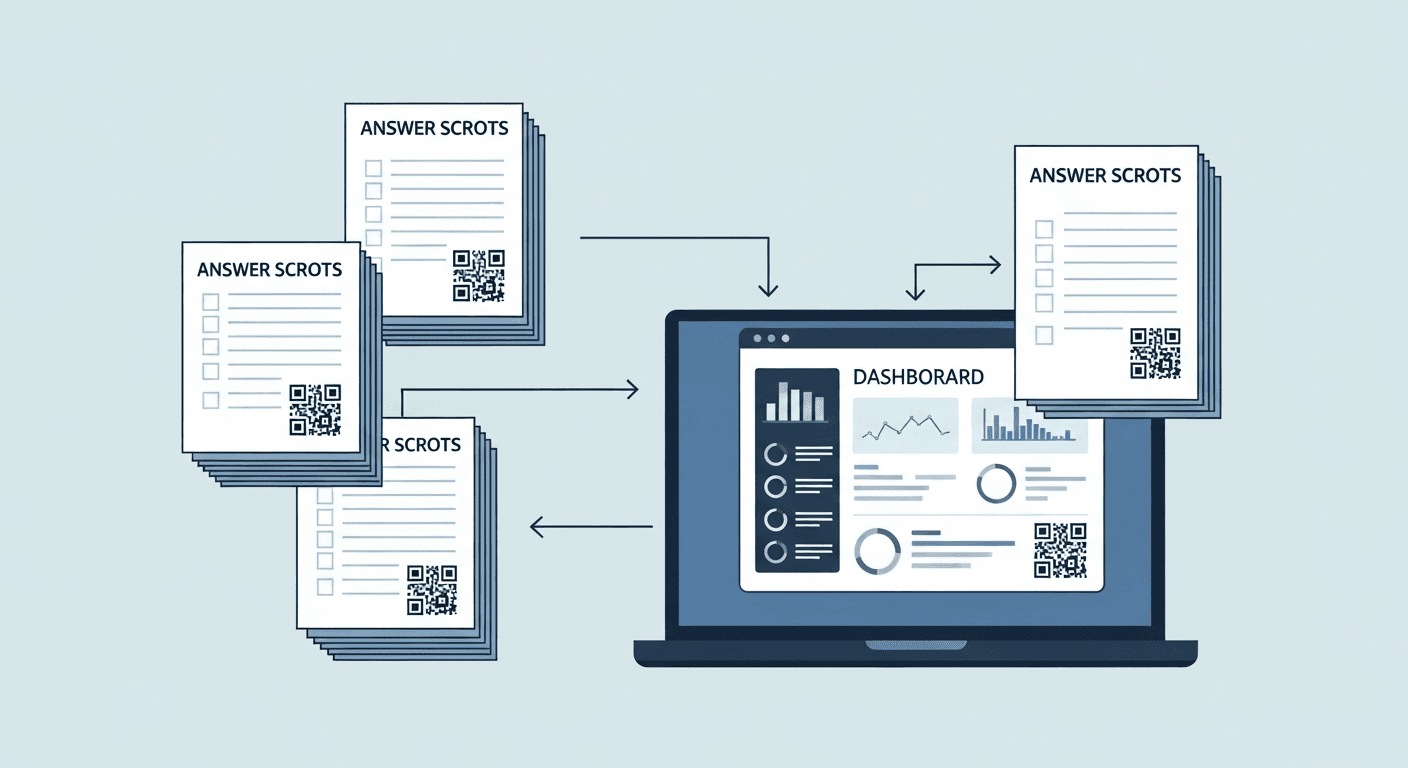
The most technically significant element of the PSEB design is that each page of the redesigned answer sheet carries a unique QR code. Scanning happens at the page level, not the booklet level.
This matters because the most common category of complaints in CBSE's 2026 revaluation cycle involved page-level errors — missing pages, misidentified pages, or pages that were scanned in incorrect sequence. When a QR code is printed on each individual page, the scanning system can verify at the moment of ingest that every page belongs to the correct answer book and has been captured in the correct order. Any anomaly triggers an immediate quality alert before the book is uploaded to the evaluation dashboard.
This is a structural prevention of the problem, not a post-hoc detection mechanism. CBSE's approach relied on students identifying errors after results were declared. PSEB's approach is designed to prevent those errors from reaching the evaluation stage.
The September 2025 Pilot
PSEB did not go live at scale for its first deployment. The board piloted the on-screen marking system during supplementary examinations held in September 2025, evaluating approximately 23,000 answer scripts through the digital pipeline before any change to the main board examination cycle.
This is a significant quantity. 23,000 scripts is large enough to stress-test the scanning workflow, evaluator interface, server capacity, result computation accuracy, and quality control gates under realistic conditions. It is not a controlled lab test — it used actual answer scripts from an actual examination, with actual evaluators working at normal pace.
The pilot allowed PSEB to identify and resolve operational problems in a lower-stakes context. Supplementary exam results are important to students, but the volume is a fraction of the main cycle and the political visibility is substantially lower. Problems that emerged in September 2025 were fixed before the March 2026 main examination.
One Subject at Matriculation
For the March 2026 main examination cycle, PSEB implemented on-screen marking for one subject of the matriculation examination. Not all subjects. Not all grades. One subject.
This phasing is deliberate and important. A single-subject rollout allows:
The plan is to expand to additional subjects in subsequent examination cycles, based on the operational performance of the 2026 deployment.
The Centralised Dashboard
Answer scripts are scanned in a protected environment and uploaded to a centralised digital dashboard. Evaluators access the dashboard to view answer pages, enter marks, and submit evaluations. The system performs automated totalling, removing a common source of manual error. Structured marking schemes are built into the evaluator interface, reducing variance in how evaluators interpret marking criteria.
The dashboard also provides real-time progress monitoring — administrators can track completion rates by examiner, identify bottlenecks, and redistribute work if any evaluator falls behind pace.
The CBSE Contrast
PSEB's implementation choices are easier to understand when placed alongside the specific problems that emerged in CBSE's Class 12 OSM deployment.
| Design Choice | CBSE 2026 | PSEB 2026 |
|---|---|---|
| Answer sheet identity | Booklet-level | Per-page QR code |
| Pilot before main rollout | No formal public pilot | 23,000 scripts (Sept 2025) |
| Scale of initial deployment | All Class 12 answer books | One subject, matriculation |
| Evaluator training timeline | Compressed pre-result | Extended, post-pilot |
| Scanning quality gates | Post-fact complaint driven | Automated at ingest |
CBSE's 2026 deployment was full-scale and first-cycle simultaneously. That combination created limited recovery margin when problems emerged after results were declared. With approximately 40,000 students subsequently filing for re-evaluation and the Cabinet Secretariat ordering a procurement inquiry, the reputational and operational cost of a rushed deployment was substantial.
PSEB went in the opposite direction on almost every design dimension. Slower initial scale, higher technical specificity in the answer sheet design, real-world piloting before main-cycle deployment.
A Replicable Model for State Boards
The Punjab implementation offers a practical sequence that other state boards can follow. The specific phases are:
Phase 0 — Design and procurement
Phase 1 — Supplementary exam pilot
Phase 2 — Single-subject main cycle deployment
Phase 3 — Phased expansion
This is a three-to-four-year transformation roadmap, not a one-season switch. The pace may feel cautious, but it produces a system that works rather than a system that generates controversy.
What State Boards Need to Get Right
Beyond the PSEB-specific design choices, several factors determine whether a state board digital evaluation rollout succeeds or generates a CBSE-style backlash:
Answer sheet scanning quality is the foundation. Every downstream problem in on-screen marking traces back to the quality of the scanned image. Blurred scans, incorrectly oriented pages, and identity mismatches at the scan stage are not solvable at the evaluation stage. Boards need to invest in scanner hardware, quality control workflows, and human oversight at the scanning centre.
Evaluator training must precede deployment, not coincide with it. Evaluators who encounter the OSM interface for the first time during actual marking make more errors and take longer. Training in a pilot context — where the stakes are lower — builds the muscle memory that produces accurate, efficient evaluation in the main cycle.
Revaluation workflows must be digital from day one. An institution that deploys digital evaluation but keeps its revaluation process paper-based immediately creates a hybrid that is harder to manage than either pure system. The revaluation interface, the access controls on evaluated scripts, and the documentation of changes must all be built into the initial platform design.
Transparency with students reduces backlash. If students understand in advance how on-screen marking works — how their answer books are scanned, how evaluators access them, what the revaluation process looks like — the number of concerns raised after result declaration drops significantly. PSEB's public announcement through the Education Minister's office is an example of proactive communication.
The Timing Advantage
PSEB made its full transition announcement in mid-2025, planned for March 2026, in the context of CBSE's ongoing OSM rollout. That timing gave Punjab the advantage of being informed by CBSE's experience.
State boards announcing OSM adoption now — in June 2026, with CBSE's full-cycle outcome visible — are in an even stronger position. The failure modes are documented. The solutions are available. The technical requirements are understood. A state board that implements the PSEB model in 2026 or 2027, incorporating the post-CBSE lessons about scanning quality and phased rollout, has access to a decade's worth of collective learning compressed into a three-year window.
The infrastructure investment is real. But so is the alternative cost: result delays, revaluation backlash, evaluator coordination problems, and the paper-storage burden that consumes examination resources every cycle. Digital evaluation does not eliminate all risk. It shifts the risk profile toward controllable, preventable failure modes — which is a better position to be in than the one CBSE found itself in after May 13, 2026.
---
Related Reading
Ready to digitize your evaluation process?
See how MAPLES OSM can transform exam evaluation at your institution.