India's Exam Integrity Gap Is at the Evaluation Stage — Here's the Architecture That Closes It
While India's anti-paper leak policy focuses on the pre-exam supply chain, a parallel vulnerability persists at the evaluation stage. Digital evaluation with the right architecture eliminates post-exam tampering structurally, not procedurally.
India's conversation about examination integrity in 2026 is almost entirely about paper leaks — and for good reason. The NEET-UG 2026 paper leak, in which "guess papers" containing approximately 120 of 410 exam questions circulated weeks before the test, triggered a re-examination for 22.79 lakh (2.279 million) candidates — the largest single re-examination in India's history. The Public Examinations (Prevention of Unfair Means) Act 2024 had been specifically enacted to criminalise such fraud. Yet five significant paper-leak episodes were reported in 2026 alone.
The policy response has concentrated on the pre-examination supply chain: digital watermarking, encrypted question papers, QR-coded seals, and decentralised printing. These are necessary reforms. But they address only the first half of the integrity problem.
The Post-Exam Vulnerability Is Larger Than the Policy Debate Acknowledges
A question paper, once leaked, is leaked. The damage is immediate and largely irreversible. But answer book manipulation — inflating marks, swapping books between students, adding or removing pages, altering marks on evaluated sheets — is a slower, quieter form of fraud with a longer chain of participants and a longer window of opportunity.
In India's paper-based evaluation model, the chain after the exam runs as follows: answer books are collected at examination centres, bundled, transported physically to evaluation camps, assigned to evaluators who may take books home or work at a common centre, marks are recorded in registers, those registers are transcribed to tabulation sheets, and tabulation sheets are entered into result systems. Each handoff is a potential intervention point, and each step between collection and entry involves physical objects that can be added to, subtracted from, or replaced.
Post-exam fraud in this chain is not hypothetical. It surfaces in high court filings across multiple states every year, in the form of:
Digital evaluation does not merely reduce this risk — it eliminates it structurally, when the platform is implemented with integrity as an architectural requirement rather than an add-on policy.
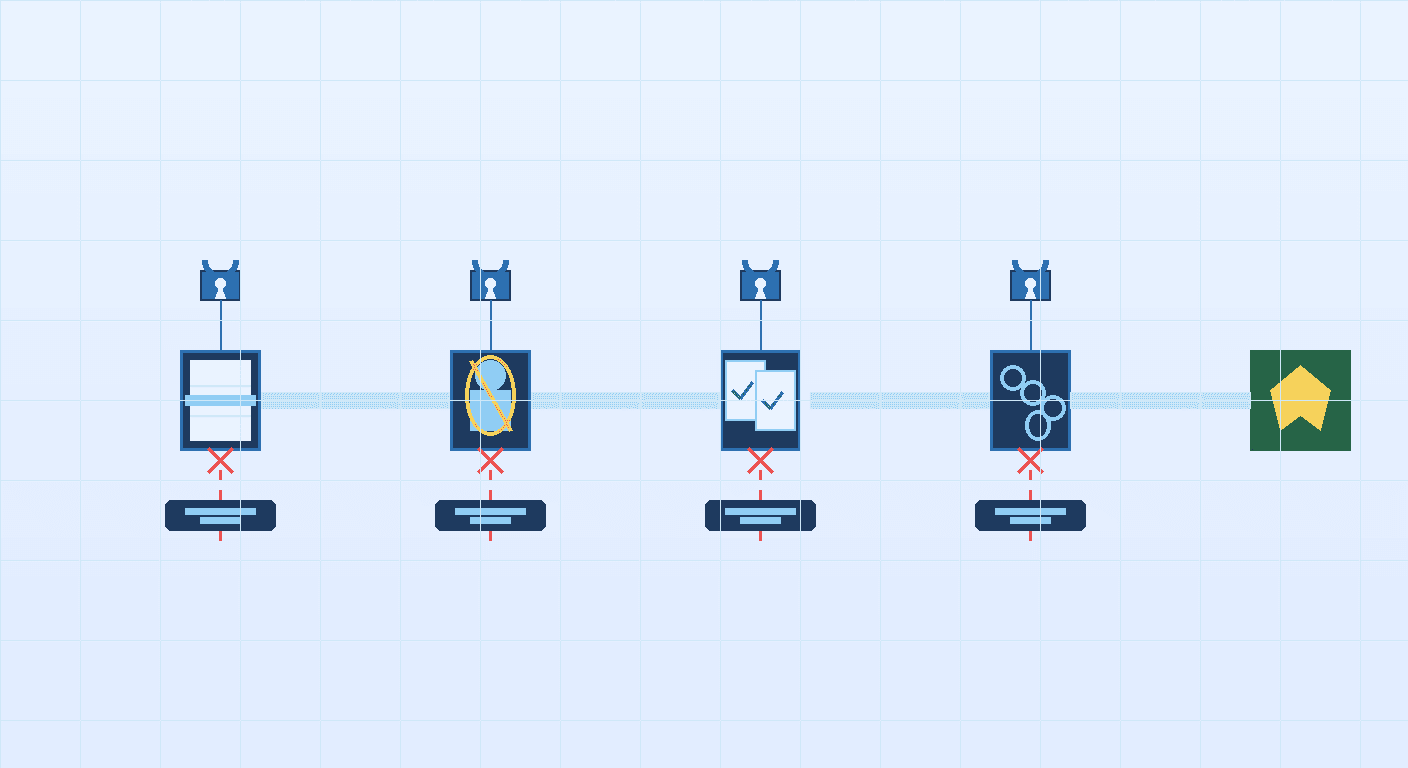
Four Controls That Remove the Attack Surface
1. Scan-and-lock before evaluation opens
In a correctly implemented OSM system, answer books are scanned at the examination centre immediately after collection, generating a cryptographic record of each scanned file. The physical books are then secured and inaccessible during evaluation. Evaluators receive only digital images.
Any difference between the scanned image and the physical book — a page added, a page removed — is detectable against that record at any later point. This single architectural decision eliminates the largest class of post-exam fraud: physical tampering with answer books after collection and before or during evaluation.
The CBSE 2026 implementation exposed what happens without this control: blurred scans were evaluated as-is, and questions about whether the scanned image matched the physical book could not be resolved against any baseline, because no scan-integrity record had been established at the point of collection.
2. Evaluator anonymity enforced at the database level
When evaluators cannot see the identity of the student whose paper they are marking, a directed bribery attack requires knowing both the anonymisation code assigned to a specific student's answer book and which evaluator received that code. These are separate pieces of information, held in separate systems, with separate administrative access paths. The attack surface doubles; the success rate collapses.
The distinction between application-layer anonymity and database-level anonymity matters. Application-layer anonymity means the evaluator's interface does not display the student's name — but the underlying database links the evaluator session to the student roll number, and that link is traversable if the system has a vulnerability. Database-level anonymity means the evaluator record and the student identity record are in separate databases with no runtime join during evaluation. The security researcher who disclosed vulnerabilities in CBSE's 2026 portal found application-layer protections without database-level isolation.
3. Mandatory double valuation with statistical escalation
Independent double valuation means two evaluators mark the same paper without knowledge of each other's marks. A statistical threshold — typically a deviation above a defined absolute or percentage range — triggers automatic escalation to a moderator or third evaluator.
This is not a manual process. The system computes the deviation and routes the paper without human intervention. In this model, a mark-inflation attempt by a single evaluator will consistently deviate from the second evaluator's marks and be flagged before the result is finalised. A successful manipulation requires two evaluators whose inflated marks coincidentally align — a significantly harder coordination problem than bribing one evaluator.
Double valuation also produces a natural explanation for revaluation requests. When a student requests revaluation, the institution can show two independent marks, their deviation, and the moderator's decision. This transparency substantially reduces the volume of disputes that reach grievance cells and courts.
4. Immutable evaluator action log
Every evaluator action in a properly built OSM platform is logged with a timestamp, an evaluator identifier, and the mark awarded. This log is append-only and cannot be edited. If a mark appears in the result system that does not match the platform's evaluator log, the discrepancy is detectable in minutes.
This makes post-tabulation fraud — changing a mark between the OSM system and the result database — immediately auditable. The audit trail answers every revaluation dispute: either the mark in the result matches the evaluator's record, or it does not. If it does not, the discrepancy is not a dispute about evaluation; it is a data entry fraud that the audit trail itself documents.
The Anti-Paper Leak Act's Missing Half
The Public Examinations (Prevention of Unfair Means) Act 2024 criminalises leaking question papers, impersonation at examinations, and related pre-exam fraud, with penalties including imprisonment up to 10 years and fines up to one crore rupees. It is an important legislative step.
It does not address the post-exam evaluation chain. India currently has no national statutory standard for:
State examination boards implementing digital evaluation are therefore doing so without a shared minimum standard. An institution with an architecturally sound implementation coexists in the regulatory landscape with one that has replicated CBSE's 2026 vulnerabilities at smaller scale — and neither is distinguished by any current compliance requirement.
J.C. Bose University as a Proof Point
J.C. Bose University's May 2026 digital evaluation cycle — completed within one month of the last paper, with zero complaints about missing or altered answer sheets — demonstrates that the architecture described above is operationally viable at university scale. Students at J.C. Bose could access their evaluated scripts online and raise objections through the ERP portal, with each objection logged against a specific evaluator action record.
The tamper-proof quality was not a feature promoted by the platform. It was a consequence of the workflow: once scanned at the centre, the answer book could not be modified in any way that would not be detected against the scan record. The evaluator could only add marks, not edit the underlying image. The marks, once entered, were logged immutably.
What Institutions Can Implement Before November 2026
For universities running their own evaluation:
| Control | What It Prevents |
|---|---|
| Scan + baseline record at centre | Physical tampering with books after collection |
| Evaluator anonymity at database level | Directed bribery against specific evaluators |
| Mandatory double valuation with auto-escalation | Single-evaluator mark inflation |
| Immutable evaluator action log | Post-tabulation mark changes |
| Student access to evaluated script | Removes incentive for post-result manipulation |
These controls do not require a technology breakthrough. They require an OSM platform that was built with integrity as a design requirement rather than a configuration option. The distinction determines whether an institution's digital evaluation deployment is substantively more secure than the paper-based system it replaces — or simply a digitised version of the same vulnerabilities.
Related Reading
Ready to digitize your evaluation process?
See how MAPLES OSM can transform exam evaluation at your institution.