After NEET 2026: How Zero-Trust Architecture Can Secure India's Exams
The NEET 2026 paper leak exposed a systemic vulnerability — too much human access at every stage. NTA's zero-trust reform plan points to where examination security is headed.
The Leak That Changed the Conversation
When NEET-UG 2026 question papers began circulating on Telegram channels hours before the June 21 examination date, investigators quickly traced the breach to a chain of human custodians who had complete, unredacted access to the paper: question setters, translators, printers, and distributors. In the end, 13 individuals were arrested and over one lakh candidates faced a re-examination — the second major NEET disruption in three years.
The investigation found that paper translators, who worked with complete question papers to produce regional language versions, were a critical breach point. Leakers allegedly charged candidates between Rs 5 lakh and Rs 12 lakh each for advance access.
The post-mortem pointed to a structural flaw that no amount of surveillance or police deployment can fully address: when the integrity of a high-stakes examination depends on every human in a chain making the right decision, the system is only as secure as its weakest actor.
What Zero-Trust Means in an Examination Context
The term "zero-trust" originates in cybersecurity, where it describes an architecture that never assumes any user or system component is inherently trustworthy — every access request must be verified, and permissions are granted on a need-to-know basis only.
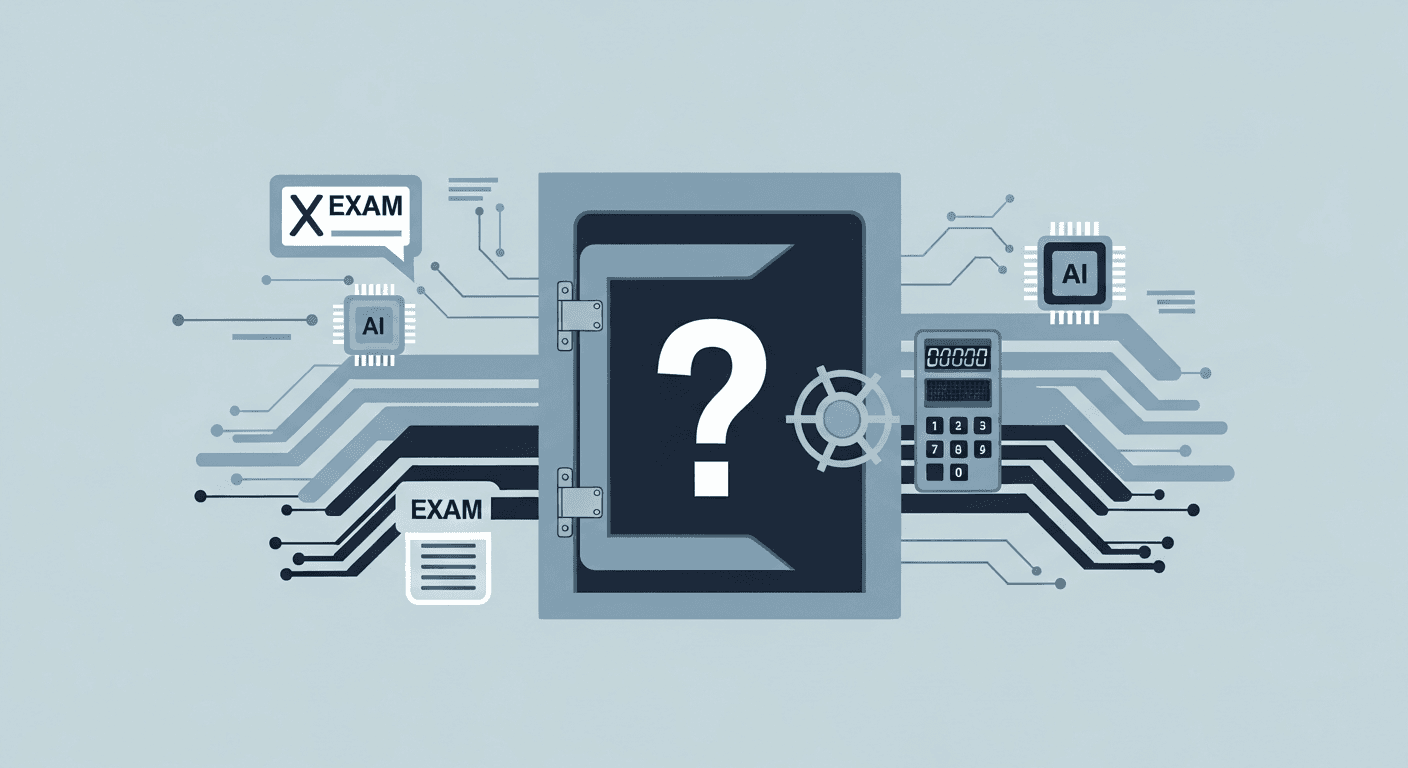
Applied to examination security, zero-trust means designing a system where no single individual — regardless of their role — has access to a complete, usable question paper at any point before the examination begins.
Following the NEET 2026 controversy, the National Testing Agency announced plans to restructure its entire question paper creation pipeline around this principle. NTA Director General Abhishek Singh stated that "excessive dependence on human processes has been one of the key vulnerabilities in examination systems."
The Four Pillars of NTA's Reform Plan
1. A Central Question Repository
The centerpiece of NTA's proposed reform is a large, centrally managed question bank containing thousands of questions across every subject and difficulty level. Questions would be tagged by topic, difficulty, and cognitive level — recall, application, analysis.
Rather than assembling a fixed 180-question paper for NEET in advance, the system would draw from this pool dynamically, potentially generating unique paper variants for each examination shift.
This approach is already standard practice in mature computer-based testing systems. JEE Advanced has used a form of adaptive question randomization for years, which is one structural reason large-scale leaks of JEE papers have been comparatively rare.
2. The Blind Contribution Model
Under the proposed system, subject matter experts would contribute questions to the central repository without knowing which examination would use their questions, or when. A faculty member asked to write questions on a specific topic would have no visibility into the final paper composition.
This compartmentalization ensures that even if a contributor were compromised, the information they could provide — a few questions out of a pool of thousands — would not constitute a viable leak of an examination paper.
3. AI-Powered Paper Assembly
The task of selecting and assembling questions — currently done by a core committee that has full visibility — would be handled by automated systems. An AI-based assembly engine would maintain topic coverage, difficulty balance, and marking scheme integrity without any human reviewing the final selection until the paper is locked and sealed.
This is the most technically challenging component of the reform. Existing AI systems can balance quantitative parameters such as topic coverage and marks distribution, but ensuring appropriate difficulty calibration across a 22-lakh-candidate cohort requires extensive testing and validation.
4. AI-Based Translation
Human translators who work with complete papers to produce Hindi, Gujarati, Tamil, Telugu, Odia, Assamese, Bengali, and Urdu versions were a confirmed breach point in the 2026 leak. NTA's plan includes using AI-based translation tools — drawing on India's Bhashini digital public infrastructure — to reduce and eventually eliminate this exposure.
Machine translation for technical scientific content is still imperfect, particularly for diagrams, chemical formulae, and domain-specific terminology. Expert review of AI-translated papers will likely remain part of the process, but reviewers would see only their assigned language version rather than the English source.
How Zero-Trust Connects to Evaluation Integrity
NTA's reform targets the front end of examination integrity — question creation and delivery. But the same principles apply to the back end: answer sheet evaluation.
Institutions that have adopted digital evaluation platforms have, in many cases, already implemented analogous controls. Evaluators see only anonymized, shuffled answer books. Marks entered through digital interfaces are logged with timestamps. No evaluator can modify a score once a supervisor has validated it. Audit trails are preserved for years.
When the question-paper side catches up to these standards, India will have something closer to an end-to-end integrity chain: secure creation, secure delivery, and tamper-proof evaluation.
What State Boards and Universities Can Take Away
NTA's plan is targeted at central entrance examinations, but the same architecture applies at any scale. The table below maps NTA's proposed reforms to equivalent measures universities can adopt in their own examination systems.
| Component | NTA's reform | University equivalent |
|---|---|---|
| Question source | Central bank, blind contribution | Department question pool, not single setter |
| Paper assembly | Automated, no full-paper human visibility | Randomized question sets per course batch |
| Translation | AI-assisted, language-limited review | Bilingual staff reviewing only their language version |
| Evaluation | Existing on-screen marking planned | On-screen marking with anonymization and audit logs |
| Audit trail | End-to-end digital logs | Evaluation timestamps and mark revision history |
The table highlights a useful point: universities have typically focused on one end of the integrity chain — either examination creation or evaluation — while leaving the other end under-designed. A comprehensive approach addresses both.
The Transition to NEET CBT 2027
NTA has confirmed the zero-trust reforms will be phased in beginning with the NEET 2027 cycle, which also marks the confirmed transition to computer-based testing. The shift to CBT mode is itself a significant security gain, as it eliminates physical paper printing and transport — the most vulnerable links in the current chain.
JEE Main, CUET UG, UGC-NET, and other NTA examinations will follow the same architecture once validated through NEET 2027.
Colleges and coaching institutions that serve NEET and JEE aspirants should begin familiarizing students with computer-based answering well before 2027. The mode change will require adaptation from students accustomed to pen-and-paper examinations.
What the Reform Signals for Higher Education
The NEET 2026 breach and NTA's subsequent announcements represent a shift in how India's examination establishment thinks about security. For over a decade, the response to paper leaks has been operational — more police escorts, sealed envelopes, last-minute transport decisions. The zero-trust reform is structural: it accepts that human actors cannot be trusted with complete access and redesigns the system so that complete access is never necessary.
That shift in thinking is as important as the technology itself. It sets a standard against which all examination systems — central and state, entrance and end-semester — will increasingly be measured.
Universities that build their evaluation infrastructure now around the same principles — separation of roles, minimal access, AI-assisted processing, and comprehensive audit trails — will find themselves well-aligned with the direction national examination policy is taking.
Related Reading
Ready to digitize your evaluation process?
See how MAPLES OSM can transform exam evaluation at your institution.