The Air Force Is Delivering NEET Papers. That Tells You Everything.
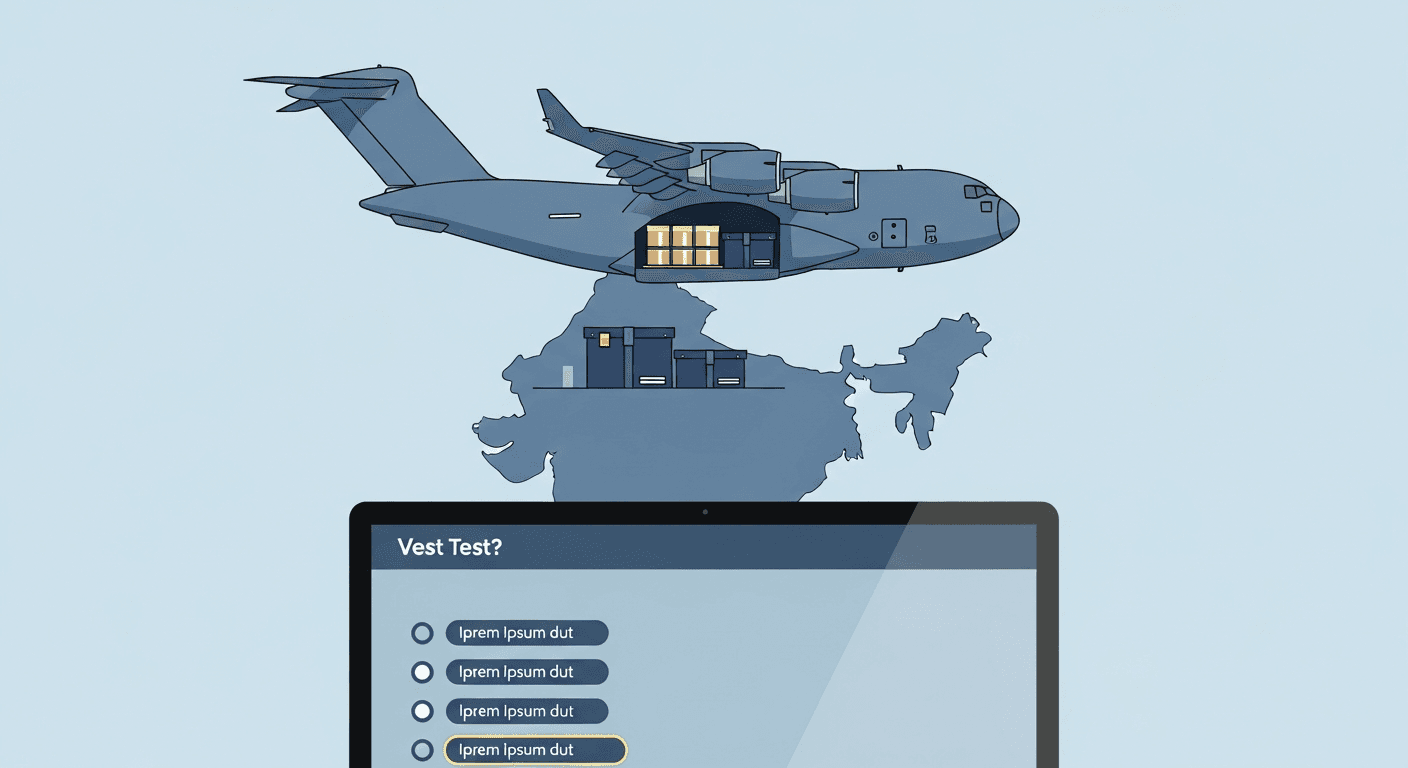
NTA is using Indian Air Force logistics to transport NEET-UG retest papers for June 21, 2026 — a measure that reveals the extraordinary cost of running a physical paper exam at national scale.
When Exam Security Requires Military Logistics
The National Testing Agency's decision to seek Indian Air Force logistical support for transporting NEET-UG retest question papers on June 21, 2026 is not merely an operational footnote. It is, in concentrated form, the clearest possible statement of what physical paper examinations require to be secure at India's scale — and why they cannot remain the long-term model.
The original NEET-UG 2026 exam, held on May 3 for approximately 22.7 lakh candidates, was cancelled on May 12 after a CBI investigation confirmed that a chemistry teacher in Sikar had identified overlap between pre-circulated "guess papers" and the actual question paper. Forty-five individuals linked to the paper distribution network were detained in Maharashtra alone. The Union Education Minister acknowledged a "breach in the command chain" and confirmed that the NEET-UG examination will transition to a Computer-Based Test format from 2027.
The June 21 retest is, therefore, being conducted under a different set of conditions. NTA has requested IAF support for question paper transport — a measure that is extraordinary by any standard — to close the physical distribution window that was exploited in May.
The Anatomy of a Physical Paper Leak
To understand why IAF logistics are being deployed, it helps to understand precisely where physical paper leaks enter the system.
A question paper printed in a centralised facility must travel to thousands of examination centres distributed across every state and union territory. That journey typically involves:
Each handoff is a potential breach point. The May 2026 leak entered the system somewhere in that chain — a photograph taken, sent over WhatsApp, and circulated to preparatory networks before papers were opened at examination centres. The same pattern had occurred with UGC-NET in December 2025, with NEET-UG in 2024, and with multiple state board examinations in 2025-26.
The IAF option removes the most vulnerable links in the chain — civilian ground transport across long distances — and replaces them with a controlled, traceable, security-cleared logistical pathway. It is an effective short-term measure. It is also a significant escalation.
What "Effective Security" Costs at This Scale
India conducts NEET-UG across approximately 550 cities in 28 states and 8 union territories. The examination is sat in a single shift on a single day, requiring coordinated paper delivery across geographic and infrastructure diversity that few countries have to manage for a single exam.
The costs of securing that distribution are not published, but the inputs are visible:
Each element adds cost. Collectively, the security overhead for a single physical paper examination at NEET scale runs into hundreds of crore rupees across the entire ecosystem — including state police deployment, which is routinely requisitioned for exam security but rarely included in public cost calculations.
The Contrast with CBT Examination Security
The government's commitment to shift NEET to CBT from 2027 reflects a recognition that the physical paper model has reached its operational limit. The security architecture of a Computer-Based Test is structurally different:
| Security Dimension | Physical Paper | Computer-Based Test |
|---|---|---|
| Paper in transit | Vulnerable during entire transport window | No paper to intercept |
| Leak vector | Photograph of printed question | Requires system compromise, much harder |
| Distribution chain | Hundreds of handoffs across thousands of centres | Encrypted files to registered servers |
| Time window for leak | Days before exam (printing to distribution) | Minutes to seconds at exam start |
| Post-leak containment | Cancellation, retest required | Randomised question banks, per-candidate variation possible |
| Evidence preservation | Physical chain of custody | Complete digital audit trail |
CBT does not eliminate exam fraud. It changes its economics fundamentally. The cost of compromising a physical paper is low — one insider, one camera. The cost of compromising a CBT system at scale is orders of magnitude higher and leaves a far more traceable digital footprint.
What the Cancellation Cost India
The May 2026 NEET-UG cancellation has produced costs that extend beyond the examination itself:
For students: 22.7 lakh candidates lost five weeks of academic preparation certainty. Many had made travel and accommodation arrangements for exam day. Students from lower-income backgrounds — already absorbing the financial cost of coaching — absorbed additional disruption disproportionately.
For the medical admissions calendar: The delay in NEET results cascades into counselling, seat allotment, and college admissions timelines. Medical colleges lose the first weeks of their academic year.
For NTA: The agency is conducting the retest on a 38-day preparation window — compressed by any standard — while simultaneously managing scrutiny from a Supreme Court-appointed oversight committee, a CBI investigation, and a parliamentary panel review.
For the broader examination ecosystem: Every state board conducting physical exams in 2026 is now operating under heightened public and institutional scrutiny. The NEET cancellation has created political momentum for examination reform that is reaching well beyond the NTA and the central government.
The Evaluation Side of the Equation
The discussion about NEET security has focused almost entirely on the question paper delivery side. The evaluation side deserves equal attention.
NEET-UG uses Optical Mark Recognition (OMR) sheets, which are already a form of digital evaluation — candidates mark answers on machine-readable forms that are scored by computer. This is why answer key challenges happen through a structured portal rather than human re-evaluation.
The transition to CBT closes the loop: both delivery and evaluation are fully digital, eliminating the physical paper entirely from the process. Candidates see their responses, scores are calculated immediately, and the entire chain from question display to result is captured in an auditable digital record.
For subjective examinations — the state board and university exams that involve handwritten answers — the equivalent transition is On-Screen Marking (OSM). The principle is the same: scan the physical answer sheet, evaluate digitally, produce a structured data record. The question paper delivery vulnerability is separate from the evaluation quality problem, but both are solved by the same underlying move away from unstructured physical processes.
What This Signals for Universities and Colleges
For administrators at universities and affiliated colleges, the NEET 2026 sequence carries a clear message: the tolerance for examination systems that cannot account for every paper in the chain is approaching zero.
This tolerance is being set not just by regulators but by students, parents, courts, and parliament. The Supreme Court-appointed oversight committee for NTA has already recommended structural reforms to exam conduct. Parliamentary panel reports on NTA governance published in May 2026 have specifically cited the physical paper model as a systemic vulnerability.
University-level examinations do not face the same national scrutiny as NEET, but they face the same structural vulnerabilities — and the same NAAC, NIRF, and UGC pressure to demonstrate that their examination governance is sound.
An institution that can demonstrate end-to-end digital evaluation — from question paper generation through answer sheet scanning and on-screen evaluation to result declaration — is positioned to show regulators, accreditors, and students alike that its examination chain is accountable at every step.
The Air Force transporting exam papers is a remarkable image. It should also be an expiry date for the model that made it necessary.
---
Related Reading
Ready to digitize your evaluation process?
See how MAPLES OSM can transform exam evaluation at your institution.