NTA's 2026 Structural Overhaul: DIGI-Exam, New Verticals, and What It Means for India's Examination Ecosystem
The K Radhakrishnan Committee's 101 recommendations are reshaping India's National Testing Agency — from biometric authentication and a dedicated DIGI-Exam platform to Mobile Testing Centres for rural aspirants.
The Crisis That Triggered a Systemic Rethink
In 2024, India's examination governance machinery faced its most serious stress test. Allegations of widespread malpractice in the NEET-UG examination — affecting roughly 24 lakh candidates — exposed systemic vulnerabilities in the National Testing Agency's operational model. Paper leaks, impersonation, and centre-level fraud led to the formation of a high-level seven-member reform committee headed by Dr. K Radhakrishnan, former chairman of ISRO.
The committee's 101 recommendations, submitted in mid-2024, are now being implemented in phases. What began as a crisis-response has evolved into the most comprehensive restructuring of India's central examination infrastructure in two decades.
What the Radhakrishnan Committee Recommended
The committee's recommendations span operational, technological, and institutional dimensions.
Organisational Restructuring
The report proposed separating NTA's core mandate from peripheral functions. NTA should focus exclusively on entrance examinations and take on additional work only after demonstrating expanded capacity. New functional verticals recommended include:
This restructuring is designed to prevent the administrative overstretch that contributed to the 2024 failures.
The DIGI-Exam Platform
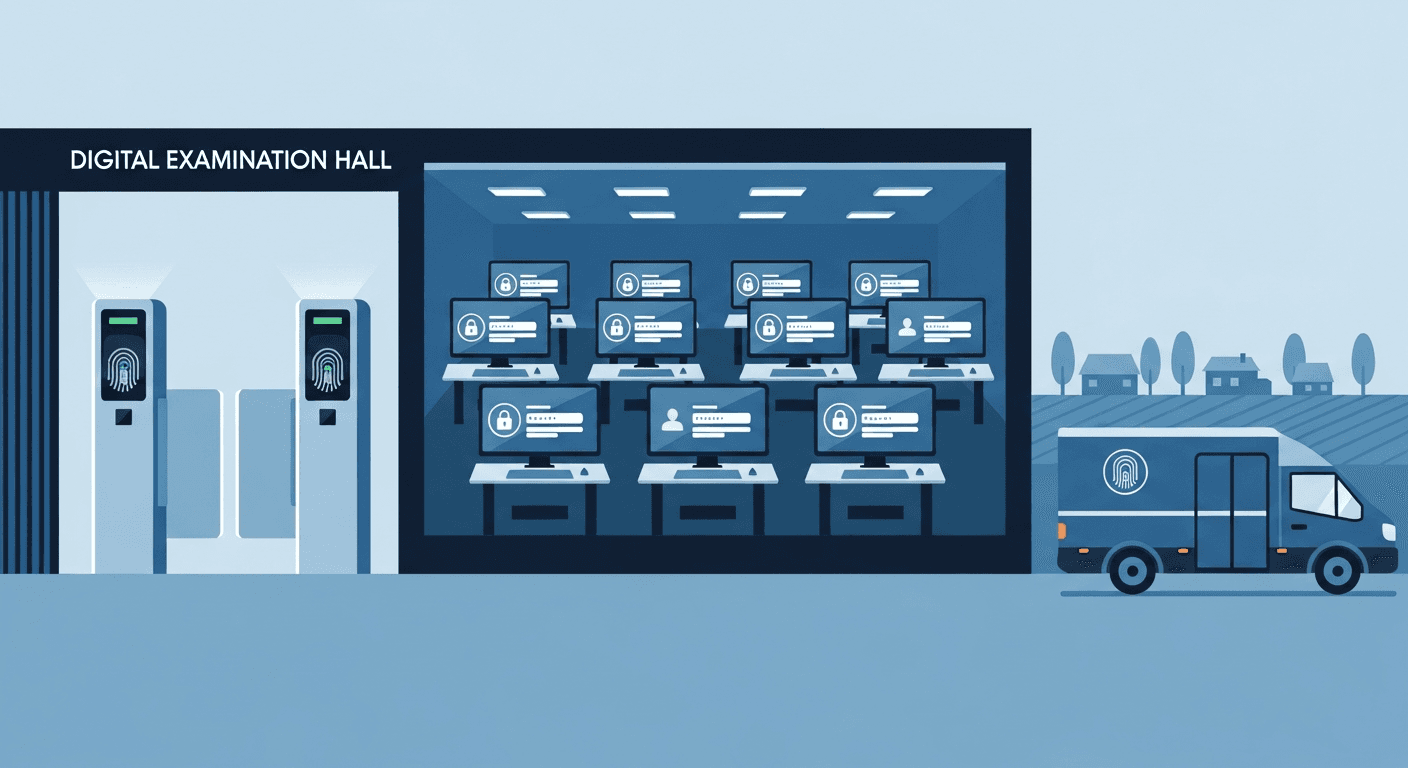
The most forward-looking recommendation is the creation of a DIGI-Exam platform — a biometric-based digital examination system modelled conceptually on DigiYatra, India's airport passenger identification system. Key features include:
NTA began implementing the facial biometric component with JEE (Main) in January 2026. The December 2025 announcement confirmed rollout across all NTA-conducted entrance examinations from 2026 onwards.
District-Level Testing Centres
One of the committee's more ambitious infrastructure proposals involves establishing at least one standardised testing centre for computer-based tests in every district across India. The existing infrastructure gap is stark — aspirants in smaller towns currently travel hundreds of kilometres to reach approved examination centres, creating logistical hardship and exposure to fraud networks operating near major cities.
The proposal also envisages Mobile Testing Centres (MTCs) — deployable examination infrastructure — for aspirants in remote, rural, and inaccessible regions. This addresses the geographic equity dimension of examination access that has been largely ignored in policy discussions.
Phasing Out Sole Private Agency Dependence
The committee flagged the risk of over-reliance on a single private test delivery agency. The recommendation is to diversify test centre infrastructure by upgrading Kendriya Vidyalayas (KVS) and Jawahar Navodaya Vidyalayas (JNV) to serve as standardised digital testing venues. This uses existing government infrastructure rather than creating new facilities.
An advanced encryption and multi-layered authentication system for question paper delivery is also recommended, with district administration and police involvement in sealing examination centres before exam day.
From Entrance Exams to University Evaluations: The Infrastructure Parallel
The NTA reforms are primarily focused on entrance examinations, but the underlying infrastructure challenge mirrors what Indian universities face in their end-semester evaluation processes.
Several key parallels are worth noting:
| Challenge | NTA Entrance Exams | University Evaluation |
|---|---|---|
| Impersonation | Candidate identity fraud at centres | Evaluator identity at evaluation camps |
| Paper security | Pre-exam leak on social media | Answer book tampering in transit |
| Geographic equity | Candidates travel to city centres | Evaluators concentrated in district hubs |
| Data auditability | Score computation transparency | Mark entry and totalling errors |
| Accountability | Centre-level fraud detection | Evaluator performance monitoring |
The DIGI-Exam framework — with its emphasis on biometric identity, encrypted data transmission, and real-time monitoring — has direct applicability to how universities run their answer script evaluation processes.
Implementation Status: 2026 and Beyond
Already in Effect
Planned for Near-Term
Longer Horizon
The Accountability Signal
What is notable about the Radhakrishnan Committee recommendations is the explicit acknowledgement that examination integrity cannot be maintained through deterrence alone. The committee emphasised structural accountability — systems where manipulation becomes technically difficult rather than merely legally risky.
This marks a shift in how India's examination policy thinking has evolved. The earlier model assumed that stringent penalties and CCTV surveillance would be sufficient. The 2024 crisis demonstrated that these surface-level controls are inadequate when examination management systems lack digital auditability.
The movement toward DIGI-Exam, biometric verification, and encrypted paper delivery is a recognition that integrity must be engineered into examination processes, not enforced after the fact.
Implications for Educational Institutions
Universities and examination boards that are independently managing their evaluation infrastructure should pay close attention to the NTA reforms for two reasons:
First, regulatory pressure. UGC and NAAC are increasingly looking at examination governance as an institutional quality indicator. NAAC's Criterion 6 (Governance, Leadership, and Management) specifically includes examination process administration. As NTA raises the bar for central examinations, the expectations for university-level processes will follow.
Second, candidate trust. Students who experience biometric authentication and real-time monitoring at JEE and NEET will expect comparable transparency when their university answer scripts are evaluated. The credibility gap between high-stakes entrance examinations and routine university evaluation will become more visible.
The NTA reform is therefore not just a bureaucratic restructuring. It is redefining what examination quality means across India's education system.
Related Reading
Ready to digitize your evaluation process?
See how MAPLES OSM can transform exam evaluation at your institution.