NIOS Digital Paper Delivery: How Last-Mile Security Closes the Exam Leak Window
India's National Institute of Open Schooling has deployed a portal-based, time-locked question paper delivery system for 1,600+ centres — a blueprint for closing the most vulnerable point in the exam security chain.
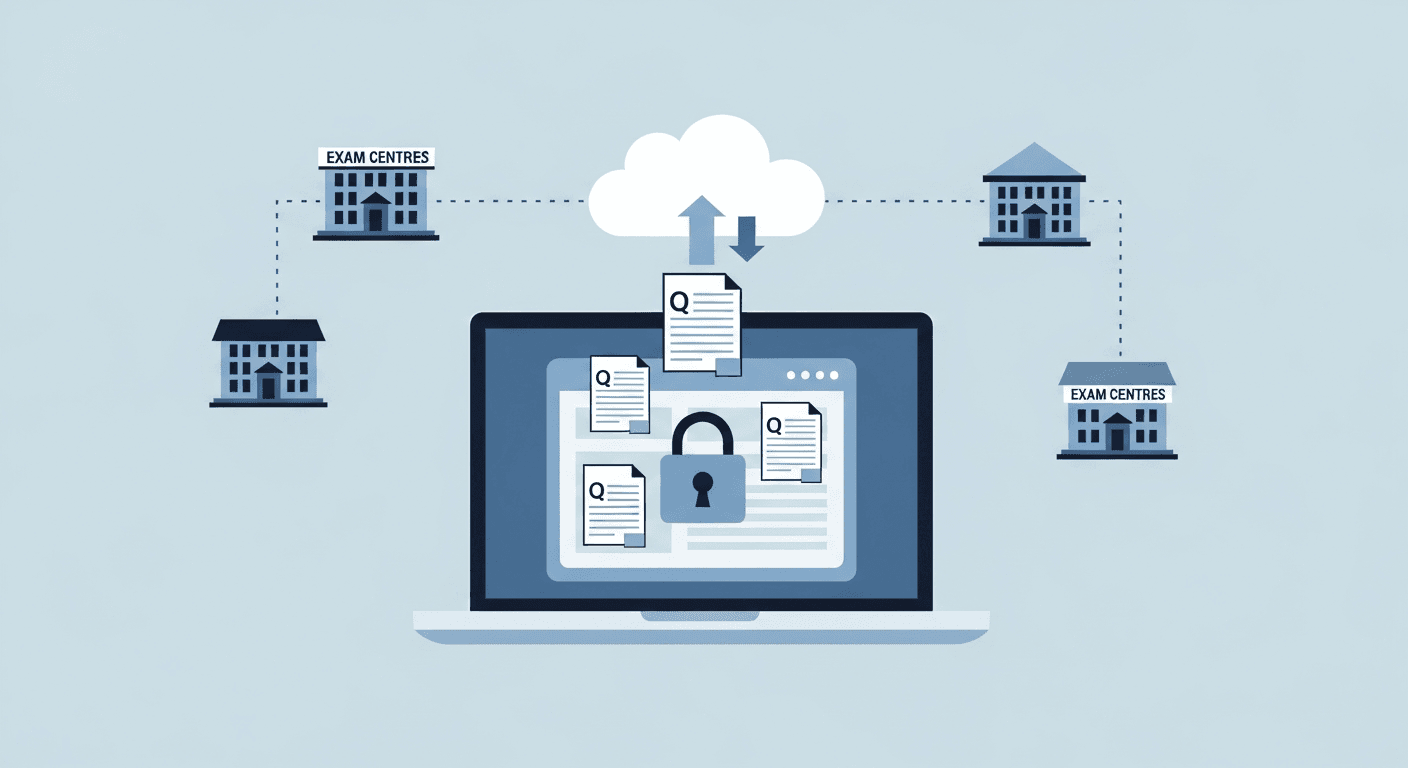
The Leak Window Nobody Talks About
When discussions about exam security arise in India, attention typically falls on evaluation — who checks papers, how marks are awarded, whether results can be tampered with. Less scrutiny lands on the hours immediately before an examination begins: the window during which physical question papers travel from printing presses to examination centres across the country.
That window has historically been exploitable. Transit delays, unauthorised access during storage at collection points, and the sheer logistical complexity of coordinating paper movement to thousands of centres create conditions where leaks become possible — and, as recent years have shown, actual.
In April 2026, the National Institute of Open Schooling (NIOS) did something that few examination bodies have attempted at this scale: it eliminated physical pre-examination paper delivery entirely.
What NIOS Has Deployed
NIOS has rolled out a digital question paper delivery system for its April–May 2026 Class 10 and Class 12 theory examinations, covering more than 1,600 examination centres across India. The architecture is straightforward but significant:
The examinations run from April 10 to May 6, 2026, making this one of the first large-scale deployments of fully portal-distributed exam papers in India's open schooling sector.
Why Traditional Physical Delivery Fails
Understanding why this matters requires appreciating the scale and logistics of Indian board examinations. NIOS operates across thousands of study centres and conducts examinations for students who could not complete schooling through the regular system — working adults, students from conflict-affected regions, learners with disabilities, and candidates seeking second chances.
For every exam cycle, traditional systems require:
Each handoff in this chain is a potential vulnerability. Papers stored overnight at a centre, in transit through courier facilities, or held at district collection points are accessible to anyone who compromises a single link. The Chhattisgarh Hindi paper leak and the Maharashtra HSC incidents of early 2026 demonstrated precisely how physical custody breaks down — and how quickly leaked content spreads via WhatsApp before a single student has entered an examination hall.
The NIOS model eliminates steps 1 through 4. There are no physical papers to intercept because they do not exist in physical form until minutes before the exam begins.
The NEP 2020 Alignment
NIOS explicitly frames its digital delivery system as aligned with the National Education Policy 2020 and the Digital India initiative. This alignment is substantive, not rhetorical.
NEP 2020 envisions a technology-enabled examination ecosystem where audit trails, real-time monitoring, and data-driven oversight replace manual processes. The specific provisions the NIOS system addresses include:
For a body whose certificates are recognised for higher education admissions and government employment — credibility depends entirely on the perceived rigour of its examinations. The integrity of paper distribution is foundational to that credibility.
Forensic Capability: The Audit Trail Advantage
One underappreciated feature of NIOS's new system is the forensic capability it creates. Every centre login, download event, and access timestamp is recorded centrally. In the physical model, determining whether a paper was compromised at the printing press, in transit, at the district collection point, or at the centre itself was often impossible — and the opacity provided cover for those involved.
With a time-locked digital system, the audit trail can narrow the window to seconds and identify the exact credential involved if a paper surfaces before the examination. This transforms how examination bodies investigate suspected breaches — and deters them in the first place.
The deterrence effect should not be underestimated. When leaks become traceable to specific actors and specific moments, the calculus for potential offenders changes fundamentally.
What This Signals for State Boards and Universities
CBSE introduced QR-coded answer books in 2026 to prevent impersonation and tampering at the evaluation stage. NIOS's digital delivery innovation targets the pre-examination stage. Together, these measures sketch a complete security architecture: papers arrive digitally, answer books are QR-tagged, and evaluation happens on-screen with full digital audit.
State boards that have not yet modernised their paper distribution infrastructure are watching. The pattern of adoption in Indian examinations follows a predictable sequence: a national body demonstrates feasibility at scale, then state boards begin phased implementation. Gujarat's GSEB, Rajasthan's RBSE, and the Himachal Pradesh Board have all conducted feasibility assessments on digital examination infrastructure in recent years; NIOS's 2026 deployment provides the operational template they have been waiting for.
For universities, the lesson extends beyond board exams. Internal examinations at the semester level — where paper-setting, printing, and distribution often happen within the same institution and are consequently more vulnerable to insider threats — are an obvious next frontier for portal-based delivery.
Projected Impact Across Exam Types
| Examination Type | Current Delivery Model | Leak Risk Level | Portal Delivery Feasibility |
|---|---|---|---|
| National board (CBSE, NIOS) | Physical + Digital (hybrid) | Low–Medium | Deployed |
| State boards | Physical, multi-tier | High | 2–3 year horizon |
| University end-semester | Physical, single institution | Very High | Immediate |
| Entrance exams (JEE, NEET) | High-security physical | Medium | Already partial |
The Remaining Gap: Evaluation Integrity
Digital paper delivery addresses pre-examination security. But integrity demands continuity through the entire lifecycle: delivery, examination conduct, answer script handling, evaluation, and result declaration.
Institutions that have adopted digital delivery alongside on-screen marking — where scanned answer scripts are evaluated through a tamper-evident platform — report the highest levels of end-to-end integrity. The NIOS deployment is a significant step; pairing it with digital evaluation of answer books would complete the chain.
A paper that is delivered digitally but evaluated manually still has a vulnerability window: the physical custody of answer scripts between examination hall and evaluation centre. The only way to close that window entirely is to digitise the answer script at the source — scanning immediately after examination — and evaluate it on-screen. That combination eliminates physical custody of content at every stage.
As NIOS results for the 2026 cycle are declared, the test will be whether the new delivery system correlates with reduced leak incidents and faster, more confident result processing. Early indicators from the April–May examination window will be closely watched by examination regulators across India.
Related Reading
Ready to digitize your evaluation process?
See how MAPLES OSM can transform exam evaluation at your institution.