NEET Goes Computer-Based in 2027: A Readiness Guide for Exam Centers and Medical Colleges
With NEET UG shifting to computer-based testing from 2027, every NTA-authorised exam center and medical college used as a venue has 12 months to prepare infrastructure, staff, and security systems for India's largest competitive entrance examination.
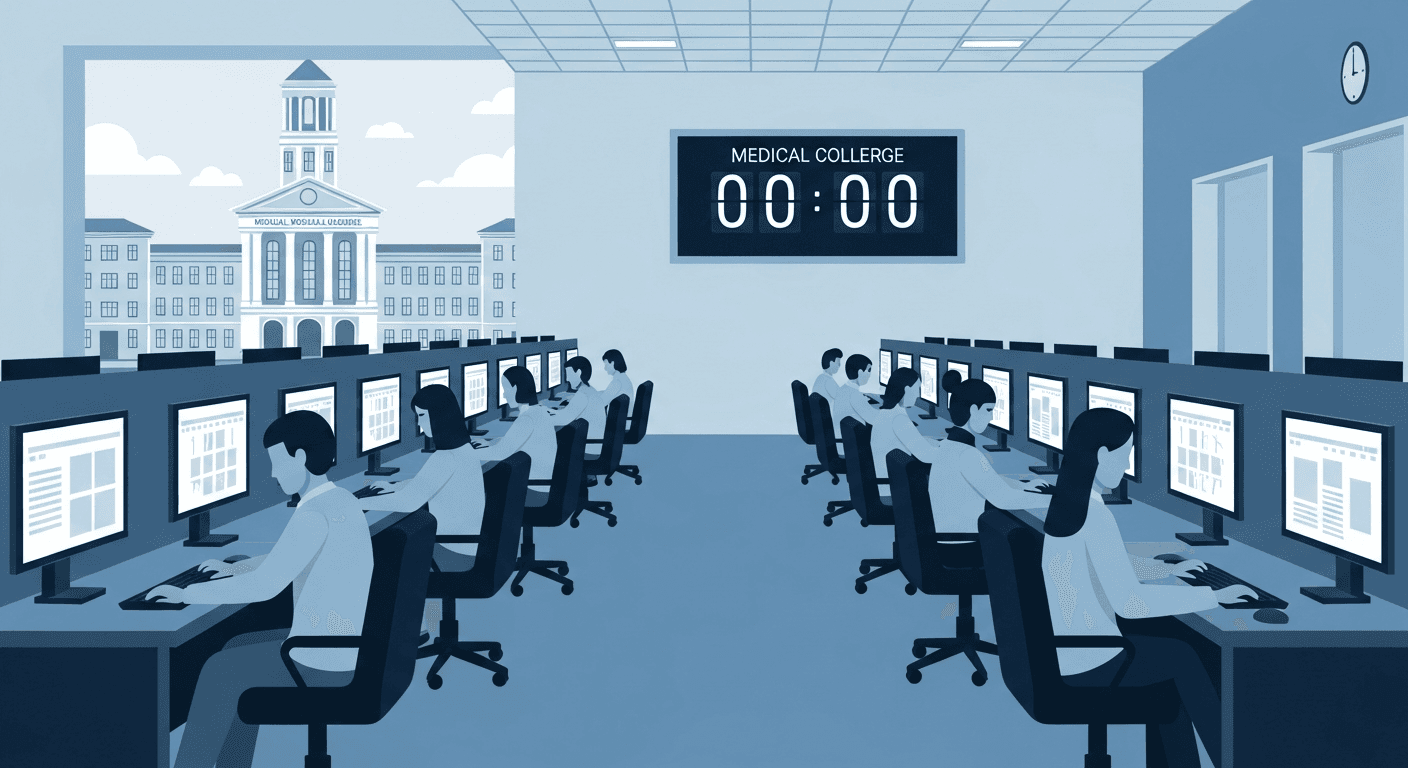
The Shift Is Confirmed
On May 15, 2026, Union Education Minister Dharmendra Pradhan confirmed that the National Eligibility cum Entrance Test (Undergraduate) will move to Computer-Based Test (CBT) mode from 2027. The decision ends nearly two decades of the pen-and-paper OMR format for India's most consequential medical entrance examination.
The 2026 NEET UG, held on May 3, was cancelled after investigations revealed overlaps between a pre-circulated guess paper and the actual question paper. The re-examination was conducted on June 21, 2026, under unprecedented security: Aadhaar-based biometric and face authentication, GPS-tracked paper consignments, signal jammers, AI-assisted CCTV, and approximately seven lakh personnel mobilised across 5,440 centres. The clean execution of the retest — with no leak complaints and 22 lakh candidates processed — validated that the security architecture can scale, but it also illustrated the inherent fragility of physical paper logistics at this volume.
NEET 2027 CBT removes the paper entirely. The implications are significant — and institutions have roughly twelve months to prepare.
The Scale of What Is Changing
NEET is not a small examination. The 2026 cycle saw approximately 2.27 crore (22.7 million) aspirants registered. By comparison, JEE Main — already a CBT — typically serves around 12–14 lakh aspirants. NEET's shift will create the largest computer-based examination event in the world.
To manage this volume without the logistical nightmare of a single exam day, NTA plans to conduct NEET 2027 across multiple sessions over approximately ten days — mirroring the JEE Main model. This spreads candidates across sessions, reduces the simultaneous infrastructure load on any single centre, and neutralises the "single paper on a single day" vulnerability that has repeatedly enabled large-scale leaks.
The evaluation pipeline changes dramatically too. OMR sheets currently require machine scanning, provisional answer key release, an objection window, and final key preparation — a process that takes four to six weeks. CBT results can be processed and released within days of the final session closing.
What Exam Centers Must Prepare
NTA's authorised exam centre network will need substantial upgrades before NEET 2027. Medical colleges, engineering colleges, and other institutions currently serving as NEET venues should begin assessments now.
Computer and Terminal Infrastructure
A centre must have enough terminals to process its allocated candidate load within a session. Current JEE Main standards require each terminal to meet minimum specifications: processor speed, RAM, storage, operating system version, and screen resolution. Many centres that have handled NEET on paper — using classrooms as seating blocks — will need to evaluate whether their computer labs have the capacity, or whether new terminals must be procured.
For a centre allocated 500 candidates per session, 500 functional terminals are required. For centres currently handling 1,000–1,500 candidates across a single OMR exam day, the infrastructure gap may be significant.
Network and Bandwidth
CBT requires either local server (LAN-based) or internet-connected delivery. NTA uses a hybrid model for JEE Main: question papers are downloaded to a local server before the session begins, reducing real-time internet dependency and eliminating the vulnerability of a live stream being intercepted. Centres must have:
Biometric and Authentication Systems
The June 21 NEET retest demonstrated the reliability of Aadhaar-based biometric and face authentication at scale. NEET 2027 will extend this to CBT mode, meaning centres need fingerprint scanners and camera systems at entry points that are integrated with the NTA candidate database. This is an upgrade for any centre that has handled NEET only in OMR mode.
Security Camera Coverage
CCTV coverage of all examination halls, server rooms, and entry points is mandatory. NTA requires feeds that can be monitored centrally. Centres should audit their current camera placement and resolution, particularly if they have added or reconfigured spaces since their last NTA inspection.
What Medical Colleges Must Plan
Medical colleges that serve as exam venues carry specific responsibilities and face specific risks.
Venue Audit and Registration Renewal
NTA updates its venue approval criteria regularly. Medical colleges should not assume that prior NEET venue approval for pen-paper mode carries forward automatically to CBT mode. An NTA inspection under CBT criteria will assess computer infrastructure, not just room capacity.
Begin the venue re-registration process early. NTA typically opens its centre application window six to nine months before the examination. Centres that miss the window or fail inspection cannot participate.
Operational Continuity
A CBT NEET running across multiple sessions over ten days creates a significantly longer operational window than the traditional single exam day. Medical colleges that host NEET must plan for:
Staff Training
Centre staff who have managed OMR-based NEET will need to be retrained for CBT operations: assisting candidates with login issues, managing session extensions for eligible candidates, handling technical failures per NTA protocols, and documenting incidents for audit purposes.
The Evaluation Shift Is Already Happening
NEET's move to CBT does not just change how candidates take the exam. It changes how results are produced. The OMR-to-results pipeline — scanning, key objections, final key, result declaration — compresses dramatically in CBT. When the last session of NEET 2027 closes, answer recording is already complete. There are no physical sheets to transport, no scans to process, no handwriting to read.
For medical colleges that sit on NMC Medical Advisory Committees or participate in counselling processes, this matters. The timeline from exam completion to rank declaration shortens by weeks. Admission cycles that have historically buffered around NEET's result timeline will need to adapt.
It also raises a structural question for university-affiliated medical colleges that conduct their own internal assessments: if NEET results arrive faster, do your own evaluation systems need to keep pace?
A Month-by-Month Readiness Checklist
| Month | Action |
|---|---|
| July 2026 | Audit existing computer lab capacity and terminal specifications |
| August 2026 | Submit infrastructure gap report and procurement plan to management |
| September 2026 | Upgrade network and UPS infrastructure; procure new terminals if needed |
| October 2026 | Install and test biometric authentication systems |
| November 2026 | Register or re-register with NTA as a CBT exam centre |
| December 2026 | Conduct a full mock session drill using NTA's test delivery software |
| January 2027 | Complete NTA inspection and receive final centre approval |
| February 2027 | Staff CBT readiness training and emergency protocol rehearsal |
| March–April 2027 | Final technical readiness checks before NEET 2027 window opens |
Institutions that begin this process now — rather than in October or November — will have time to absorb delays, address infrastructure gaps, and avoid the last-minute procurement pressure that has historically created compliance shortcuts.
Related Reading
Ready to digitize your evaluation process?
See how MAPLES OSM can transform exam evaluation at your institution.