NEET 2026's Human Firewall: Inside the Paper Setter Lockdown Before June 21
NTA has confined paper setters, moderators, and translators at an undisclosed location without phones or internet until the June 21 re-exam. The protocol reveals how much human effort physical exam security requires — and why it still cannot guarantee a leak-proof paper.
The Lockdown Nobody Was Expecting
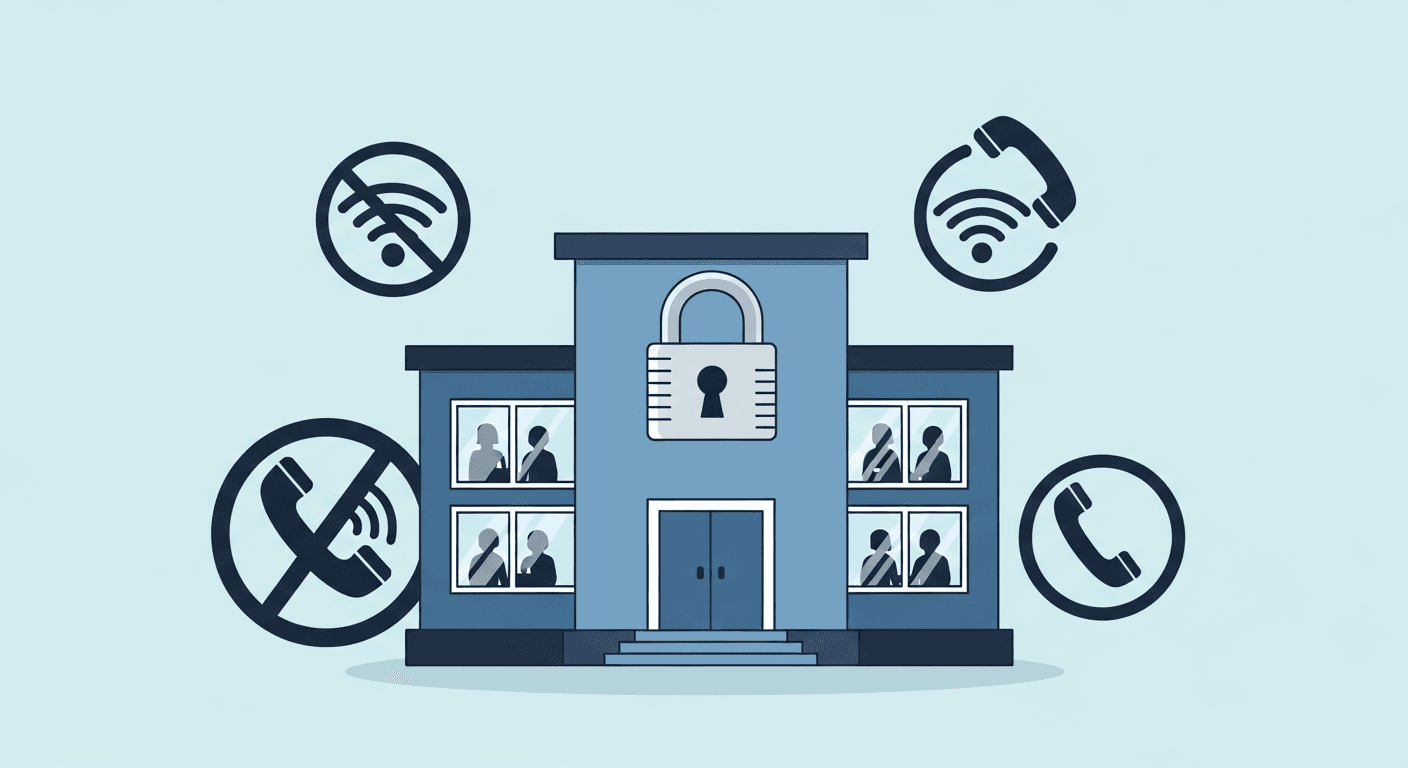
Weeks before the NEET-UG 2026 re-exam on June 21, the National Testing Agency did something unprecedented: it placed all personnel involved in preparing the question paper — setters, moderators, translators, technical reviewers — under strict confinement at a secure, undisclosed location.
No mobile phones. No laptops. No internet access. No smartwatches or wearable devices. Entry and exit monitored. Only authorised personnel permitted contact with the outside. The isolation is total and indefinite, continuing until the re-exam concludes.
The decision followed the cancellation of the original NEET-UG 2026 examination on 3 May after allegations that a "guess paper" circulating on messaging platforms contained questions closely matching the actual paper. NTA has stated that social media claims of a June 21 paper already being leaked are "false, fraudulent, and intended to mislead." The lockdown is the agency's structural answer to that accusation.
The protocol is also a mirror. What it reflects — for examination administrators, policymakers, and technology planners — is how much human effort, at what cost, physical exam security now requires.
Who Is Inside the Lockdown
The NEET question paper passes through at least five distinct categories of personnel before it reaches an examination hall:
Under the current protocol, the first three categories — setters, moderators, and translators — are under lockdown. Each group is compartmentalised: no single person or team has access to the complete paper in all its versions. The rationale is containment of partial information. Even if one member of the chain attempted disclosure, the fragment they possess would be insufficient to reconstruct the full examination.
For the June 21 re-exam, NTA has also reportedly explored Indian Air Force aircraft for the secure transportation of question paper packets to examination centres across 551 Indian cities and 14 international locations. This is a logistics chain operating at the scale of a military supply operation.
What the Chain Still Cannot Prevent
The compartmentalised human lockdown is effective against one specific threat vector: an insider — a paper setter, moderator, or translator — deliberately leaking questions for money. Against that threat, the protocol is arguably the best available response within a paper-based examination architecture.
It is not effective against several other threat vectors.
The printing window is the highest-risk point in paper-based examination security. Once the paper exits digital preparation and enters physical printing, compartmentalisation ends. Personnel at the printing press see the full paper. Multiple copies pass through QC supervisors and packing staff before sealed packets leave the facility.
The logistics chain introduces additional exposure. Sealed packets travel from printing facilities to thousands of examination centres across India. At each transit point — warehouse, vehicle, district collection centre — physical handling occurs. Centre supervisors receive packets hours before the examination. Local administrative staff are present.
The 22-lakh-candidate scale amplifies every weak link. With over 22 lakh candidates sitting across thousands of centres, the probability that a sealed packet is opened early — deliberately or by administrative error — is a function of the number of centres, not of the lockdown at the source.
The NEET 2025 paper leak originated in Patna, where packets were reportedly opened and photographed before the examination started at a local centre. The lockdown protocol addresses the origin of the paper; it does not address the terminus.
The Security Inversion Problem
There is a structural asymmetry in paper-based examination security that no protocol design can eliminate. The more candidates take an exam, the larger the physical chain required to deliver the paper. A larger chain means more personnel, more transit points, and more opportunities for failure. Security costs scale linearly — or faster — with candidate volume.
For NEET-UG, this scaling problem is severe. The examination serves 22 lakh candidates annually, distributed across every state, tier-2 and tier-3 cities, and international centres. Each of those locations requires a physically delivered, sealed packet. The human chain that delivers those packets involves tens of thousands of individuals.
Computer-based testing inverts this relationship. In a CBT architecture, there is no physical paper to transport. The question bank is stored encrypted on a central server. Each candidate at their terminal receives a dynamically drawn subset of questions, decrypted only at the moment of the examination, unique to their session. A leak from one terminal does not compromise any other candidate's paper. As candidate numbers increase, the value of any individual leak decreases — the attack surface shrinks as scale grows.
The Supreme Court declined to permit a CBT format for the June 21 NEET re-exam, citing concerns about infrastructure readiness and equitable access across socioeconomic groups. The government has confirmed that NEET will transition to computer-based testing from 2027. Until then, the lockdown protocol and its associated logistics represent the best available answer to a problem that CBT would render structurally irrelevant.
The True Cost of Physical Exam Security at Scale
The direct costs of the current protocol are significant: IIT and expert faculty confined for weeks, Indian Air Force logistics support deployed for civilian examination materials, biometric verification systems installed at thousands of centres, electronic jammers blocking signals in examination rooms.
These costs are not captured in any standard examination fee or budget line. They are absorbed as administrative overhead and government expenditure. The indirect costs — continued student preparation under sustained anxiety, disruption to medical college admission timelines, the psychological toll documented in mental health research — are harder to quantify but no less real.
For the 22 lakh candidates who sat the cancelled May 3 examination and must now sit again on June 21, the lockdown protocol offers little visible reassurance. The paper's origin is secured. The paper's journey to their desk is still a human chain.
What Digital Evaluation Removes from the Chain
In the context of post-exam answer-sheet evaluation — the domain of onscreen marking rather than CBT — digital evaluation removes a comparable set of vulnerabilities. Physical answer books moving between examination centres, evaluation camps, and moderation venues create a handling chain with many of the same properties as the paper-distribution problem: physical custody, human handling, potential for loss or tampering.
Digital evaluation replaces that physical chain with an encrypted, logged transfer. Answer-book images reside on a secured server. Evaluators access them remotely. The chain from examination hall to final mark is fully auditable, with every access timestamped and attributable. No packet can be opened early. No book can be lost in transit. No unmarked page can go unnoticed without the system flagging it.
The NEET re-exam on June 21 will still use pen-and-paper OMR sheets. The lockdown protocol for paper preparation is, under those constraints, the right response. It is also a vivid illustration of the ceiling that physical examination security has reached.
Related Reading
Ready to digitize your evaluation process?
See how MAPLES OSM can transform exam evaluation at your institution.