India's Multi-Script Examination Challenge: What Digital Platforms Must Handle
With NEP mandating three languages and UGC allowing regional language answers, digital evaluation platforms must support Devanagari, Tamil, Telugu, and 12 more scripts — here is what that requires.
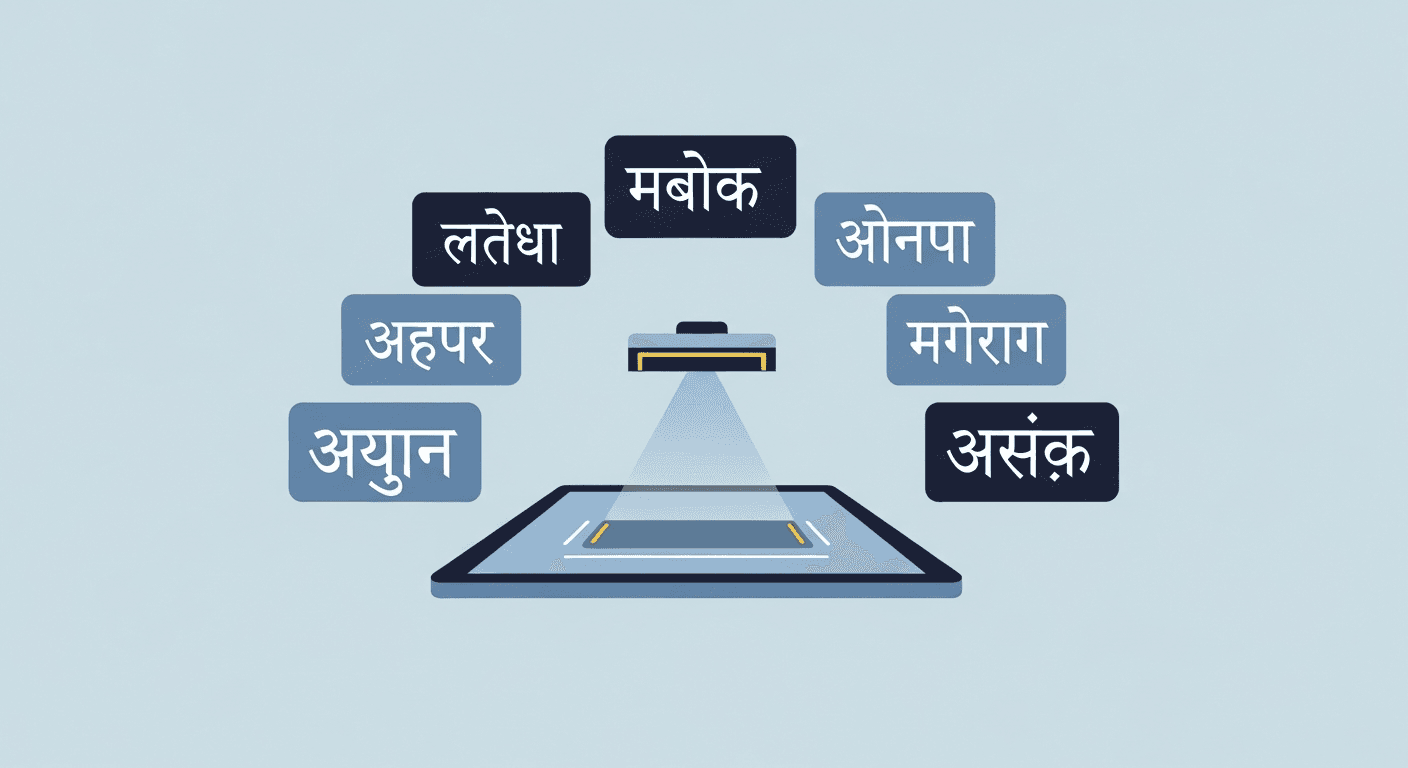
The Scale of India's Language Diversity in Examinations
India's higher education system operates across at least 15 languages that carry significant examination volume. While English and Hindi dominate at the central level, state boards and affiliating universities routinely conduct examinations in Marathi, Tamil, Telugu, Kannada, Malayalam, Bengali, Odia, Gujarati, Assamese, Urdu, and Punjabi — each using a distinct script.
Until recently, this linguistic diversity was largely invisible to digital evaluation systems, either because examinations were conducted only in English (as at most IITs and NITs) or because answer sheets were evaluated manually by language-matched evaluators without any digital intermediary.
Two recent policy shifts are making linguistic diversity an active engineering requirement for digital evaluation platforms.
Two Policy Shifts Driving Change
The NEP Three-Language Framework
The National Education Policy 2020 mandates instruction in the mother tongue or regional language through at least Class 5, with a phased approach through secondary school. The Central Board of Secondary Education operationalized this in April 2026 with a circular requiring schools to implement a three-language structure — R1 (primary), R2 (secondary), R3 (third language) — for Class VI students from the 2026-27 session onward. The board made at least two of these three languages Indian languages.
The policy means students may reach graduation having studied — and written internal assessments or semester papers in — combinations of languages that differ substantially from peer to peer. A student who studied Kannada, Hindi, and English brings different language competencies than one who studied Tamil, English, and Sanskrit.
As the NEP implementation timeline pushes into undergraduate programs, universities will face increasing diversity in the languages in which students answer questions.
UGC's Mother-Tongue Examination Allowance
The University Grants Commission has separately notified universities that students may write examination answers in their mother tongue even when the course is offered in English medium. This is not a marginal policy: in large affiliating universities drawing students from linguistically diverse districts and states, a material share of students may choose to answer in a language other than the question language.
For universities using on-screen marking, this creates a routing problem. An evaluator competent in English must be matched to answers written in English. A student who answered in Telugu must be routed to a Telugu-competent evaluator. The system must manage this assignment without breaking evaluator anonymity — and without creating a de-anonymization risk. If only one evaluator in the pool reads Telugu, routing Telugu answer scripts to that evaluator effectively reveals information about the student's linguistic profile.
What Digital Platforms Must Handle
1. Multi-Script Rendering
The most fundamental requirement is that scanned answer sheets in any Indian script display correctly to evaluators. This sounds straightforward but has specific technical implications:
Platforms built primarily for English-language evaluation often fail on the third point, displaying boxes or question marks where regional language characters appear in concatenated report strings. This is not a cosmetic problem: a marksheet with corrupted script characters is not a usable credential.
2. Scanning and Image Quality for Dense Scripts
Tamil, Devanagari, Bengali, and Malayalam have closer inter-character spacing than Latin script, and many include vowel diacritics positioned above or below the base character. Optical distortions from poor-quality flatbed scanning — barrel distortion at page edges, uneven illumination, page curl — are more disruptive to readability in these scripts than in Latin text.
Evaluation platforms that specify minimum DPI requirements and scanner calibration standards should validate those standards against the specific scripts used in their institution's examinations. A 200 DPI scan adequate for English text may produce illegible output for student handwriting in a complex script at comparable pen pressure.
Scanning station operators benefit from explicit guidelines that account for script type — recommended DPI, platen cleaning frequency, page alignment protocols — rather than applying a single generic standard across all answer book types.
3. Evaluator Language Matching and Anonymity Preservation
A digital evaluation platform serving a multilingual examination must support:
This is a data architecture question as much as a UI question. The platform's assignment logic must ensure that language-based routing does not become a channel through which evaluator or student identity can be inferred from pattern analysis.
4. Marking Scheme Localization
When an examination is conducted in multiple language versions, the marking scheme must be available to evaluators in a form that corresponds to the language of the answer being assessed. An evaluator assigned to a Telugu answer script should see the Telugu marking scheme, not an English version requiring mental translation.
This means platform administrators must be able to upload and link multiple marking scheme versions at the point of examination setup, with the correct version surfaced to each evaluator automatically based on the script routing.
5. AI-Assisted Language Detection
For institutions where language tagging is not performed at the scanning stage — or where students mix languages within a single answer — AI-based language detection can classify answer scripts post-scan. Technologies from India's Bhashini initiative, a government-funded digital public infrastructure for natural language processing, include language identification models covering all 22 scheduled languages.
Integration of these tools into evaluation platforms is early-stage, but their utility for large affiliating universities managing answer scripts across multiple language groups is significant. A library of several thousand answer books can be automatically sorted by language in minutes rather than requiring manual classification.
The Accreditation Case for Getting This Right
NAAC's evaluation framework directly rewards institutions that translate NEP's language policy into operational practice. The following criteria are specifically impacted by multilingual evaluation infrastructure:
NAAC Criterion 1.3 (Curriculum Enrichment): The NEP implementation narrative expected in NAAC submissions includes evidence that the institution supports mother-tongue instruction and assessment. An examination system incapable of handling regional language answer scripts contradicts this narrative.
NAAC Criterion 5.1 (Student Support and Progression): Accessible assessment in a student's preferred language is a measurable student support mechanism, especially for students from rural or non-English-medium backgrounds.
NAAC Criterion 7.1 (Institutional Values and Best Practices): Inclusive assessment practices — eliminating language-of-instruction bias in evaluation — are cited in NAAC's descriptor as examples of value-based education in action.
Institutions in Maharashtra, Tamil Nadu, Karnataka, Kerala, West Bengal, and Andhra Pradesh — where large proportions of students may prefer to answer in regional languages — have the strongest near-term incentive to ensure their digital evaluation platforms are multilingual-compliant.
A Checklist for Exam Controllers at Multilingual Institutions
Before deploying or renewing a digital evaluation platform, exam controllers should verify the following capabilities:
| Requirement | Question to ask the vendor |
|---|---|
| Multi-script rendering | Does the evaluator interface render Tamil, Telugu, Devanagari, and Malayalam correctly in all views, including report exports? |
| Scan quality standards | What is the minimum DPI specification, and has it been validated for handwritten regional scripts? |
| Language tagging | Can answer scripts be tagged by language at intake, and does this tag flow through to evaluator routing? |
| Evaluator language profiles | Does the system record evaluator language competency and use it for script assignment? |
| Marking scheme localization | Can multiple language versions of a marking scheme be uploaded and linked to corresponding answer scripts? |
| AI language detection | Does the platform support or integrate with tools for automated language identification of untagged scripts? |
| Report rendering | Do consolidated marksheets and audit reports render regional script characters without substitution or corruption? |
These are not aspirational requirements. They are operational prerequisites for any institution conducting examinations in more than one language — and a growing proportion of Indian universities fall into that category.
What Institutions Can Do Now
The shift toward multilingual examination is happening incrementally. Universities do not need to solve the entire problem at once. A practical starting point is to inventory the languages in which students currently submit answer scripts and establish what share is already being handled outside the digital evaluation workflow.
Even if the volume is small today, the policy trend is clear. NEP's three-language framework, UGC's mother-tongue allowance, and the growth of regional-language undergraduate programs under the FYUGP structure will steadily increase multilingual examination volume over the next four to six years.
Platforms chosen today should be evaluated not just for current institutional requirements but for this foreseeable direction.
Related Reading
Ready to digitize your evaluation process?
See how MAPLES OSM can transform exam evaluation at your institution.