Maharashtra Board's AI Evaluation Pilot: What It Means for Supplementary Exams
MSBSHSE is piloting AI-assisted digital evaluation and encrypted question paper delivery for June-July 2026 supplementary exams — the largest state board experiment of its kind.
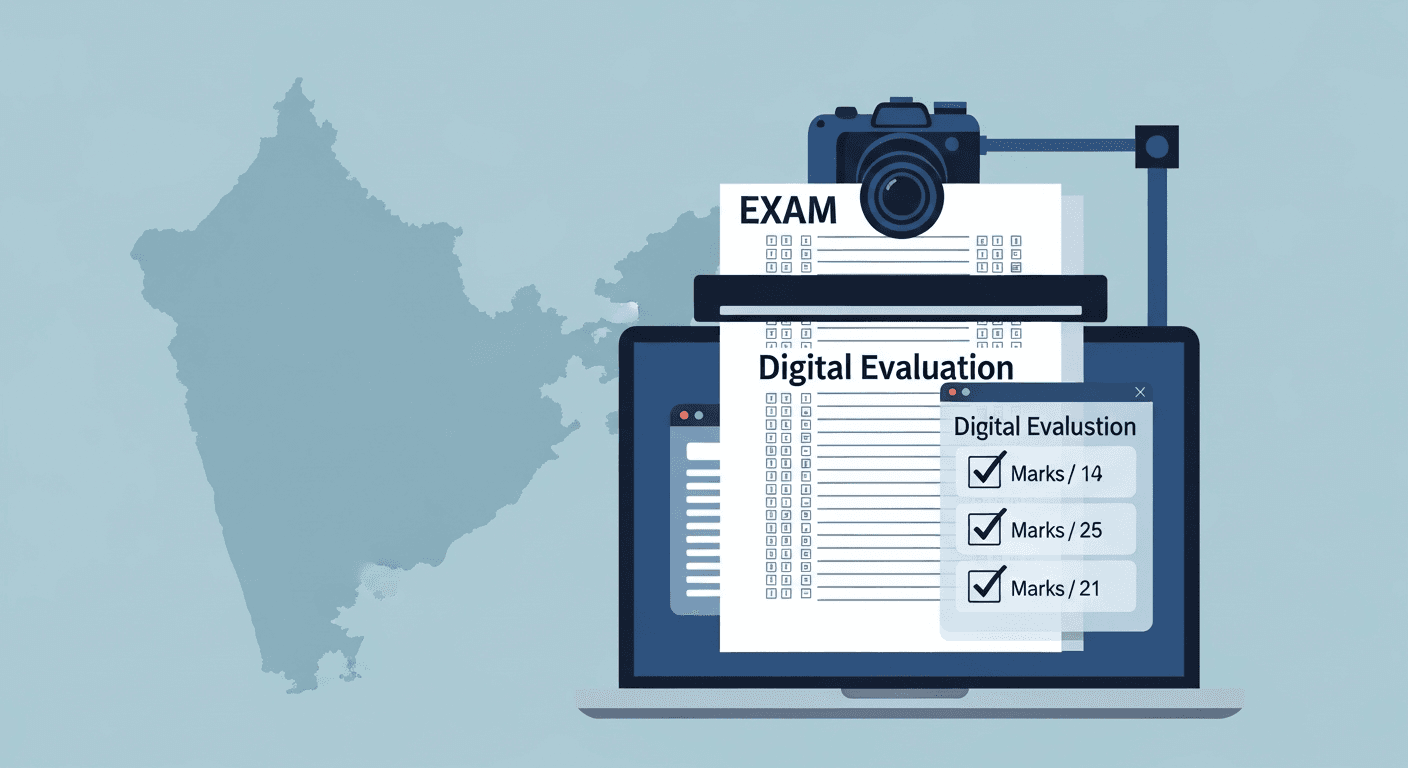
Maharashtra Board's Bold Step: AI Evaluation Enters Supplementary Exams
The Maharashtra State Board of Secondary and Higher Secondary Education (MSBSHSE) has announced a pilot combining digital question paper transmission with AI-assisted on-screen evaluation for its June-July 2026 supplementary examinations. With hundreds of thousands of students appearing for HSC and SSC supplementary exams annually across Maharashtra, this is among the most consequential state-level digital evaluation experiments India has seen outside of CBSE.
MSBSHSE Chairman Trigun Kulkarni confirmed the initiative, stating the board is building "a more secure, efficient and technology-driven examination system" in direct response to recurring paper leak risks and the administrative weight of the traditional physical evaluation chain.
What the Pilot Actually Involves
The Maharashtra pilot operates on two fronts simultaneously.
Encrypted Digital Question Paper Delivery
Examination centres will receive encrypted digital copies of question papers rather than sealed physical packets. The files can be downloaded and printed immediately before the exam begins, using time-locked password-protected access. This eliminates the entire physical transportation window during which paper leaks most commonly occur.
The timing is pointed. Maharashtra faced three separate HSC paper leak incidents linked to WhatsApp groups during the February-March 2026 board exams. Each incident followed the same pattern: a paper in transit, a photograph, a group message. Encrypted digital delivery severs that chain entirely.
On-Screen Evaluation with AI-Assisted Quality Checks
After the examination, answer booklets will be scanned and uploaded to a centralised, controlled platform. Evaluators access digitised answer sheets on screen rather than handling physical booklets. AI-assisted tools add a quality control layer: monitoring evaluator consistency, flagging answers that receive marks at statistical extremes of a rubric, and automatically summing and validating question-wise marks.
The primary evaluators remain human teachers. AI functions as a quality filter, not a replacement for examiner judgment.
Infrastructure requirements specify stable internet connectivity and backup power generators at all participating exam centres — a signal that the board is planning around real-world conditions rather than ideal ones.
Why This Matters Beyond Maharashtra
Maharashtra runs one of the largest board examination systems in the world. The board conducts the HSC (Class 12) and SSC (Class 10) examinations for over 30 lakh students each year, with a supplementary cycle that adds several lakh more.
When Maharashtra moves at this scale, the operational decisions it makes become reference points for other state boards. Rajasthan, Uttar Pradesh, Bihar, and Madhya Pradesh have all been under pressure to digitise their evaluation chains. A successful Maharashtra supplementary pilot provides the most directly relevant evidence base these boards could ask for: same paper-and-booklet format, same language diversity, similar infrastructure constraints.
The pilot's timing is also deliberate. It follows CBSE's first full-scale OSM cycle for Class 12 in 2026 — a rollout that demonstrated the technical feasibility of scanning and evaluating answer sheets digitally across lakhs of candidates. Maharashtra is building on that proof of concept at state level.
The Infrastructure Story: GPS Locks to AI Evaluation
The MSBSHSE did not arrive at this pilot suddenly. During the February-March 2026 board exams, the board piloted GPS-enabled digital locks on question paper boxes in Baramati taluka, tracking paper movement in real time from printing presses to examination centres. That was the surveillance layer.
The AI evaluation pilot is the evaluation quality layer. Maharashtra is treating paper security and evaluation integrity as a single problem requiring a connected set of digital solutions, not isolated fixes.
What AI-Assisted Evaluation Specifically Does at This Stage
It is worth being precise about the role of AI in a supplementary exam pilot. The capabilities being deployed are:
None of these functions require AI to read or understand handwriting. They are statistical and rule-based quality checks that layer on top of human evaluation. The result is a measurable reduction in clerical errors — misadded totals, skipped questions — without requiring AI to take on interpretive assessment responsibilities.
Implications for Colleges Affiliated to Maharashtra Boards and Universities
Faster supplementary results: Digital evaluation pipelines consistently cut result declaration timelines. For supplementary exams specifically, faster results directly affect students' ability to apply for college admissions, secure hostel seats, and plan academic year progression. Even a 7-10 day improvement has downstream institutional value.
Revaluation transparency: OSM systems generate a digital record of each evaluated answer sheet. Maharashtra's pilot is likely to include a student-facing verification layer — allowing students to view their scanned sheets — following the model CBSE has now deployed. This reduces both frivolous revaluation requests and legitimate grievances about undisclosed errors.
NAAC and NIRF evidence: For affiliated colleges preparing NAAC submissions, digitally evaluated examinations generate structured, auditable data on evaluation timelines, consistency, and student performance patterns. This feeds directly into Criterion 2 (Teaching-Learning and Evaluation) and Criterion 6 (Governance) evidence portfolios.
What to Watch For in the Coming Months
The pilot is framed as a feasibility study. MSBSHSE will track:
| Metric | What It Reveals |
|---|---|
| Encrypted paper delivery success rate | Infrastructure readiness of exam centres |
| Evaluator adoption and throughput | Training adequacy and usability |
| System downtime incidents | Platform robustness at scale |
| Student satisfaction with digital verification | Acceptance of the new revaluation model |
If the supplementary pilot succeeds on these dimensions, the path to a full-scale February-March 2027 rollout for main board exams becomes significantly shorter.
A National Pattern Accelerating
Maharashtra's pilot is the latest move in a pattern that is now visible across India. CBSE completed its first full-scale OSM cycle for Class 12 this year. Telangana and Karnataka have scaled digital evaluation for state board and PUC exams. BSEB Bihar reported its fastest result declaration in 2026, citing digitised evaluation workflows. West Bengal's semester system structurally requires digital evaluation to manage volumes.
Each state board that transitions adds weight to the evidence base. The question for state boards that have not yet moved is no longer whether digital evaluation is feasible at India's scale — it demonstrably is. The question is how long they can absorb the cost of not moving.
---
Related Reading
Ready to digitize your evaluation process?
See how MAPLES OSM can transform exam evaluation at your institution.