CBSE's First Full-Scale Digital Evaluation Is Wrapping Up. What Worked, and What Did Not.
With Class 12 marks upload beginning April 8 and results expected in May 2026, CBSE's historic on-screen marking rollout is nearing its conclusion — and India's university boards are watching closely.
India's Biggest Evaluation Experiment Enters Its Final Stage
In October 2025, CBSE announced that the 2026 Class 12 board examinations would be evaluated entirely through On-Screen Marking — the first time in the board's history that all answer scripts for a high-stakes national examination would be scanned and graded digitally, without physical scripts being dispatched to evaluators' homes. Approximately 18.5 lakh students sat for those examinations between February and March 2026.
By April 8, 2026, marks upload for the West Asia region had begun. Results for the full national cohort are expected between May 5 and May 15. India's largest-ever digital evaluation exercise is, for all practical purposes, complete. The question now is: what did it actually achieve — and what did it leave unresolved?
What CBSE Built
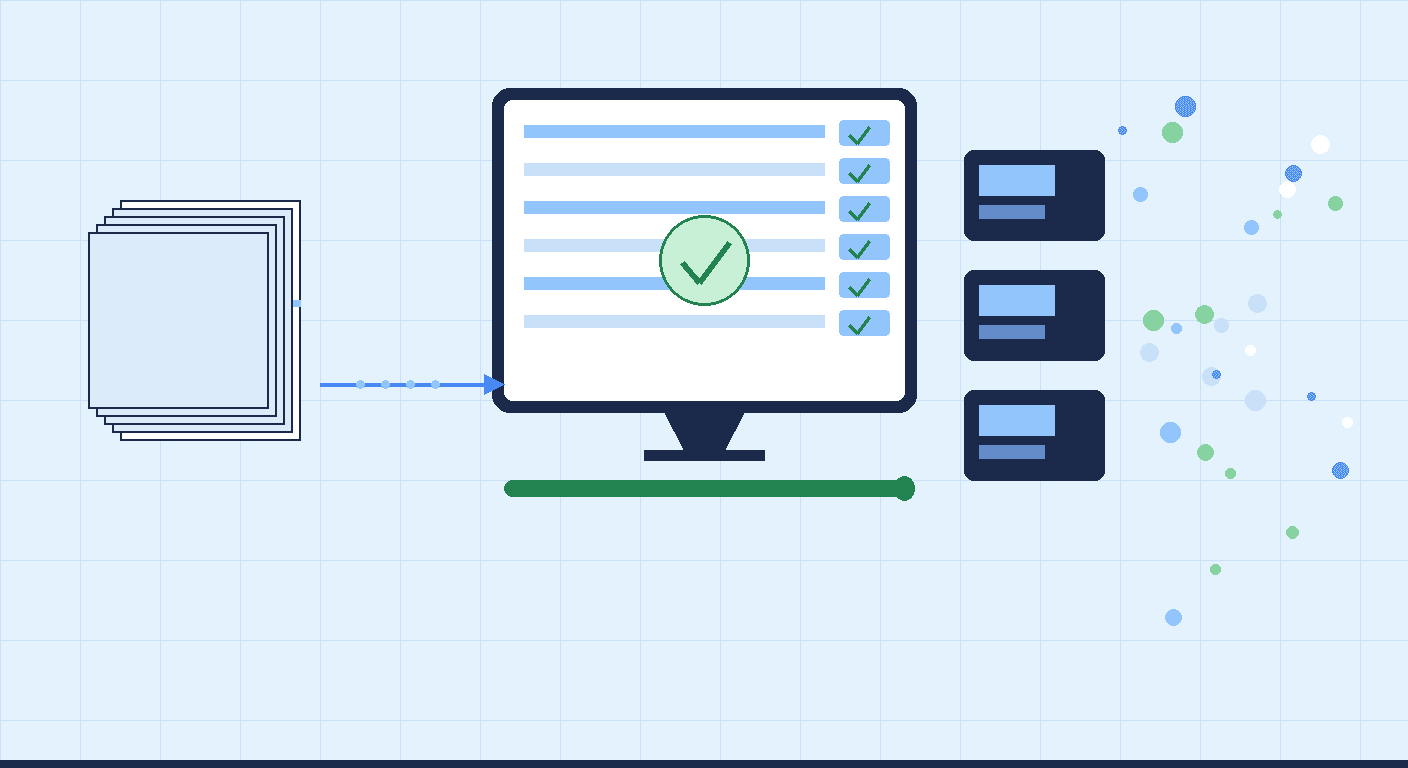
The 2026 OSM architecture involved several interdependent components deployed at national scale:
Central scanning infrastructure: Answer scripts were scanned at regional scanning centres rather than being dispatched to individual examiners' homes. High-resolution scans were uploaded to CBSE's dedicated evaluation portal.
Examiner-facing interface: Evaluators logged into the portal using individually credentialled accounts. Marking occurred on-screen, with examiners entering marks directly through the interface — no physical script, no manual mark sheet.
Automated safeguards: The system flagged unattempted questions to ensure no response was overlooked. Totalling was automated, removing the arithmetic errors that historically accounted for a significant share of post-result mark correction requests.
Centralised audit trail: All evaluation data — which examiner marked which response, marks awarded, timestamps of each entry — was stored centrally. Every evaluation event became part of a persistent, queryable record.
CBSE also established a dedicated digital evaluation and AI support centre in Dwarka, Delhi, where pilot evaluations were conducted before national rollout. Teacher training for on-screen evaluation ran through the second half of 2025.
The Rocky Start: Mock Evaluation Failures
Not everything ran smoothly. During CBSE's compulsory mass mock evaluation exercise — a rehearsal for examiners conducted in late 2025 — schools across multiple regions reported that teachers were unable to generate login credentials for the evaluation portal. Those who successfully logged in encountered rendering difficulties for answer sheets containing detailed diagrams or complex mathematical notation.
The Tribune reported that CBSE's mock evaluation was "marred by technical glitches," with login failures as the primary complaint. These were not trivial problems: an examiner who cannot log in during a controlled rehearsal is unlikely to be productive under the time pressure of the actual evaluation cycle. Exam boards that have observed India's own CBSE pilot draw one consistent lesson from rollouts of this scale — evaluator readiness is underestimated almost universally relative to platform readiness.
CBSE responded by extending the mock evaluation window and issuing revised credential guidance. By the time actual evaluation began in April, the immediate access issues appeared to have been resolved. Marks upload is proceeding. But the mock evaluation experience is a candid illustration of what every large-scale digital evaluation deployment will face: the technology may be ready before the people using it are.
What CBSE Removed: The End of Marks Verification
The more consequential shift may be what CBSE eliminated rather than what it added. Beginning with the 2026 cycle, the board removed the post-result marks verification process for Class 12. Students can no longer apply for recounting or re-totalling of their answer scripts.
For context: in previous years, a substantial proportion of mark correction requests arose from purely clerical errors — incorrect totalling, marks entered in the wrong column, pages missed by evaluators working through large physical bundles of scripts. The OSM system's automated totalling and mandatory page-completion checks make such errors structurally impossible. CBSE's stated position is that these digital safeguards render post-result verification redundant.
This is a meaningful claim if accurate. If totalling is automated and the system prevents submission unless every scanned page has been marked, the most common category of mark correction appeal — arithmetic error — disappears by design. The question of whether other categories of appeals (substantive disagreements about marks awarded for a particular answer) also diminish is a separate issue that the 2026 results cycle will only begin to illuminate.
What it does mean, practically, is that students who receive marks they believe are incorrect now have fewer formal mechanisms to challenge those marks. This trade-off — reduced friction in exchange for reduced recourse — is a policy judgment that other examination boards will need to make explicitly if they adopt similar architectures.
The 74 Percent That Was Not CBSE
While CBSE has moved decisively, its 18.5 lakh Class 12 students represent a fraction of India's total examination load. India has approximately 50 state and central examination boards. The majority of India's board examination students — roughly 2.5 crore annually across Class 10 and Class 12 combined — sit examinations administered by boards that have not yet implemented on-screen marking at scale.
The pattern of adoption matters. Tamil Nadu's SSLC evaluation, Karnataka's 2nd PUC cycle, UP Board, Rajasthan Board, and Maharashtra's HSC system collectively evaluate many times more answer scripts than CBSE. These boards are watching the 2026 CBSE cycle, but watching is not the same as committing. The infrastructure requirements — regional scanning centres, portal licensing, evaluator training programmes, network connectivity at evaluation hubs — represent investment commitments that smaller and lower-resourced state boards have not yet made.
CBSE's 2026 completion provides the reference case those boards lack. A system that evaluated 18.5 lakh Class 12 answer sheets without a systemic failure — technical glitches during the mock notwithstanding — is a more persuasive argument for digital evaluation adoption than any cost-benefit analysis prepared in advance.
What India's 800+ University Systems Are Watching
Beyond school boards, CBSE's rollout is being observed by university examination controllers and academic affairs administrators across India's higher education sector. Universities collectively evaluate hundreds of crore of answer scripts annually — the majority through physical evaluation that has changed little in 40 years.
The applicability of the CBSE model to university contexts is direct in several respects:
Centralised scanning over home evaluation: Universities that send physical scripts to individual examiners' homes face the same chain-of-custody risks as paper-based boards. CBSE's centralised scanning model addresses these risks without requiring structural redesign of the evaluation workforce.
Automated totalling as baseline: CBSE's automated totalling should be understood as the floor, not the ceiling, of what digital evaluation delivers. Manual totalling errors in university examinations are documented; removing them reduces the volume of re-totalling applications universities process every semester.
Evaluator-level attribution: CBSE's credentialled portal creates a complete record of which evaluator marked which response. Universities adopting equivalent architectures can provide this documentation to NAAC assessors, RTI applicants, or legal proceedings without manual record reconstruction.
The Verdict, When It Arrives
The CBSE Class 12 results expected in mid-May 2026 will be the first real data point for this system. Year-on-year comparisons of grade distributions — subject-wise, region-wise, school-wise — will indicate whether the shift to on-screen marking changed marking behaviour in measurable ways.
If the distributions are broadly stable, the case for digital evaluation will rest primarily on process improvements: fewer errors, faster results, cleaner audit trails. If distributions shift significantly — higher marks overall, lower marks, or changed variance — the more interesting analytical question becomes whether OSM changed how examiners mark, and whether that change is desirable.
India's examination boards and university systems should note the date. The experiment is wrapping up. The data will be available shortly. There will not be a better moment to evaluate the evaluation system.
---
Related Reading
Ready to digitize your evaluation process?
See how MAPLES OSM can transform exam evaluation at your institution.