India's Fake Degree Crisis: Why Tamper-Proof Evaluation Records Are Now Urgent
With over one million fake academic credentials exposed in a single 2025 operation and courts still unwinding forged university marksheets, India's examination system has a fraud problem that only tamper-proof digital records can solve.
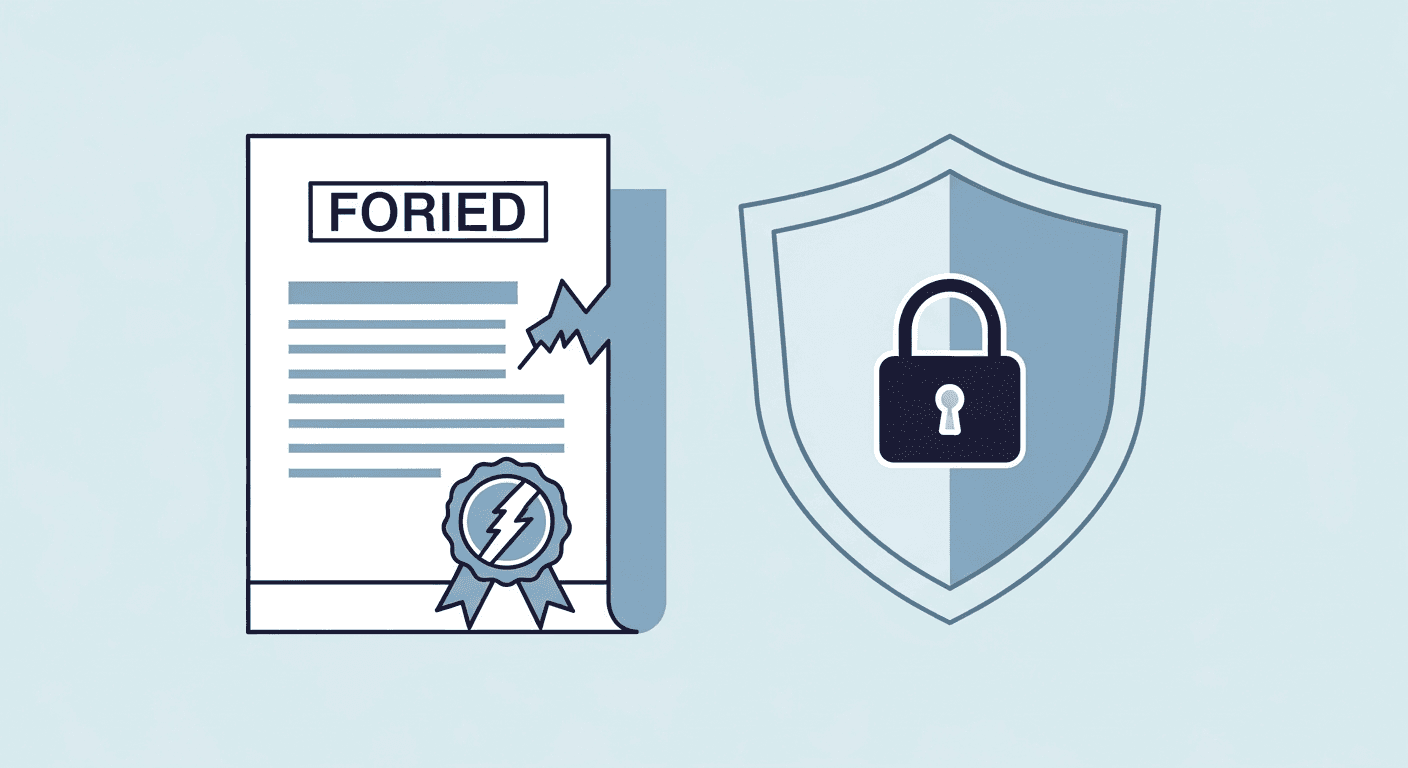
The Scale India Cannot Ignore
On December 10, 2025, Indian authorities announced the results of what may be the largest academic credential fraud bust in recorded history. A coordinated operation spanning multiple states uncovered a sophisticated criminal network that had supplied counterfeit academic certificates — degrees, marksheets, migration certificates — to more than one million people across the country. The certificates were indistinguishable from originals: correct logos, institutional seals, holograms, and formatting.
One month earlier, the Supreme Court had flagged a different but connected crisis. In Uttar Pradesh alone, approximately 8,000 fake degrees issued by Agra University had found their way into government employment records. The court directed the state to conduct a statewide verification drive, dismiss employees with forged credentials, and initiate criminal proceedings. The language of the bench was stark: this was not an isolated incident, but an "organised racket" operating at systemic depth.
These are not one-off failures. They are the predictable result of an examination and credential system built on paper, signatures, and manual processes — a system with no reliable way to trace the chain of custody from exam hall to final certificate.
How the Fraud Actually Happens
Understanding why fake certificates are so easy to produce requires understanding how marks reach a marksheet in most Indian universities today.
An evaluator checks a physical answer book, writes marks in ink, and totals them on a cover sheet. That cover sheet passes through a series of human hands — assistant superintendent, subject coordinator, data entry operator — before marks reach a central spreadsheet. The spreadsheet is processed by a results section that generates a provisional marksheet, which is then printed and distributed.
At each handoff, a determined bad actor can intervene: overwrite a mark, substitute a cover sheet, bribe a data entry operator to inflate a total, or simply produce a counterfeit marksheet using scanned originals as templates. The West Bengal State University case illustrates this exactly.
Between 2014 and 2015, a racket operated inside WBSU that illicitly inflated marks for students who had applied for post-evaluation review. The Controller of Examinations and Assistant Controller were suspended. CID filed charge-sheets. Over a decade later, the courts are still adjudicating cases from that period. In March 2026, the Calcutta High Court dismissed an appeal by a TET-qualified teacher who had attempted to use a forged 2014 review marksheet — one issued during the racket's active period — to secure a teaching appointment. The court held that the university's digital database was the authoritative record, and that any document contradicting it was presumptively fraudulent.
That database — not a paper file, not a physical marksheet — saved the integrity of the institution's record in court. But it only existed because someone had the foresight to preserve it.
The International Consequence
By January 2026, the scale of India's fake certificate problem had begun affecting students with genuine qualifications. Multiple countries — particularly those processing large volumes of Indian student visa applications — tightened their verification requirements for Indian academic credentials. Institutions were asked to provide additional documentation, third-party verification, or direct confirmation from the awarding university.
For the millions of Indian students applying for postgraduate study abroad with legitimate degrees, this creates an unfair burden. The credibility damage caused by forged certificates falls disproportionately on honest graduates.
This is the externality that the domestic debate rarely captures: academic fraud is not just a domestic governance problem. It is a reputational liability that affects every Indian degree holder internationally.
What a Tamper-Proof System Actually Looks Like
The chain of custody in a digital evaluation system is fundamentally different from paper-based processes. When answer scripts are scanned and uploaded to a secure platform for on-screen marking:
The answer book itself, in scanned form, remains stored against the candidate's registration number. If any question arises about a mark, the system can produce the original scanned script with its evaluation annotations — something a paper-based system cannot do without maintaining physical archives for years.
The Double Valuation Deterrent
One feature of structured digital evaluation workflows that receives less attention in the fraud context is double valuation — where a second evaluator independently marks the same script and results are compared.
In a paper system, double valuation is administratively expensive and logistically complex. In a digital system, the same scanned script can be sent to a second evaluator without revealing the first evaluator's marks. Statistical moderation can flag cases where two evaluators diverge significantly, prompting a third review.
This structure makes it substantially harder to corrupt the evaluation process: a bad actor would need to compromise two independent evaluators, each working in isolation, whose scores are automatically compared. The fraud yield drops sharply.
The Gap Between Boards That Have Moved and Those That Have Not
CBSE introduced on-screen marking for Class 12 board exams in 2026 — the first time at this scale for a national board. Several state boards have adopted digital mark entry, centralised scanning, and structured audit trails. DigiLocker integration for marksheets has expanded significantly across CBSE, CISCE, and a growing number of state boards.
But a large number of Indian universities — particularly affiliating universities managing examinations for hundreds of affiliated colleges — continue to rely on manual processes at critical points in the evaluation chain. These are precisely the institutions where the fraud risk is highest.
| System Feature | Manual Process | Digital Audit Trail |
|---|---|---|
| Evaluator identity logged | No | Yes |
| Mark change traceable | No | Yes, full history |
| Original script retrievable | Rarely | Always |
| Credential instantly verifiable | No | Via DigiLocker |
| Double valuation scalable | Expensive | Standard feature |
What Needs to Happen
The 1 million fake certificate operation, the Agra University probe, and the West Bengal marksheet racket are not isolated failures that can be addressed by arresting a few bad actors. They reflect structural vulnerabilities in systems that were not designed for the verification demands of the 21st century.
Institutions that continue to operate manual evaluation workflows carry a fraud liability that compounds over time. Every cohort that passes through a paper-based system without a digital audit trail adds another generation of credentials that cannot be verified against an authoritative digital source.
The UGC, examining bodies, and state boards need to treat digital audit trails not as a future upgrade but as a present requirement — for the sake of the institutions they protect, and for the millions of genuine graduates whose credentials are being devalued by a problem that has a known technical solution.
Related Reading
Ready to digitize your evaluation process?
See how MAPLES OSM can transform exam evaluation at your institution.