ESIC Plans India's Newest Medical University: The Examination Infrastructure Challenge
The Employees' State Insurance Corporation's proposal to consolidate 21 health institutions into a single deemed university will require building a complete examination governance system — standardised, scalable, and digitally auditable across 15 states.
A University Built From Scratch
On July 2, 2026, Business Standard reported that the Employees' State Insurance Corporation is planning to establish the ESIC Institute of Medical Sciences and Occupational Health as a deemed-to-be university. The institution would consolidate 17 medical colleges, 2 dental colleges, and 2 nursing colleges under a single academic framework — with 11 additional medical colleges in the development pipeline that would expand the network to 28 institutions across 19 states and one Union Territory.
The stated objectives are direct: standardise teaching and training programmes, oversee examinations and curriculum development, strengthen occupational health research, and increase the use of AI and digital technologies in medical education. A hub-and-spoke model for faculty and infrastructure sharing is envisaged across the network.
Among those objectives, examination oversight is the most operationally complex. A new university beginning that function in 2026 has an option that most older institutions did not: it can build digital-first from the start.
The Scale of the Problem
ESIC's current network of 21 institutions offers 1,830 MBBS seats annually, alongside dental, nursing, and paramedical programmes. When the expansion to 28 institutions is complete, that seat count will increase substantially. Spread across 15 states today — each with its own examination culture, logistical constraints, and infrastructure baseline — the network currently has no unified examination calendar, no standardised evaluation protocol, and no common audit trail.
This is not unusual for a network that grew institution by institution under a central employer rather than as a unified academic body. Most ESIC medical college examinations are affiliated to local or state universities, which means evaluation standards, result timelines, and grievance processes vary by the affiliate rather than by ESIC's own requirements.
The proposed deemed university status changes this entirely. Once ESIC becomes its own affiliating body, it is directly responsible for the examination process at every institution in the network — conducting examinations, evaluating answer scripts, maintaining records, processing revaluations, and publishing results. Across 28 geographically distributed colleges, this is not an administrative upgrade from the current model. It is a new capability being built from zero.
What "Oversight of Examinations" Requires
The language in ESIC's proposal is concise — "oversee examinations" — but the operational content of that function is substantial. At minimum, a university exercising genuine examination oversight must be able to:
Standardise question papers across sites. Eighteen medical colleges conducting the same internal assessment in the same week need a common question bank infrastructure, controlled paper distribution, and breach-resistant delivery to exam halls across the country.
Ensure consistent evaluation standards. A question about pharmacology should attract the same marks whether evaluated by a faculty member in Rajasthan or Tamil Nadu. Without a structured inter-examiner calibration process and a system that flags statistical outliers, this standard cannot be maintained across a distributed network.
Maintain verifiable audit trails. NMC's inspection framework and NAAC's accreditation criteria both require institutions to produce evidence of evaluation governance — not assertions. When ESIC medical colleges submit for NMC annual renewal or NAAC accreditation, the university must be able to export answer sheet custody logs, evaluator activity records, and result computation trails for each examination cycle.
Manage revaluation at scale. At 1,830 MBBS seats with multiple examinations per academic year, even a 3% revaluation request rate generates hundreds of cases annually. A paper-based revaluation process — physical retrieval, re-evaluation by a different examiner, manual mark amendment — does not scale across a multi-state network without significant delays and chain-of-custody risk.
Why Digital-First Is the Only Viable Architecture
Previous generations of deemed universities and affiliating bodies built examination infrastructure sequentially: paper-based processes first, partial digitalisation later. The results are visible in the current examination environment — legacy systems that handle scanning but not evaluation, or evaluation but not integrated revaluation, or result computation but not audit export.
ESIC has the opportunity to avoid that path. A university building examination infrastructure in 2026 for a 21-28 institution network spread across 15-19 states has an architecture decision to make at the outset: whether the canonical record is a physical answer book or a digital file.
If the canonical record is digital — meaning answer books are scanned at examination centres, evaluated on-screen by faculty logged into a central evaluation platform, and stored with full transaction metadata — the downstream functions become manageable:
The alternative — building a paper-based examination function across 28 institutions and retrofitting digital processes later — has a documented cost. The institutions and boards that have attempted this path since 2015 are, in 2026, still managing the technical debt of that choice.
The NMC and NAAC Compliance Dimension
ESIC medical colleges that come under the new university's umbrella will face accreditation assessments under two frameworks: NMC's annual renewal process and NAAC's periodic accreditation cycle.
NMC's inspection criteria include an explicit review of examination governance — evaluation processes, grievance mechanisms, and result integrity. The NMC has recently directed institutions to integrate Health Facility Registry and Hospital Management Information System data into their renewal submissions, signalling a broader shift toward verifiable digital records as the standard of evidence.
NAAC's Criterion 2 (Teaching-Learning and Evaluation) and Criterion 6 (Governance, Leadership and Management) specifically evaluate the examination systems institutions use. Under the binary accreditation framework operational since 2025, the evidence standard has shifted: peer teams expect structured data, not narrative descriptions, of evaluation quality.
A newly constituted university that can produce, from its first examination cycle, clean digital records of how each answer script was handled, who evaluated it, when, and at what mark — and that can export that data in structured formats for accreditation review — begins its accreditation history in a materially stronger position than one that cannot.
Hub-and-Spoke Examination Operations
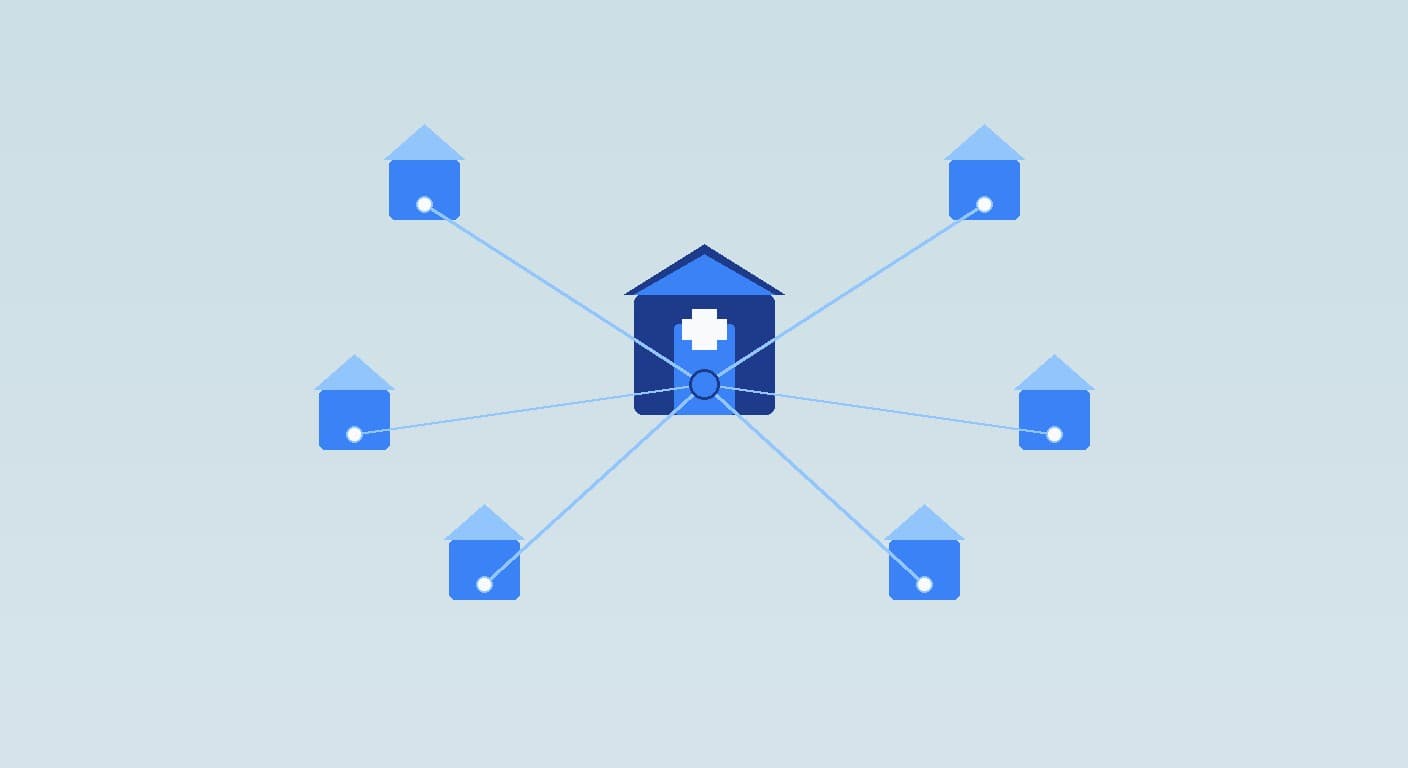
ESIC's proposed hub-and-spoke model for faculty and infrastructure sharing has a direct corollary in examination management. In a digital evaluation network, a single centralised scanning and evaluation team can support multiple institutions simultaneously:
This operational model is not theoretical. It is the model under which organisations managing distributed examination networks at scale — the institutions and boards that have moved to on-screen marking for multi-site cohorts — currently operate. The infrastructure already exists and is in active use elsewhere in the Indian examination ecosystem.
The Window for Getting This Right
ESIC's university proposal is at the planning stage. Regulatory clearances, governance design, and legal architecture are ahead. That timeline is an advantage, not a constraint, for examination infrastructure.
The decisions that determine whether examination governance works — whether canonical records are digital or physical, whether evaluation platforms are centralised or distributed, whether audit trail data is captured by design or reconstructed after the fact — are almost always cheaper to make correctly at inception than to correct after three or four examination cycles have created institutional inertia around the wrong model.
The institutions and boards that set that foundation correctly are, in 2026, the ones generating examination data that supports accreditation, enables fast results, and produces evidence of quality without requiring a manual reconstruction exercise before every assessment.
Related Reading
Ready to digitize your evaluation process?
See how MAPLES OSM can transform exam evaluation at your institution.