India's DPI@2047 Blueprint and the Examination Infrastructure Gap
NITI Aayog's April 2026 roadmap identifies skill credentialing as central to India's next digital transformation. Universities that digitize evaluation records today are building the nodes of a national credential infrastructure.
India's Digital Transformation, Second Phase
On 27 April 2026, NITI Aayog released the DPI@2047 strategic roadmap — a document that reframes how India thinks about digital infrastructure for the next two decades. Developed in partnership with EkStep Foundation and Deloitte, the roadmap charts two phases: DPI 2.0 from 2025 to 2035 focused on livelihood-led growth, and DPI 3.0 from 2035 to 2047 targeting broad-based prosperity.
The first generation of India's Digital Public Infrastructure was built to solve inclusion problems: getting services to the last mile, verifying identity at scale, enabling small-value digital transactions. By any measure, it succeeded. Aadhaar has processed over 20,000 crore authentication requests. UPI handles more than 600 crore transactions per month. DigiLocker has issued over 600 crore documents digitally.
The second generation must solve productivity problems. And among the eight sectoral transformations the DPI@2047 roadmap identifies as central to DPI 2.0, education occupies a structural position. Skill credentialing, AI-assisted personalised learning, and vocational certification digitisation are listed as priority interventions — not because digital learning is new, but because the credential infrastructure to make educational outcomes verifiable and portable does not yet exist at scale.
The underlying problem is one that university administrators and Controllers of Examinations will recognize immediately: India has world-class digital infrastructure for payments and identity, but almost no interoperable infrastructure for academic credentials.
The Credential Gap India Has Not Solved
India currently operates 53,461 colleges and 1,409 universities. Most maintain examination records in formats — physical registers, institution-specific databases, scanned PDF archives — that cannot be queried, verified, or ported across institutions or national borders.
The downstream consequences are visible in multiple contexts:
An employer cannot programmatically verify whether a degree certificate issued by a mid-tier university in one state is authentic. They write to the university registry and wait weeks.
An Indian student applying abroad submits documents that overseas institutions cannot verify through any automated system. Credential verification bottlenecks cause delays and rejections.
A student who wants to transfer credits between institutions under NEP 2020's Multiple Entry and Exit provisions finds that the receiving institution cannot read her credit records from the originating institution in any standardized format.
The Academic Bank of Credits, envisioned in NEP 2020 as the equivalent of UPI for academic credentials, is the proposed solution. The UGC's June 30, 2026 deadline requiring institutions to upload examination year 2025 records to the NAD-ABC platform is the first compulsory implementation checkpoint.
But the June 30 deadline exposes the gap rather than closing it.
The Problem Is Upstream of the Platform
What the UGC deadline and the DPI@2047 roadmap both surface — without naming it directly — is that credential interoperability depends entirely on the quality and structure of evaluation records at their origin.
You cannot upload examination records to the NAD-ABC platform if those records do not exist in structured digital form. You cannot timestamp a credit unit if the underlying assessment was conducted on physical answer books that were never ingested into a digital system. You cannot query academic achievement data if evaluation was performed manually and scores were keyed into a spreadsheet at the end of a physical valuation camp.
Institutions that digitize evaluation records as a post-hoc process — scanning physical registers, manually entering marks from paper-based valuation into an upload template — are meeting the letter of the UGC deadline while undermining its purpose. The ABC framework requires records with structured metadata: subject codes, credit values, assessment dates, evaluation method. Paper-based evaluation that is retroactively digitised typically cannot supply this metadata with the fidelity the system requires.
The DPI@2047 roadmap describes India's credential gap as a "structural bottleneck" preventing the education sector's integration into the national productivity economy. What this means for examination administrators is concrete: institutions running paper-based evaluation are not merely making an operational choice — they are maintaining a gap in national digital infrastructure.
The India Stack Analogy
The parallel with the first generation of India Stack is instructive. Before Aadhaar, identity verification required physical documents — ration cards, voter IDs, passports — that could not be verified programmatically and demanded human intermediaries at every step. Hundreds of millions of people were functionally invisible to the formal economy because their identity could not be expressed in a format that digital systems could consume.
Aadhaar replaced that with a verifiable, programmable identity. Once identity was programmable, UPI could be built on top of it. Once UPI existed, thousands of applications were constructed on top of UPI.
Academic credentials are at approximately the same stage that identity was in 2005. They exist, but they cannot be programmatically verified. They are stored in institution-specific formats. They require human intermediaries to authenticate. They cannot be consumed as inputs to downstream systems — hiring platforms, credit assessment models, scholarship disbursement, government welfare programmes, or international admissions portals.
The DPI@2047 roadmap explicitly positions DIKSHA (curriculum-aligned digital content for schools) as part of the education DPI layer. The NAD-ABC is designed to be the credential layer. But neither platform can function without source data, and the source data for academic credentials is the evaluation record — the structured, timestamped, evaluator-attributed digital output of an examination cycle.
What NAAC and NIRF Are Already Signalling
The DPI@2047 roadmap is not the only policy signal pointing in this direction. NAAC's new Binary Accreditation Framework, announced in February 2025, moved to AI-assisted document verification and standardised digital Data Capture Formats. The framework is designed on the assumption that institutions can produce machine-readable evidence.
Examination records that exist within digital evaluation platforms — with timestamped evaluation logs, evaluator session data, moderation histories, and per-script audit trails — are exactly the kind of structured digital evidence these systems are built to process. PDF photographs of physical register pages are not.
NIRF's upcoming 2026 rankings, to be released in August, include graduation outcomes and placement data weighted at approximately 30% of the institutional score. Institutions with digital evaluation platforms can query their own outcome data — pass rates, distinction percentages, subject-level performance distributions — in hours. Institutions without digital evaluation records produce this data through manual counting exercises that introduce errors and take weeks.
The convergence is not coincidental. NAAC, NIRF, UGC-NAD, and NITI Aayog's DPI@2047 are all pressing toward the same requirement from different angles: structured, machine-readable, verifiable academic records.
The Infrastructure Horizon and the Timing Question
The DPI@2047 roadmap targets 2035 for DPI 2.0 to be operational at scale across its eight sectors. For the education sector, this means a functioning national credential infrastructure — one in which academic records from the majority of India's universities and colleges flow into an interoperable, verifiable system — needs to be substantially assembled by 2035.
Working backward from 2035, institutions need to have three to four complete examination cycles' worth of structured digital evaluation data in place before the credential infrastructure matures enough to penalise institutions that are not participating. That implies institutions must have a functioning digital evaluation platform in place no later than 2031 to have usable data by 2035.
Institutions that begin digitizing evaluation in 2026 will have close to a decade of structured examination data available when the national credential infrastructure reaches operational scale. Those that wait until 2031 will be entering with one cycle of data — not enough for the trend analysis, longitudinal outcome tracking, and curriculum improvement evidence that accreditation frameworks require.
Three Immediate Actions
For university administrators who have read the DPI@2047 roadmap or are planning for the UGC June 30 deadline, three actions connect institutional examination infrastructure to the national DPI mission:
The Local Node in a National System
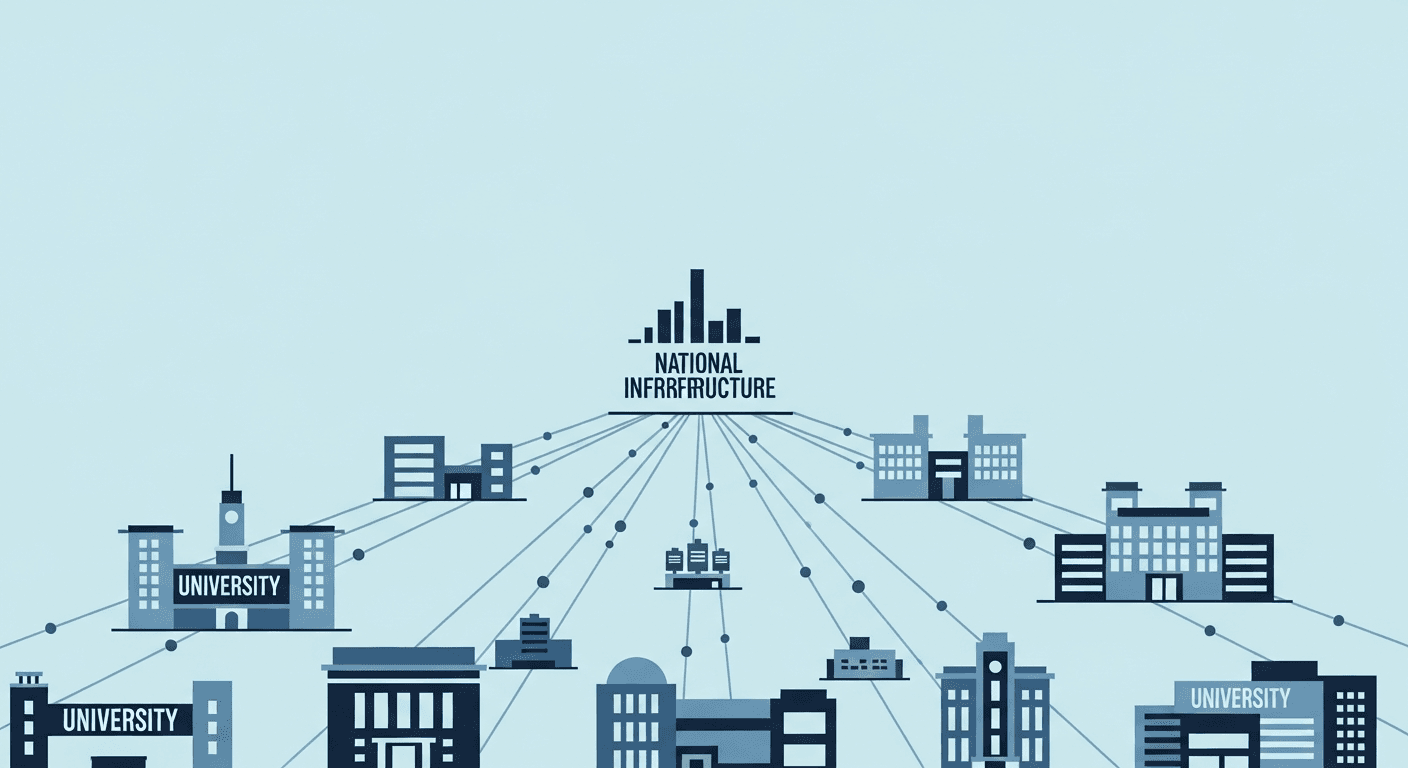
The DPI@2047 roadmap is not asking individual institutions to build national infrastructure. It is asking them to build the local node — the evaluation record — from which national infrastructure can be assembled.
UPI is not a single platform. It is an interoperability protocol that thousands of institutional nodes plug into. The national academic credential system will work the same way: each university's digital evaluation platform becomes a verified node in a federated credential network. The quality of the national system is the sum of the quality of its institutional nodes.
For examination administrators making platform decisions in 2026, this framing clarifies the stakes. A digital evaluation platform is not just a way to mark answer books faster, or a tool for generating NAAC evidence. It is the institution's connection point to a national credential infrastructure that will, within a decade, determine how Indian academic qualifications are verified, valued, and used — in India and internationally.
The infrastructure gap is real. The roadmap to close it is funded and documented. The timing advantage is available now.
---
Related Reading
Ready to digitize your evaluation process?
See how MAPLES OSM can transform exam evaluation at your institution.