India's National Credit Framework: Why Digital Evaluation Is Now a Structural Requirement
The NCrF turns every assessment into a digital record that feeds India's Academic Bank of Credits — making paper-based evaluation a compliance liability, not just an operational inefficiency.
A Framework That Changes Everything About How Credits Are Earned
India's National Credit Framework (NCrF), gazette-notified in April 2023 and now in active implementation across regulated institutions, is not just another policy document. It is an architectural shift in how academic achievement is recorded, transferred, and redeemed — and it has a direct, unavoidable implication for how universities conduct examinations.
At its core, NCrF establishes a single national standard: one credit equals thirty notional learning hours. A full year of education, whether in school, higher education, or vocational training, yields forty credits. A three-year undergraduate degree requires 120 credits. A four-year degree requires 160. And every one of those credits must be earned through a verifiable assessment.
That word — verifiable — is where paper-based evaluation runs into a structural problem.
Three Verticals, One Standard
NCrF spans three sub-frameworks:
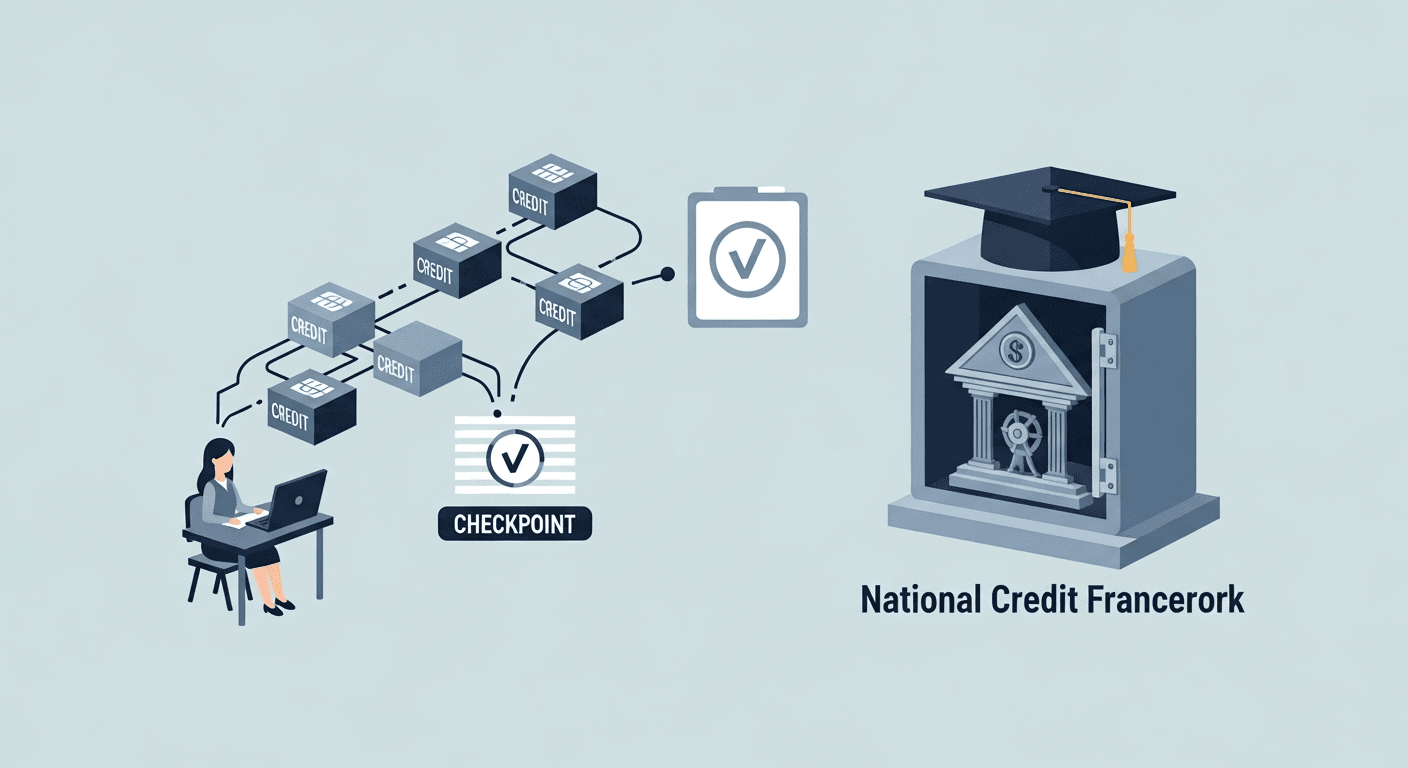
All three feed into a single national credit ledger: the Academic Bank of Credits (ABC). When a student registers, an Aadhaar-linked ABC account is created. Every time a course is completed and assessed, the awarded credits are deposited into that account. The account functions like a DigiLocker for academic achievements — portable, permanent, and auditable.
The critical dependency is this: for credits to flow into ABC, the underlying assessment must generate a digitally traceable outcome. A mark sheet produced from a manually graded paper bundle is not inherently traceable in the way NCrF's audit infrastructure requires.
The Credit Flow and Where Evaluation Sits
The chain from teaching to credential looks like this:
| Stage | What Happens |
|---|---|
| Instruction | Faculty delivers 30 hours of learning per credit |
| Assessment | Student is evaluated at end of course/semester |
| Credit award | Institution validates marks and credits the outcome |
| ABC deposit | Validated credits are posted to the student's national account |
| Credential redemption | Student exits with Certificate (40 credits), Diploma (80), or Degree (120/160) |
The assessment stage is the linchpin. If it produces unreliable, manually transcribed outcomes, errors compound at every downstream stage. A university with 10,000 students running eight semesters of NCrF-compliant courses is generating 80,000+ individual credit assessments per academic cycle. Manual handling at that scale does not just create inefficiency; it creates compliance exposure.
Under DVV (Data Validation and Verification) processes used by both NAAC and UGC, institutions are expected to substantiate claimed academic data with digital evidence trails. A university that cannot trace an individual student's semester-end marks to a digitally managed evaluation will find its NCrF credit claims questioned during audit.
What This Means for Examination Infrastructure
The NCrF implementation timeline is unambiguous. UGC has issued standard operating procedures requiring all affiliated and autonomous universities to begin ABC credit depositing for enrolled students. The expectation is that institutions that have not digitized their evaluation pipelines will encounter growing friction:
The NAAC and NIRF Alignment
NCrF does not exist in isolation from the other frameworks governing institutional quality. Its requirements overlap directly with two of the most influential assessment regimes:
Under NAAC's binary framework, Criterion 2 (Teaching-Learning and Evaluation) asks institutions to demonstrate the effectiveness of evaluation processes. Criterion 1 (Curricular Aspects) asks for evidence of learning outcome achievement across courses. Both are far easier to satisfy with digital evaluation data than with manually compiled mark registers.
Under NIRF's Teaching, Learning and Resources parameter, which carries thirty percent of total weightage, institutions are assessed partly on outcome achievement. Graduation outcomes — carrying twenty percent — are directly tied to how reliably an institution can track and report student progression. NCrF credit tracking is becoming part of this data submission.
Universities that have already digitized evaluation have access to per-student, per-course, per-semester analytics. They can demonstrate to NAAC how many students achieved learning outcomes at different levels. They can show NIRF auditors clean, reproducible graduation outcome data. Institutions on paper cannot make the same case.
The 2030 Pressure Point
NEP 2020's implementation timeline adds urgency. By 2030, all higher education institutions are expected to be NCrF-compliant, with ABC integration mandatory for degree-granting institutions. The Four-Year Undergraduate Programme, now rolling out across central and state universities, generates eight semesters of assessment data per student. For an institution that has not yet digitized evaluation, each new FYUGP cohort adds to a growing data deficit.
Institutions that adopt digital evaluation in 2026 will have four to five years of clean assessment records before the 2030 deadline becomes a compliance crisis. Institutions that wait will face a retroactive documentation problem with no good solution.
Implementation Priorities
For a university beginning its NCrF-aligned digitization journey, the practical sequence is:
The shift is not optional. NCrF has moved from policy aspiration to institutional obligation. The question for any university in 2026 is not whether to digitize evaluation but how quickly it can reach the standard that NCrF's credit infrastructure demands.
Related Reading
Ready to digitize your evaluation process?
See how MAPLES OSM can transform exam evaluation at your institution.