CUET 2026 TCS iON Server Crash: What Went Wrong and Why It Matters
A server failure by technology partner TCS iON disrupted the CUET UG 2026 exam on May 30, leaving 3,765 candidates unable to complete their test. Here is what the incident reveals about India's national exam technology infrastructure.
When the Server Goes Down on Exam Day
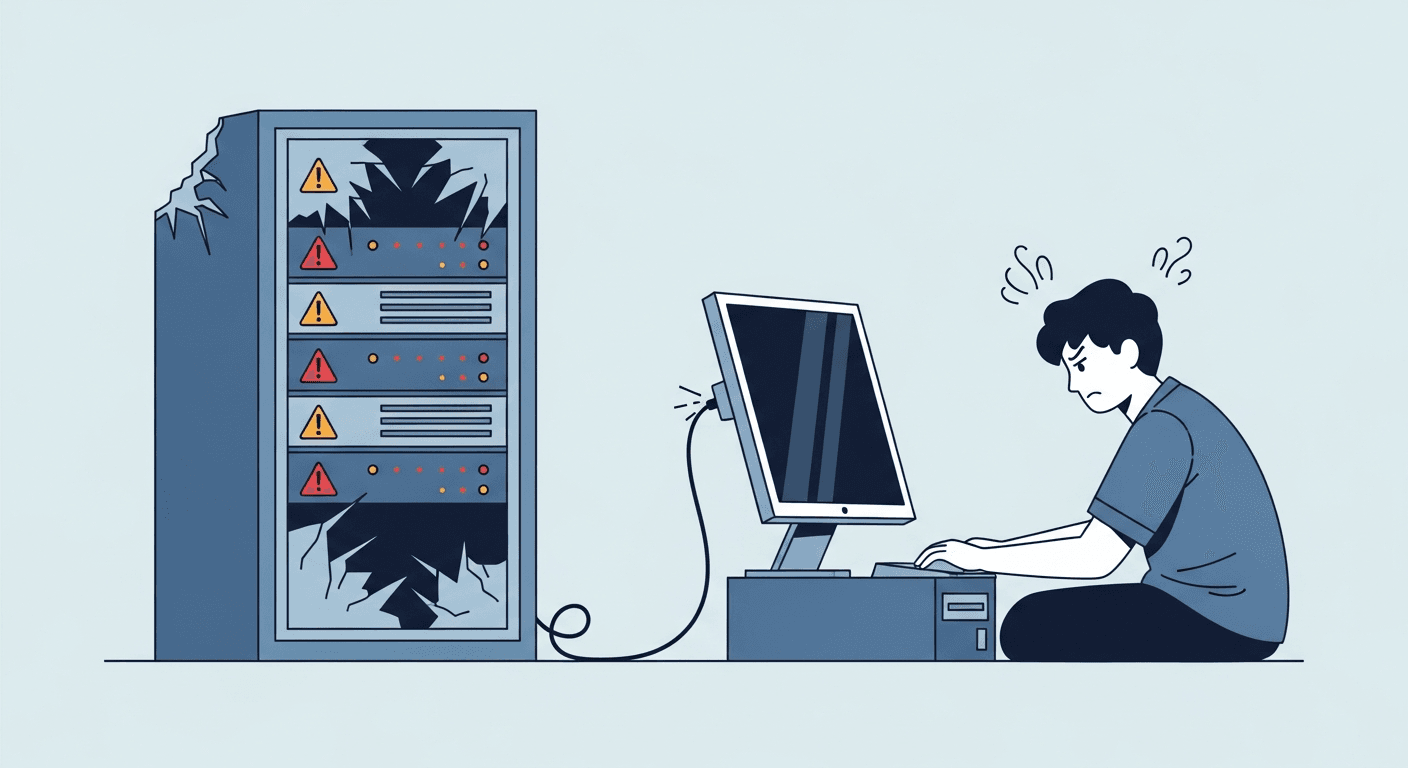
On the morning of May 30, 2026, thousands of students arrived at CUET UG examination centres across India for the first shift. They completed biometric registration. They sat down at their terminals. Then, for 3,765 of them, nothing worked.
The disruption was traced to a server failure at TCS iON, the National Testing Agency's technology partner responsible for delivering the computer-based test. The system that was supposed to present question papers simply stopped functioning. Students in Noida and other centres waited for hours. Some were eventually given compensatory time. Others could not complete the exam at all.
The NTA announced rescheduled exam dates of June 6 and 7 for the affected candidates and ordered a probe into TCS iON's infrastructure failure. Opposition parties used the incident to renew criticism of the government's stewardship of national examinations, coming as it did barely three weeks after NEET UG 2026 was cancelled over a paper leak.
This article examines what actually went wrong on May 30, why it matters beyond the immediate disruption, and what standards India's examination technology infrastructure must meet.
What TCS iON Does — and What Failed
TCS iON is a subsidiary of Tata Consultancy Services that provides digital learning and assessment infrastructure to governments, exam boards, and institutions. For CBT examinations like CUET, TCS iON is responsible for the full technology stack: delivering question papers to candidate terminals at exam centres, managing the testing environment, recording responses, and transmitting results to the NTA.
The May 30 failure was specifically on the delivery side. Candidates who had authenticated themselves biometrically at their centres could not proceed to the exam because the system that serves question papers did not respond. This is distinct from internet connectivity issues at individual centres — it was a centralised infrastructure failure.
Exactly what caused the server failure has not been publicly detailed by either NTA or TCS iON as of this writing.
The Single-Vendor Risk in National Examinations
The CUET incident illustrates a structural risk in how India currently runs large-scale computer-based examinations: heavy dependence on a single technology vendor for mission-critical delivery infrastructure.
When JEE Main, CUET, or similar examinations are conducted, hundreds of thousands of candidates appear simultaneously across hundreds of centres. The entire examination lives on the vendor's platform. If that platform has a centralised failure point — a primary database cluster, a load balancer, an authentication service — a single fault can cascade into a nationwide disruption.
Good resilience engineering requires that mission-critical systems have no single point of failure:
None of this is technically difficult. Banks and payment systems in India serve hundreds of millions of transactions daily with this level of resilience. The question is whether examination technology contracts specify and verify these capabilities before deployment.
The Procurement Problem
The deeper issue is procurement. Examination technology contracts are typically awarded through a lowest-bid government tender process that prioritises cost over demonstrated resilience. Vendors are not always required to prove their infrastructure under realistic load conditions before going live.
A stress test for a national examination system should simulate the concurrent load of the actual exam day — all candidates authenticating within the same 30-minute window, all requesting question papers simultaneously — and verify that the system holds. Disaster recovery testing should verify that failover works within seconds, not minutes.
The CUET disruption suggests either these tests were not conducted, or they did not simulate the conditions that led to failure. NTA's investigation into TCS iON will hopefully surface which controls failed.
The Impact Beyond 3,765 Candidates
The immediate cost is visible: over three thousand candidates who prepared for months had their exam day disrupted. Many had booked travel to their examination cities. Some had taken leave from work. The rescheduled dates of June 6-7 required them to stay in their exam cities for additional days or return after travelling home.
The downstream cost is less visible but significant. Universities that use CUET scores for undergraduate admissions receive results later. Counselling processes for those 3,765 candidates are delayed. If those candidates are making choices between universities that have application deadlines, even a one-week delay can affect their options.
At the system level, repeated technology failures erode candidate confidence in computer-based examinations at precisely the moment when India is trying to move more national exams to digital formats. The government's announcement that NEET will shift to CBT mode from 2027 will be harder to sell to students and parents if CUET's existing CBT infrastructure has demonstrated reliability problems.
What Solid Examination Technology Looks Like
The contrast with well-run digital examination infrastructure is instructive. In the context of digitised answer sheet evaluation — which is distinct from CBT delivery but faces similar infrastructure demands — institutions that have moved successfully to on-screen marking have done so by:
These are engineering principles, not secrets. They are equally applicable to CBT examination delivery.
What the NTA Probe Must Establish
For the investigation into the May 30 failure to be useful, it needs to answer specific questions:
Answers to these questions should be published. Examination candidates and institutions deserve to understand why failures occur and what changes prevent recurrence.
Conclusion
The CUET 2026 TCS iON failure was an operational disruption of a kind that cannot be entirely eliminated from large-scale computer-based testing. But the scale — 3,765 candidates, two separate makeup dates — suggests that resilience standards for this infrastructure are not where they need to be.
India is in the process of digitising more of its examination infrastructure, not less. The CUET disruption is an early warning that the digital examination technology ecosystem requires the same engineering rigour and vendor accountability that other critical digital infrastructure sectors have learned to demand. Getting this right matters: the students sitting in those examination centres deserve infrastructure that is as prepared for their exam day as they are.
---
Related Reading
Ready to digitize your evaluation process?
See how MAPLES OSM can transform exam evaluation at your institution.