CBSE Drops Revaluation Fee to Rs 100 With Full Refund: What This Signals About OSM
After student backlash over Class 12 marks under On-Screen Marking, CBSE slashed its revaluation fee from Rs 700 to Rs 100 and introduced a full refund if marks change. The policy shift reveals how digital evaluation changes the economics of mark disputes.
A Fee Structure That Changed Overnight
When CBSE declared Class 12 results in May 2026, the board faced an unusual wave of student grievances. Not about incorrect totalling or missing marks — the traditional complaints — but about marks that seemed inconsistent with students' own expectations and their simultaneous performance in JEE Main.
The On-Screen Marking system, which CBSE used to evaluate all 1.25 crore answer sheets this year in its first full-scale implementation at this size, was at the centre of the controversy. Students argued that stepwise marking under OSM had been applied more strictly than under the previous hand-marking system. Some reported a meaningful gap between their board scores and their JEE Main percentiles.
CBSE's response was immediate. The board slashed its post-result service fees across the board:
| Service | Previous Fee | New Fee |
|---|---|---|
| Scanned answer sheet copy | Rs 700 per subject | Rs 100 per subject |
| Verification of marks | Rs 500 per subject | Rs 100 per subject |
| Rechecking (per question) | Rs 100 | Rs 25 |
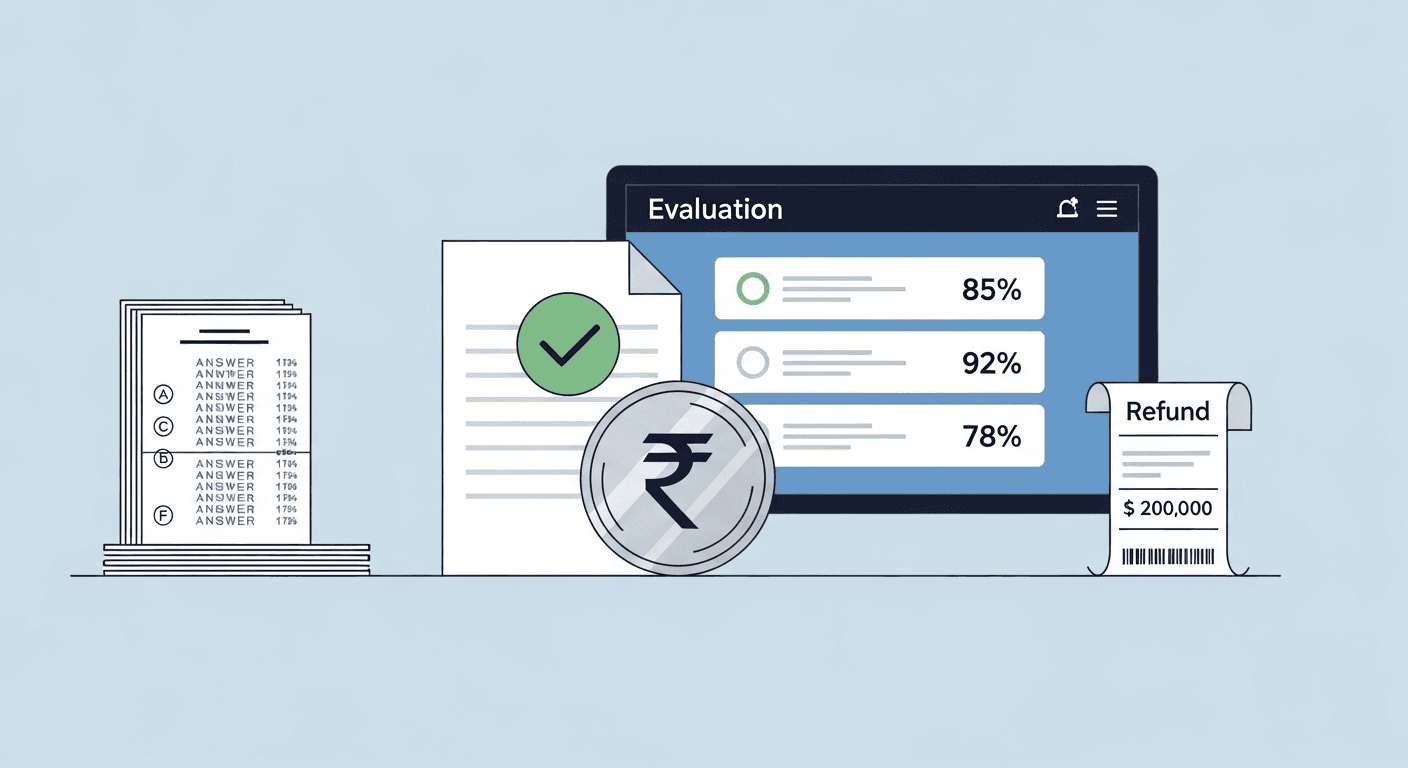
More significantly, CBSE introduced a full refund clause: if marks increase after scrutiny or re-evaluation, the entire fee paid is refunded. If marks remain unchanged, the fee is non-refundable.
The window for obtaining scanned copies opened on May 19 and closed on May 22. Verification opens from May 26.
---
Why This Is More Than a Consumer-Protection Move
The fee reduction is being read as a concession to student pressure, and to some extent it is. But the mechanics of the refund clause reveal something more significant about how CBSE views the accuracy of its own OSM system.
A full refund if marks change is a financial commitment to evaluation accuracy. If CBSE expected a substantial proportion of rechecked papers to come back with higher marks, the refund guarantee would be financially unviable. The policy only makes sense if the board is confident that OSM marks are correct in the overwhelming majority of cases.
This is not a trivial signal. Under hand-marking, marks verification commonly surfaced totalling errors, missed pages, and carry-forward mistakes. OSM eliminates all of these categories: totals are computed automatically, every page of a scanned booklet is visible to the evaluator on-screen, and the system flags incomplete evaluations before submission. The residual error rate in OSM relates to rubric interpretation — how an evaluator applies the marking scheme to a given answer — which is substantively harder to challenge and correct.
By offering rechecking at Rs 25 per question with a full refund if marks go up, CBSE is in effect saying: challenge us question by question, and if we got a question wrong, we will pay you back. That is institutional confidence in marking quality.
---
The Background: OSM at 1.25 Crore Scale
CBSE introduced OSM in 2014 as a pilot. The 2026 Class 12 evaluation was the first year the system was used at full national scale, with approximately 9.8 million answer booklets scanned and uploaded to a secure evaluation portal before marking began.
Under OSM, evaluators log into a portal from authorised computers at designated centres. Answer sheets appear page by page on the screen. Evaluators mark responses directly on-screen, and the system records every mark, every annotation, and the time taken per question. Totals are computed automatically. An evaluator cannot submit an evaluation with blank sections.
The system creates a complete digital audit trail: which evaluator marked which question, when, and what they awarded. Head Examiners can review individual evaluators' marking patterns across the cohort and flag outliers for re-training or re-marking.
This infrastructure is what enables CBSE's fee-with-refund model. Because the board can audit exactly how each mark was assigned, it can examine a challenge and determine whether the marking departed from the scheme — a determination that is impossible under hand-marking, where the evaluator's rationale is not preserved.
---
What Student Backlash Actually Revealed
The complaints that drove CBSE's fee reduction deserve careful reading. The core grievance was not that OSM produced arbitrary marks but that OSM produced stricter marks — particularly in stepwise marking of long-answer questions in sciences and mathematics.
Under hand-marking, studies have consistently found that evaluators apply marking schemes variably: some award partial credit generously, others apply it stringently. At scale, this variance averages out, but it also means that a student's mark in a given subject depends partly on which evaluator happened to receive their booklet.
OSM with standardised on-screen rubrics reduces that variance. If the marking scheme says three marks for a derivation with two intermediate steps correct, OSM evaluators are more likely to apply that specification consistently than hand-markers working in isolation in a school staffroom.
From the student's perspective, a mark that is lower than expected feels like an error. From the examination system's perspective, a mark that is consistent with the marking scheme across all 1.25 crore scripts is the point. The student backlash reflects, at least in part, an adjustment to a more rigorous and consistent marking environment — not a failure of OSM but its first visible systemic impact on results at this scale.
The pass rate for Class 12 2026 declined modestly compared to the previous year. Experts have attributed this partly to stricter stepwise marking enforcement. A similar calibration was observed in early years of OSM adoption at other examination boards globally.
---
What Universities Operating Their Own Evaluation Should Take From This
The CBSE model of OSM-backed fee-with-refund has direct applicability for universities running their own semester and annual examinations. Several practical lessons emerge:
Publish the marking scheme publicly, at the question level. If students can see exactly what a full-credit, partial-credit, and zero-credit response looks like, the basis for a challenge — and the basis for upholding a mark — becomes objective. CBSE's OSM rubrics are increasingly question-level specific; universities can adopt the same approach.
Use OSM to support mark dispute resolution, not just initial evaluation. Because OSM preserves the evaluator's marks question by question, a re-evaluation under OSM can focus specifically on the disputed question. Under hand-marking, re-evaluation often means re-marking the entire script, introducing new variance.
Build transparency into re-evaluation pricing. The Rs 100-with-full-refund model is essentially a commitment to accuracy backed by a financial guarantee. Universities that adopt OSM can offer similar policies credibly, because their audit trail supports it.
Prepare for an adjustment period. The first full year of OSM typically generates more rechecking requests than subsequent years, as students and institutions calibrate to the new marking environment. Planning for this spike — in terms of staff training, dispute resolution workflows, and communication — reduces the administrative burden.
---
What Comes Next
CBSE's fee reduction does not resolve the underlying tension between student expectations and OSM-enforced marking consistency. That tension is likely to persist through one or two more examination cycles before outcomes under OSM become the new baseline expectation.
What the fee reduction does establish is a model: digital evaluation systems that produce auditable, challengeable, question-level records enable mark dispute policies that paper-based systems cannot replicate. The Rs 100 fee with full refund is not just a price cut; it is an institutionalised confidence statement about the accuracy of marks produced by on-screen evaluation.
That statement has implications for every institution managing examination integrity, revaluation workloads, and student trust at scale.
---
Related Reading
Ready to digitize your evaluation process?
See how MAPLES OSM can transform exam evaluation at your institution.