Cambridge International Goes Digital: The Global Signal India Cannot Ignore
Cambridge International Education is rolling out digital examinations from June 2026, with India-based schools eligible from 2027. Here is what the global shift means for Indian institutions, their exam infrastructure, and their accreditation goals.
A Quiet Revolution in How the World Evaluates
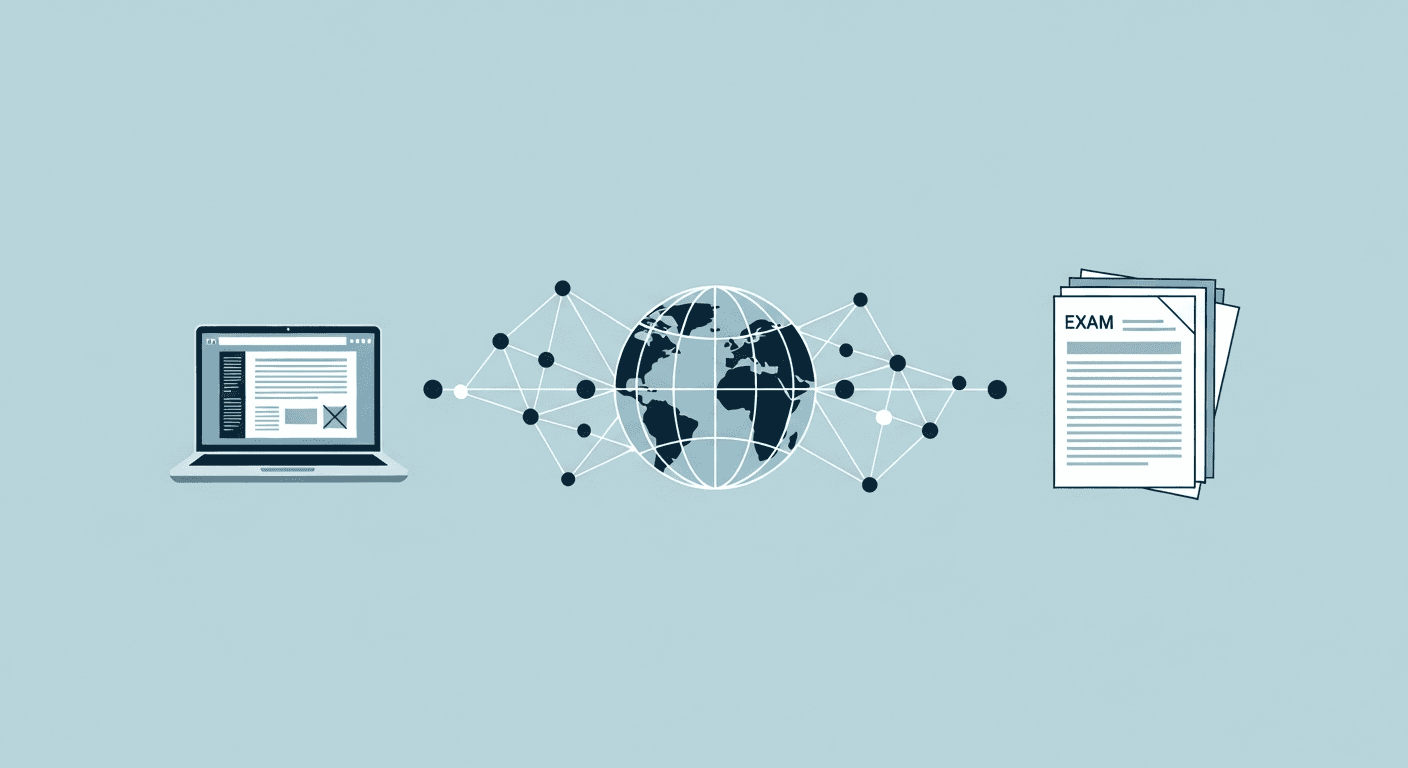
In October 2024, Cambridge International Education made an announcement that went largely unnoticed outside specialist education circles: all Cambridge IGCSE, AS, and A Level examinations would transition to fully digital delivery by 2033, with the first digital exams launching in June 2026.
For Indian education institutions, this milestone deserves far more attention than it has received. Cambridge International operates in over 160 countries. India is one of its largest markets, with hundreds of Cambridge-affiliated schools. When the world's most internationally recognised school examination system commits to digital-first assessment, it sets a benchmark that every institution competing for global standing must acknowledge.
The Cambridge Timeline in Detail
The digital transition is being structured in deliberate phases.
June 2026 — Early Adopter Programme: The first wave covers select subjects in Europe, the Middle East and North Africa, and the United States. Digital examinations will be available for multiple-choice question papers in Cambridge IGCSE Accounting, Economics, Biology, Chemistry, and Physics, along with the Cambridge International AS Level English General Paper.
June 2027 — Global Rollout: Any Cambridge-affiliated school worldwide that meets the technical requirements will be able to opt in for available digital subjects. This is the phase directly relevant to India's 700+ Cambridge International schools.
2033 — Near-Complete Transition: By this date, Cambridge projects that 85 per cent of its high-stakes IGCSE and International AS and A Level qualifications will have a digital option.
This is not an experiment. Cambridge describes it as "the start of Cambridge's global rollout of digital exams," and the stated ambition is to eventually assess competencies — collaboration, research, data analysis — that paper exams cannot fully capture.
What "Digital Examinations" Actually Means
It is important to distinguish between two distinct processes that the term "digital examinations" covers.
Front-end delivery: Students take their exam on a laptop or device rather than on paper. Multiple-choice responses are auto-marked instantly. Essay and subjective responses are typed and submitted electronically.
Back-end evaluation (onscreen marking): The scanned or digitally submitted responses are evaluated by examiners on a secure online portal. Examiners log in with credentials, mark individual responses on screen, and the system automatically computes totals and flags potential discrepancies.
Cambridge has used onscreen marking for the back-end evaluation of its paper-based exams for years. The June 2026 transition adds digital front-end delivery to this already-digital evaluation infrastructure.
India's own CBSE on-screen marking (OSM) initiative — which went live for Class XII in 2026, covering over 17 lakh students and approximately 1 crore answer sheets — operates on the same back-end principle. Answer sheets are scanned, uploaded to a secure portal, and evaluated digitally by certified examiners. The front-end delivery remains pen-and-paper; only the evaluation is digital.
Both systems are converging toward the same destination.
Why This Matters for Indian Institutions
NIRF Rankings and International Perception
The National Institutional Ranking Framework (NIRF) assigns 30 per cent weight to the Research and Professional Practice parameter and an additional 10 per cent to Perception — how the institution is viewed by peers, employers, and students beyond its immediate geography. Institutions with modernised examination infrastructure that aligns with global standards contribute meaningfully to the perception score.
As international academic partnerships, student exchange programmes, and joint degrees become increasingly central to institutional strategy, the ability to demonstrate that an institution's evaluation processes meet global norms — tamper-proof, digitally auditable, examiner-anonymous — becomes a competitive differentiator.
NAAC Criterion 6: Governance and Leadership
NAAC's revised binary accreditation framework places significant emphasis on Criterion 6, which assesses institutional vision, governance quality, financial management, and strategy implementation. Investing in digital evaluation infrastructure signals institutional intent — that the leadership is actively aligning internal processes with national policy (CBSE's OSM mandate, UGC digital examination guidelines) and global best practice (Cambridge's transition).
Institutions that can demonstrate a planned, documented migration to digital evaluation — with milestones, training records, and outcome data — build a stronger Criterion 6 narrative than those treating evaluation as a compliance activity.
Engineering Colleges and NBA: The Outcome Evidence Requirement
For engineering and technical institutions seeking NBA accreditation, Outcome-Based Education (OBE) requires continuous, verifiable evidence that students are achieving defined programme outcomes. Digital evaluation systems generate this evidence automatically: marks distribution by question, evaluator consistency metrics, pass-fail patterns by cohort.
As Cambridge moves toward assessing "competencies crucial for higher education and workplace readiness," Indian technical institutions need parallel data systems. Digital evaluation is the foundational layer.
The Technology Gap India Must Close
The June 2027 Cambridge digital exam rollout will require India's Cambridge-affiliated schools to meet specific technical requirements: sufficient computing devices, reliable broadband, secure examination environments, and trained invigilators. These are infrastructure investments that take time to plan and execute.
More broadly, India's 800-plus affiliating universities — which collectively oversee examinations for tens of millions of students — face a similar infrastructure planning challenge. The difference is scale.
A few critical gaps persist:
The Convergence Is Not Coincidental
CBSE's OSM for Class XII 2026. Cambridge's digital exam launch in June 2026. ICAI's full digital evaluation for CA examinations since 2023. UGC's push for digital examination under the NEP 2020 framework. These are not isolated decisions by independent bodies. They reflect a broad consensus that has been building for over a decade in global assessment circles: paper-based evaluation at scale is operationally fragile, statistically unreliable, and increasingly difficult to defend to students who have been asked to trust a system with no observable audit trail.
The institutions that treat this convergence as an invitation to invest are building durable advantage. Those waiting for a regulatory mandate before moving will find themselves perpetually behind.
What Indian Institutions Should Do Now
Audit your current examination workflow. Map every step from answer sheet submission to result declaration. Identify the points where physical handling creates risk — transport, storage, distribution to evaluation centres, manual totalling.
Benchmark against Cambridge's technical requirements. The device, connectivity, and security standards Cambridge has published for its digital exam rollout are a reasonable proxy for what any credible digital examination system requires.
Begin with evaluation, then extend to delivery. Most institutions are better served by digitalising the evaluation back-end first — scanning and onscreen marking — before attempting fully digital front-end delivery. This is precisely the path Cambridge itself followed.
Document everything. Whether the goal is NAAC accreditation, NIRF improvement, or global partnership eligibility, the institutions that win are those that generate clean data trails and can present them on demand.
The Signal Has Been Sent
Cambridge International's shift to digital examinations is a signal, not just a logistics announcement. It communicates to the global education community that the era of paper-based examination — with its physical vulnerabilities, evaluation inconsistencies, and opaque audit trails — is ending.
India's own digital evaluation momentum, built through CBSE's OSM rollout and state board adoption, is aligned with this global direction. The question for individual institutions is whether they are participating in that alignment or observing it from a distance.
---
Related Reading
Ready to digitize your evaluation process?
See how MAPLES OSM can transform exam evaluation at your institution.