Beyond DigiLocker: How Blockchain Is Making Indian Exam Records Tamper-Proof
CBSE has issued blockchain-anchored academic documents since 2021. Odisha Board integrated blockchain with cloud storage in 2026. Here is why blockchain-backed credentials matter for NAAC accreditation, NIRF rankings, and international recognition.
The Credential Problem in Indian Higher Education
CBI investigations in 2025-26 uncovered more than 1,500 cases of forged degree certificates from universities across India. Multiple state-level investigations revealed rackets where intermediaries produced marksheets and degree certificates indistinguishable from originals — accurate logos, correct watermarks, plausible roll numbers. The underlying problem is not malicious ingenuity; it is verification friction. A recruiter in Pune receiving a marksheet from a university in Assam has no low-cost, real-time way to confirm the document is genuine. They phone a registrar's office, wait for a call back, or pay an attestation agency. Most do neither and accept the document at face value.
DigiLocker has partially addressed this. Certificates uploaded by CBSE, state boards, AICTE-registered institutions, and select universities are now accessible to third parties through a standardised API. A college admission office can request a student's marksheet directly from DigiLocker, bypassing the student-supplied photocopy entirely.
But DigiLocker is a storage and delivery layer. It does not, by itself, make the underlying document provably unaltered from the moment of issuance. A document stored in DigiLocker is as trustworthy as the institution that uploaded it — which is adequate for most purposes, but not sufficient for high-assurance verification. That is where blockchain enters.
What Blockchain Adds to Digital Evaluation
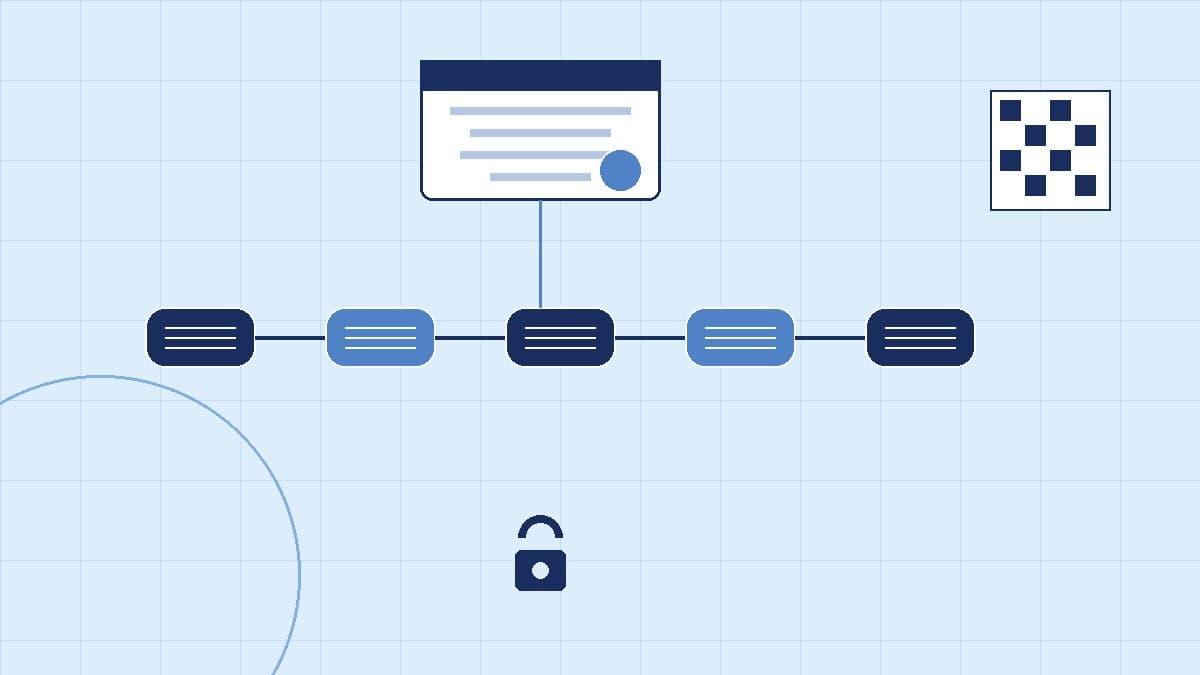
A blockchain is an immutable, distributed ledger — a chain of records where each block is cryptographically linked to the block before it. The property that matters for academic credentials is tamper-evidence at the document level: once a record is written to the chain, altering it invalidates every subsequent block in the chain across all nodes. Fraud becomes computationally infeasible and mathematically detectable.
When an academic credential is issued as a blockchain document, the process is as follows:
The student can share the document freely by any means — email, WhatsApp, uploaded to an application portal — without the receiving institution needing to contact the issuing institution. Verification takes seconds.
CBSE's Implementation
CBSE began issuing Academic Blockchain Documents in 2021, making it one of the earliest national examination bodies in Asia to do so at scale. Class 10 and Class 12 result certificates are anchored to a cryptographically secured chain where result data is stored in linked blocks.
The CBSE implementation records academic data in a linked chain structure where each block is cryptographically bound to the previous one. Altering any single certificate would require recomputing every subsequent block across all nodes in the distributed network — a task that is computationally infeasible with current hardware and makes fraud economically unviable at any scale.
Colleges and employers that receive a CBSE Academic Blockchain Document verify it by querying the blockchain record directly, without contacting CBSE, writing to regional offices, or waiting for a manual verification response. Verification takes seconds. This has eliminated a significant share of the verification backlog that CBSE regional offices previously managed.
Odisha Board's 2026 Integration
In 2026, the Board of Secondary Education, Odisha integrated blockchain technology with cloud-based storage for student examination records. The integration ensures that results, marksheets, and provisional certificates are tamper-proof from issuance and accessible via mobile and web platforms.
The Odisha implementation links blockchain-anchored records to student accounts accessible through the state's digital education portal. Students can download their verified credentials on demand. Institutions can verify them through a standardised API endpoint without requiring a physical copy or manual confirmation from the board.
The Odisha model is notable because it pairs blockchain with cloud storage rather than replacing one with the other. Cloud storage provides accessibility and redundancy; blockchain provides integrity assurance. The combination means a credential is both easily retrievable and independently verifiable — two requirements that previously pulled in different implementation directions.
Why This Matters for NAAC Accreditation
NAAC's upgraded DVV (Desk Verification Visit) process, implemented as part of the 2024-25 framework revision, cross-references institutional data against UGC, AICTE, AISHE, and NIRF databases automatically. Discrepancies surface algorithmically. An institution that submits graduation outcome data in its Self-Study Report that does not align with AISHE-reported figures for the same period will receive a DVV query before the peer team visit.
Blockchain-issued credentials make institutional data natively machine-verifiable. For Criterion 2 (Teaching, Learning, and Evaluation) and Criterion 5 (Student Support and Progression), peer teams increasingly require evidence that graduation outcomes, pass percentages, and student progression rates are backed by records that can withstand external verification. A blockchain-anchored result set is higher-assurance evidence than a scanned marksheet folder submitted through the IQAC portal.
Under the new Binary Accreditation framework with MBGL grading, institutions must demonstrate that their data meets integrity standards across measurable outcomes. An institution whose examination records are blockchain-anchored can demonstrate data integrity structurally — as a property of the issuance system — rather than through attestation, affidavit, or self-declaration. This is a qualitatively different level of evidence in a peer team review.
For NIRF data submissions — particularly Graduation Outcomes, which carries weight across all ranking categories — blockchain-verifiable result data eliminates the data-quality risk where unverifiable internal records reduce the evidence credibility of the submission. The NIRF 2026-27 cycle, with expected results in August 2026, will likely see institutions that can provide verifiable graduation outcome data fare better in DVV processing.
International Credential Recognition
For Indian universities seeking partnerships with overseas institutions, or for students applying to graduate programmes abroad, blockchain-backed credentials address a significant friction point. Many international universities require verified academic transcripts dispatched directly from the issuing institution — a process that can take 3-6 weeks and cost Rs. 2,000-8,000 in attestation, courier, and notarisation fees.
A blockchain-anchored credential eliminates the need for apostille or manual attestation for most purposes. The student presents the digital credential; the receiving institution runs the verification query and receives a cryptographic confirmation in seconds. The Association of Commonwealth Universities and several European credential recognition networks have begun accepting blockchain-verified academic documents as equivalent to notarised or apostilled transcripts.
For universities participating in Memoranda of Understanding with overseas institutions — an activity that contributes to Criterion 7 (Institutional Values and Best Practices) under NAAC and to the International Outlook parameter in some rankings — being able to issue credentials that overseas partners can verify without correspondence is a practical enabler, not merely a reputational one.
The APAAR ID Connection
APAAR (Automated Permanent Academic Account Registry) assigns a unique 12-digit identifier to every student enrolled in a UGC-recognised institution. As APAAR adoption scales — currently mandatory for new enrolments at affiliated colleges from 2024-25 — the student's academic journey from enrolment through graduation is captured under a single, nationally unique identifier.
Blockchain-anchored credentials linked to APAAR IDs create a continuous, tamper-proof academic record that follows the student rather than residing in fragmented institutional databases. A student who transfers institutions under the Academic Bank of Credits (ABC) framework carries a cryptographically verifiable transcript. Each institution in the transfer chain can verify the credits from previous institutions without relying on paper documents that must be re-validated at each step.
The APAAR-ABC-blockchain combination represents the architecture India's National Education Policy 2020 envisioned under the Academic Bank of Credits: a student-centric, verifiable record that enables flexible degree pathways without the verification overhead that currently makes credit transfers administratively burdensome.
What Universities Need to Do
Implementing blockchain-backed credential issuance does not require building a distributed ledger from scratch. Several platforms operating in the Indian higher education market provide institution-facing APIs: the institution submits a credential document, the platform anchors it to a distributed ledger, and returns a QR code or verification link for inclusion in the issued document.
Audit current data quality first. Blockchain anchoring is only as reliable as the underlying data. If examination records contain inconsistencies — mismatched student IDs, marks that were manually corrected without audit trails, gaps in the progression data — these need to be resolved before anchoring. This audit is typically productive in its own right: institutions that undertake it often surface long-standing data quality issues that were affecting DVV performance without being visibly attributable to any single cause.
Layer on top of DigiLocker, not instead of it. Most institutions already have or are acquiring DigiLocker issuer status. Blockchain credential issuance can be added as a parallel channel — students receive their credential in DigiLocker for everyday access and as a blockchain-anchored document for high-assurance verification. The two mechanisms serve different use cases and are complementary.
Document the implementation for NAAC Criterion 6. Under Criterion 6 (Governance and Leadership), the adoption of technology-driven quality assurance mechanisms is a scoreable indicator. Blockchain credential issuance, documented in the Annual Quality Assurance Report (AQAR) and IQAC meeting records, contributes to the evidence portfolio for this criterion. The documentation should cover the technical implementation, the number of credentials issued, and the verification mechanism provided to receiving institutions.
Build a verification guide for employers and admission offices. Blockchain-anchored credentials are only as valuable as their adoption by receiving parties. A one-page guide — showing exactly how to run a verification query against the public blockchain endpoint for credentials your institution issues — ensures that the investment in issuance translates into real reductions in manual verification requests to the registrar's office.
---
Related Reading
Ready to digitize your evaluation process?
See how MAPLES OSM can transform exam evaluation at your institution.