Why the Global AI Cheating Crisis Is Making On-Screen Marking Indispensable
As ACCA abandons remote exams and 46% of students admit using LLMs in graded work, supervised handwritten exams evaluated on-screen have become the only academically credible format.
The World's Largest Accounting Body Just Abandoned Remote Exams
On 4 November 2025, the Association of Chartered Certified Accountants (ACCA) — a professional body with over 500,000 members and students across 180 countries — quietly ended the sale of remote exam tokens. From March 2026, all ACCA session-based examinations reverted to physical, in-person test centres.
The reason: artificial intelligence.
ACCA's CEO stated that "technological developments have made policing remote assessments more challenging, particularly with the rise of artificial intelligence tools. Those attempting to bypass safeguards are evolving faster than the systems designed to stop them."
For Indian universities evaluating their examination strategy, this decision carries a message that cannot be ignored.
How Bad Is the AI Cheating Problem?
The numbers from 2025-26 academic research are stark:
The Deccan Herald has noted that Indian universities "are not sufficiently prepared to identify AI-generated content that is contextually relevant and original." As of early 2026, UGC has no comprehensive policy specifically addressing AI misuse in academic submissions.
The problem is structural, not merely disciplinary. Students are not breaking rules that exist — they are operating in a policy vacuum, with tools that produce passing-grade work in seconds.
Why Handwritten, Supervised Exams Are Now the Last Line of Defence
Every major cheating vector that AI enables requires one condition: the student must have unsupervised access to a device.
| Assessment Format | AI Cheating Risk | Mitigation Available |
|---|---|---|
| Take-home assignment | Extremely high | Detection tools mostly ineffective |
| Online open-book exam (remote) | High | AI proctoring partially effective |
| Online closed-book exam (centre) | Medium | Locked browsers, monitoring |
| Handwritten in-person exam | Very low | Physical supervision |
The supervised, handwritten examination remains the one format where artificial intelligence cannot intervene at the moment of response generation. A student sitting in an exam hall with a pen and an answer book cannot route questions through an LLM and transcribe responses in the time remaining.
This is precisely why ACCA, after evaluating every available technological countermeasure, concluded that in-person delivery is the only reliable solution.
India's Competitive Advantage — and the Risk of Abandoning It
India's examination system has, largely by convention, maintained the format that the rest of the world is now trying to return to: supervised, handwritten examinations.
State boards, university semesters, CBSE Class 10 and 12, and most internal assessments at affiliated colleges still rely on students writing answers by hand, under supervision, in designated halls. This is not backwardness. It is the most AI-resistant assessment architecture available.
The risk arises when institutions, seeking modernisation, move assessments online without a clear integrity strategy. Remote open-book or online examinations — popular during the COVID-19 period — have not been retired at many colleges despite the restoration of in-person learning. These are now high-risk formats.
ACCA's India market is one of its largest globally. As the body reverts to centre-based delivery, Indian students in professional programmes face extended travel and logistics challenges. Universities watching this trend should draw the correct lesson: not that digital is bad, but that unsupervised digital is a category error.
Where On-Screen Marking Closes the Loop
The question for universities is not whether to run handwritten supervised exams. The question is how to evaluate those answer books with accuracy, consistency, and speed — without manual processes that introduce bias, errors, and delays.
This is where on-screen marking (OSM) resolves the tension.
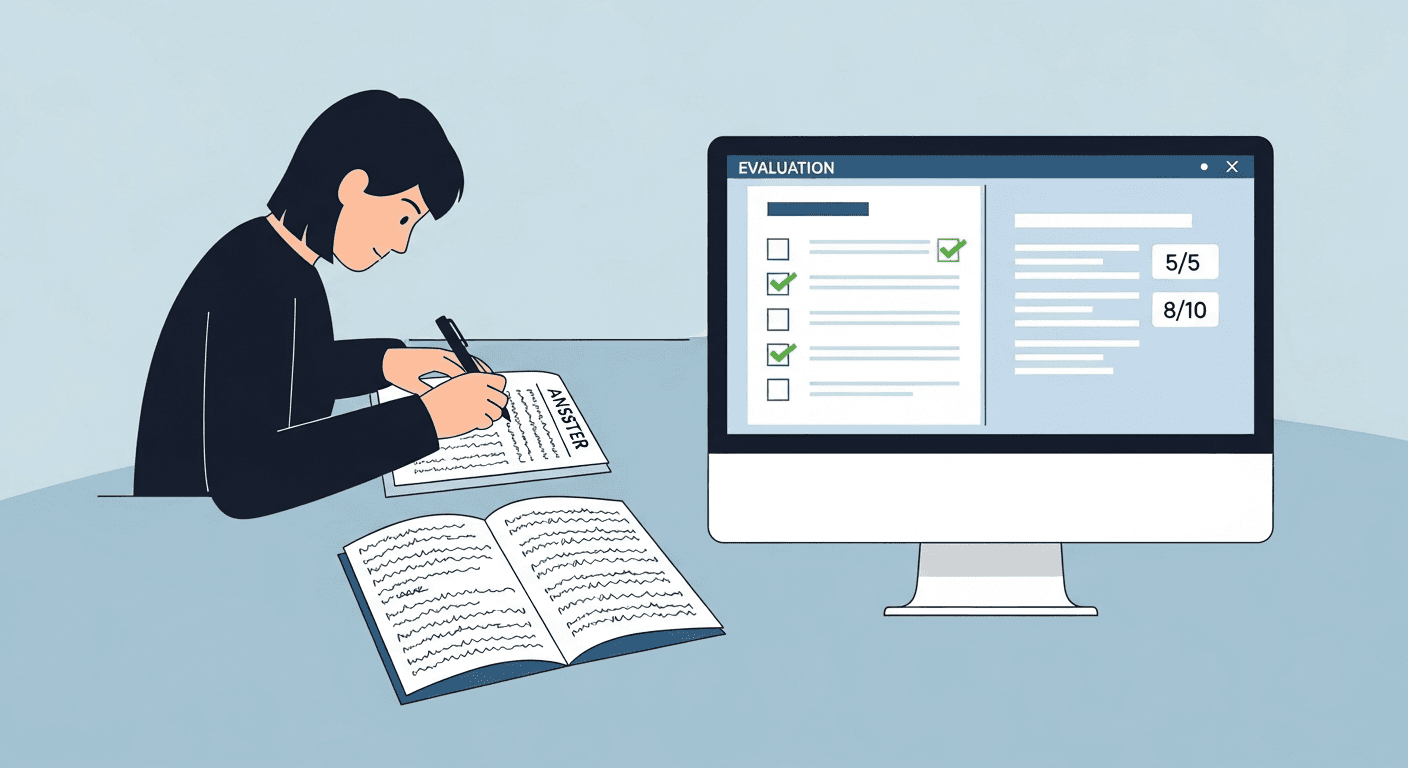
OSM does not change what students write. It changes how that writing is assessed:
The combination — handwritten supervised exam (AI-resistant input) + on-screen marking (bias-resistant evaluation) — addresses both ends of the academic integrity problem simultaneously. Students cannot use AI to write the answers. Evaluators cannot award inflated marks based on handwriting familiarity or coaching centre relationships.
This is not a compromise. It is the design the moment calls for.
Why LLM-Generated Handwritten Answers Are Still Detectable
A legitimate concern: can a student use an LLM to generate an answer, then transcribe it by hand in the exam hall? In theory, yes — if a student memorises an AI-generated response and reproduces it.
In practice, this is constrained by several factors:
Subject-specific working: In mathematics, physics, chemistry, and engineering papers, examiners award marks stepwise — for each line of working, each intermediate result. An AI-generated final answer without the correct sequence of steps scores poorly. LLMs frequently produce plausible-looking incorrect working in technical subjects.
Stylistic inconsistency: Students who transcribe AI responses verbatim typically produce answers that are unusually well-structured and verbally consistent across questions, while showing weak performance on unexpected sub-parts that required adapting the response. Experienced examiners notice this pattern.
Time constraints: An LLM-memorisation strategy for a three-hour examination covering unpredictable questions is practically infeasible for most candidates. It requires prior access to the exact questions — which is the paper leak problem, not the AI problem.
On-screen marking actually helps detect transcribed AI responses in one additional way: evaluators reviewing scripts on-screen can zoom in on individual responses and flag anomalous quality patterns for moderation, without the fatigue of marking physical booklets across three hours.
What Indian Universities Should Do Now
Four steps for institutions reviewing their assessment strategy in light of the global AI cheating landscape:
The Broader Signal
The global examination sector spent 2020-2024 trying to replace the exam hall with remote proctoring, online open-book assessments, and digital submissions. The AI inflection of 2024-25 has forced a rapid reassessment.
ACCA's decision is the clearest institutional signal yet that the pendulum is swinging back. The exam hall is not going away. What is changing — and what must change — is how the answer books that emerge from that exam hall are evaluated.
On-screen marking of handwritten scripts is not a backward technology. It is the evaluation methodology that works with India's existing examination infrastructure to produce the one thing every institution needs right now: a result that both students and regulators can trust.
Related Reading
Ready to digitize your evaluation process?
See how MAPLES OSM can transform exam evaluation at your institution.