Building a Digital Examination Grievance Redressal System: A University Guide
Indian universities face a surge in revaluation applications and court challenges. A structured digital grievance system reduces legal exposure, resolves disputes faster, and generates NAAC compliance evidence automatically.
The Grievance Problem Has Reached Systemic Scale
India's examination system generates tens of millions of evaluated answer books every year. Even a very small error rate across that volume produces a large absolute number of genuine grievances. When examination bodies also face allegations of systematic evaluation failures—as has happened repeatedly at state board and university level in recent years—the number of revaluation and mark-verification applications can surge dramatically within weeks of result declaration.
Universities are not equipped to handle this volume manually. The CBSE on-screen marking rollout in 2026 received over 70,000 grievance applications within three weeks of results. Individual state universities regularly receive tens of thousands of revaluation requests in the 30-day post-result window. The institutional response to these requests—how fast, how transparent, and how reliably they are resolved—has significant legal, financial, and reputational consequences.
Courts are increasingly involved. Students who do not receive timely or satisfactory responses to grievances file RTI applications, approach consumer courts, and file writ petitions in High Courts. The legal cost of defending a single writ petition in a High Court is typically between Rs. 50,000 and Rs. 5,00,000 in institutional legal fees, plus significant management time. A university receiving 5,000 revaluation applications that escalates even 1% of them to court-level disputes is spending Rs. 25 lakh to Rs. 2.5 crore annually on grievance-related litigation.
A well-designed digital grievance redressal system does not just speed up processing. It prevents escalation.
What a Digital Examination Grievance System Must Do
Before selecting technology or designing workflows, an institution should define what the system needs to accomplish:
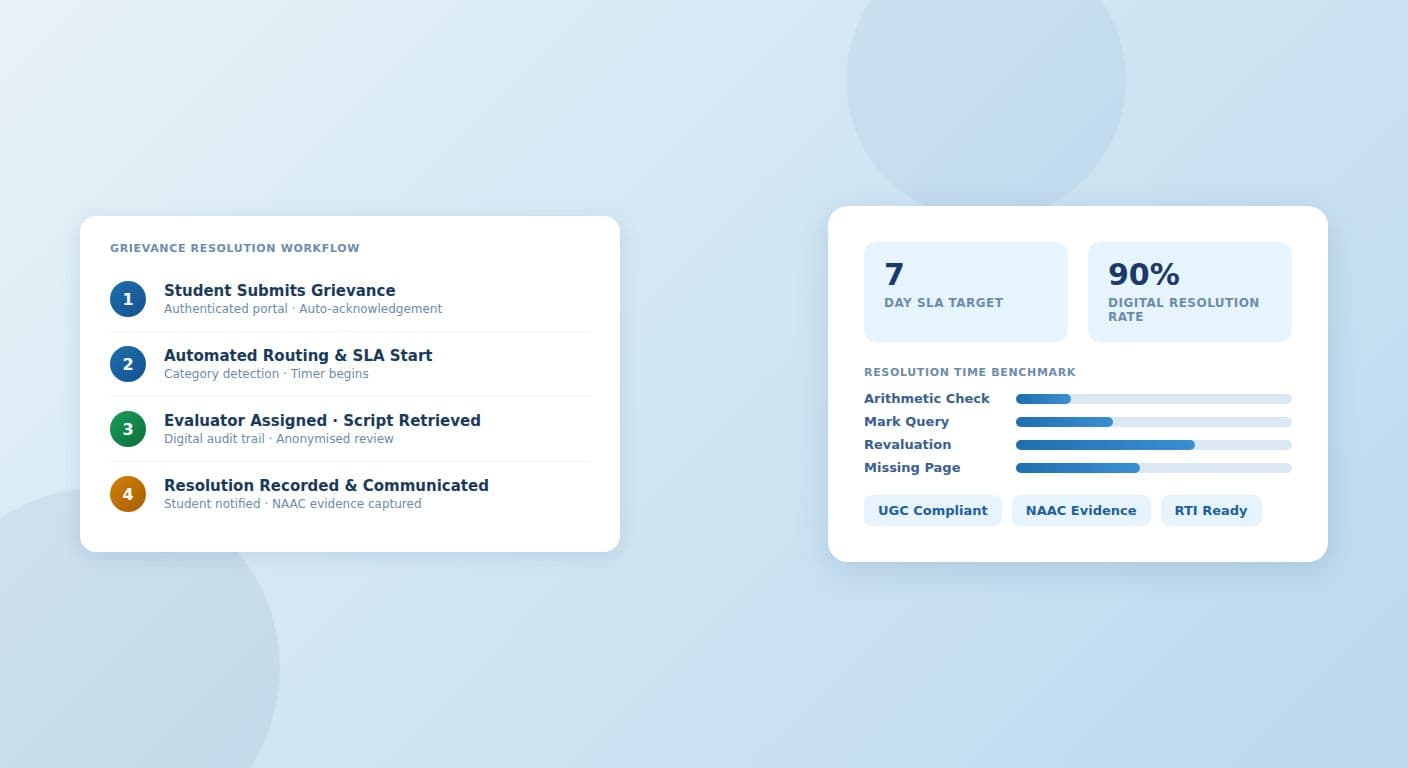
Student-facing complaint submission: Students must be able to submit a grievance—mark verification request, revaluation application, missing mark complaint, evaluation error report—through a single, authenticated interface. The system should record the submission timestamp and generate a unique complaint ID.
Automated categorisation and routing: Not all grievances are the same. A request to verify total marks is resolved by arithmetic check; a request for full revaluation requires evaluator time; a complaint about a missing answer book page requires scan verification. The system should route each category to the appropriate resolution workflow automatically.
SLA tracking with escalation alerts: Every grievance category should have a defined resolution timeline—for example, mark verification within 3 working days, standard revaluation within 15 working days. The system should track elapsed time against these SLAs and escalate to supervisors automatically when a grievance approaches its deadline without resolution.
Evaluator assignment and audit trail: When a revaluation is required, the system should assign a fresh evaluator (different from the original), track when the evaluator received the assignment, when they completed it, and what mark was awarded. This audit trail is the institution's defence in any subsequent dispute.
Student communication: At each stage—receipt acknowledgement, processing update, resolution—the student should receive automated notification via email or SMS. Silence breeds frustration and litigation. Automated updates are low-cost and high-impact.
Outcome recording with reasoning: When a grievance is resolved, the resolution outcome and the basis for it should be recorded. "Total marks verified; no arithmetic error found" or "Revaluation conducted; original mark confirmed" or "Page scanning error identified; mark revised to [X]" are all specific resolution records that protect the institution from repeat grievances and court challenges.
Step-by-Step Implementation Guide
Step 1: Audit Your Current Grievance Volume and Types
Before designing a system, understand the scale of your problem. Pull data from the last three examination cycles:
This audit reveals your bottlenecks. An institution where 60% of grievances are arithmetic verification requests (a fast, straightforward check) but where these requests take 45 days because they are queued with complex revaluations has a routing problem, not a capacity problem.
Step 2: Define Your Grievance Taxonomy
Establish standardised categories:
| Grievance Type | Typical Resolution Time | Resolution Pathway |
|---|---|---|
| Total marks arithmetic check | 1-3 working days | Administrative verification |
| Individual question mark query | 3-5 working days | Marking scheme comparison |
| Standard revaluation | 10-15 working days | Fresh evaluation by new evaluator |
| Missing answer book page complaint | 3-7 working days | Scan and physical record comparison |
| Evaluator identity dispute | 5-10 working days | Evaluator attribution audit |
| Answer book not found | 5-15 working days | Complete audit of handling chain |
Step 3: Integrate with Your Evaluation Data
A grievance system that operates in isolation from the evaluation system forces manual data retrieval for every complaint. An integrated system allows the grievance portal to:
If your evaluation system records structured per-question marks with evaluator attribution—as digital on-screen marking systems do—the grievance system can resolve a significant proportion of complaints automatically by presenting the student with the documented basis for their mark. Many students who believe they were graded incorrectly, when shown the answer key mapping alongside their script and question-level marks, withdraw their revaluation request without further process.
Step 4: Define Your SLAs and Publish Them
Universities are required under UGC regulations to have grievance mechanisms with defined turnaround times. Publishing those timelines—on the institution's examination portal, in the student handbook, and in every result notification—creates accountability and reduces the volume of follow-up queries from students who don't know what to expect.
Recommended public SLA commitments:
The existence of an emergency pathway for students with documented admission deadlines reduces court interventions dramatically. A student who can get a revaluation result in 5 working days before their admission deadline has no reason to go to court; a student who cannot and loses an admission opportunity will.
Step 5: Train All Stakeholders
The technology is only part of the implementation. Training is required for:
Examination cell staff: How to process incoming submissions, route them correctly, and respond to system escalation alerts.
Evaluators assigned to revaluations: Revaluation is not a second attempt at the same evaluation—it is a fresh, independent evaluation with no knowledge of the original mark. Many evaluators need explicit training on maintaining this independence.
Student-facing staff: Front desk and helpdesk staff need to be able to explain the grievance process accurately and consistently. Inconsistent information is a major driver of student frustration and escalation.
IQAC members: The grievance system generates data—complaint volumes, resolution rates, types—that should feed into the IQAC's quality monitoring. This is also NAAC evidence.
Step 6: Monitor and Improve
A grievance system is not a set-and-forget installation. Monthly review of:
This monitoring data feeds into evaluation quality improvement. If revaluation of Chemistry papers consistently produces mark changes above 30%, there is a Chemistry evaluation process problem that should be addressed at the evaluator training or marking scheme level—not managed indefinitely through the grievance system.
The NAAC Evidence Dimension
NAAC's current framework requires institutions to demonstrate:
A digital grievance system that produces structured resolution records, completion timestamps, and trend data directly satisfies these requirements. The institution's NAAC Self-Study Report (SSR) can include verified statistics—"X grievances received, Y% resolved within 15 working days, Z% resulted in mark revisions"—without requiring manual compilation.
This data is also relevant to UGC compliance requirements, RTI responses, and any court challenge where the institution needs to demonstrate systematic and fair handling of student complaints.
What Institutions Should Avoid
Do not create a grievance system that promises transparency but delivers opacity. Students who submit a complaint and receive no update for 30 days are angrier than students who were never given a portal to begin with. A system must deliver on its SLA commitments or its existence will increase litigation, not reduce it.
Do not disconnect the grievance system from the evaluation system. A portal that stores complaint text but cannot retrieve original evaluation data forces manual intervention for every resolution. This defeats the efficiency purpose.
Do not restrict the grievance taxonomy to protect the institution. If students can only apply for "total marks verification" but cannot dispute specific question marking, legitimate grievances will escalate directly to courts. A broad, accessible category structure reduces litigation by capturing and resolving more complaints internally.
The Investment Case
The cost of implementing a digital examination grievance system—whether as a module within an existing on-screen marking platform or as a standalone portal—is a fraction of the annual litigation costs most mid-size universities bear. An institution receiving 3,000 revaluation applications annually that reduces court-escalation from 2% to 0.5% prevents approximately 45 court cases per year. At a conservative average legal cost of Rs. 1 lakh per case, that is Rs. 45 lakh in annual litigation savings from improved process alone—before counting management time, reputational impact, and the NAAC evidence value.
The grievance system is not overhead. It is risk management infrastructure.
Related Reading
Ready to digitize your evaluation process?
See how MAPLES OSM can transform exam evaluation at your institution.