RBSE Rajasthan 2026: How India's Largest State Boards Manage the April Results Rush
Rajasthan Board declared Class 12 results on March 31 — just 20 days after the final exam. The speed benchmark reveals what efficient state-board evaluation looks like at scale.
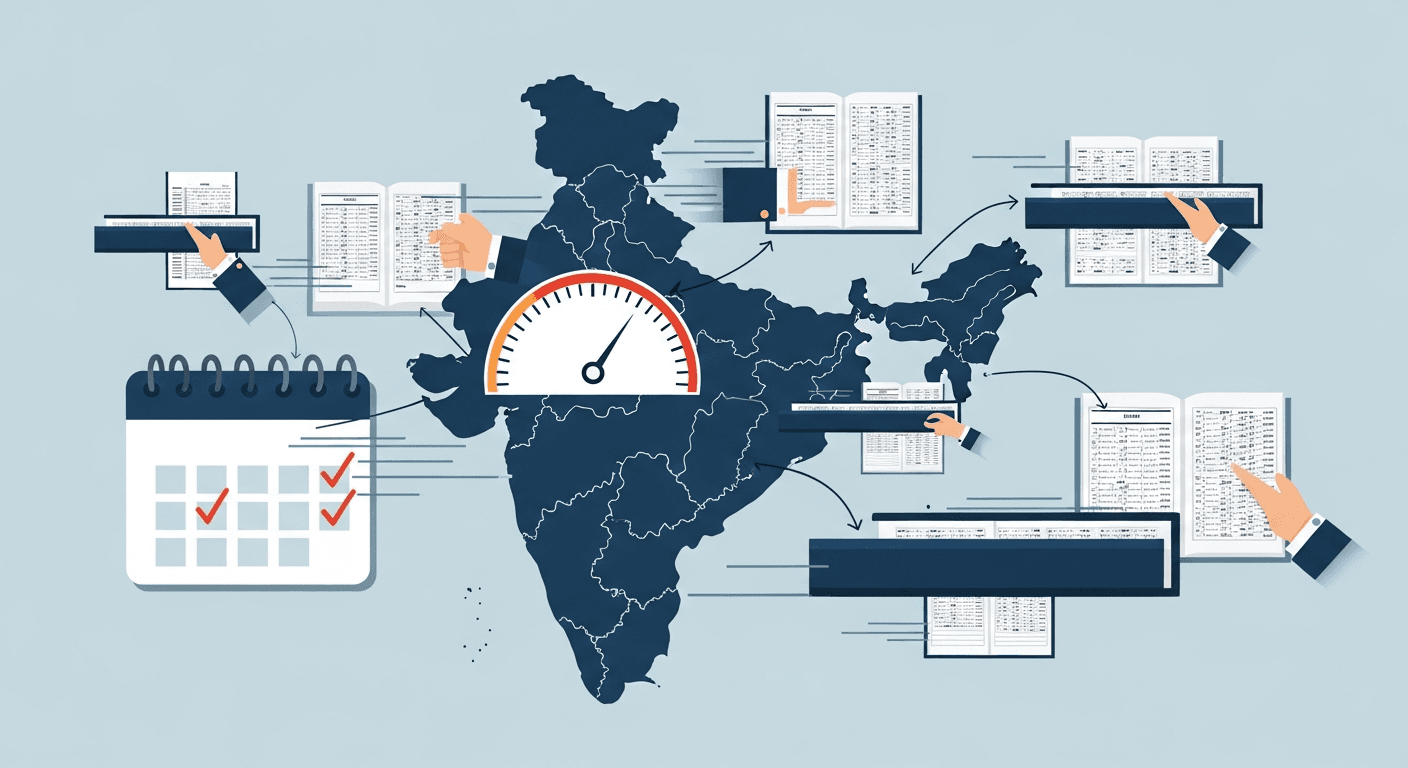
Twenty Days From Last Paper to Results
When the Board of Secondary Education, Rajasthan (RBSE) declared its Class 12 results on March 31, 2026, it did so just 20 days after the final examination paper was written on March 11. Approximately 9 lakh students had appeared for the examinations, which ran from February 12 across 139 exam centres in Rajasthan. The board reported a 96.30 percent pass rate for the Senior Secondary examination.
Twenty days is a tight window for processing 9 lakh answer scripts. In examination management, the interval between last paper and result declaration is one of the most revealing metrics of a board's operational efficiency. It reflects how quickly answer scripts are collected and transported to evaluation centres, how smoothly the evaluator network functions, how fast marks are tabulated, and how reliably quality checks are completed before the final result file goes live.
Rajasthan's performance in 2026 invites a broader look at how India's major state boards manage the evaluation sprint — and what separates the faster results from the slower ones.
The Scale Across India's Major State Boards in 2026
Result declaration timelines varied significantly across major boards in 2026:
| Board | Last Exam (Approx.) | Result Declared | Interval |
|---|---|---|---|
| RBSE Rajasthan (Class 12) | March 11 | March 31 | ~20 days |
| TS Intermediate (TSBIE) | Early March | April 12 | ~5 weeks |
| AP Intermediate (BIEAP) | Early March | April 15 | ~5-6 weeks |
| UP Board (UPMSP) | March | April 23 | ~4-5 weeks |
| CBSE Class 12 | March | ~April 30 | ~6 weeks |
| ICSE / ISC (CISCE) | March | ~April 30 | ~6 weeks |
The variation is not fully explained by board size. RBSE handled 9 lakh Class 12 students in 20 days. UP Board processed 52 lakh students across Class 10 and 12 in a longer window. CBSE's OSM-based digital evaluation, which eliminated the travel time associated with physically transporting scripts to evaluation centres, was expected to produce results in approximately 9 days of active evaluation — yet the full cycle from last paper to result declaration spans roughly six weeks due to quality-check and moderation workflows.
What Drives Result Declaration Speed
The evaluation pipeline between last examination day and result declaration involves several sequential stages, each with its own bottleneck potential:
Collection and Transport
In paper-based systems, answer scripts must travel physically from examination centres to evaluation centres. For a state the size of Rajasthan — spanning 342,239 square kilometres — this logistics chain is non-trivial. Scripts are bundled, sealed, transported by designated vehicles, and received at evaluation centres with verification documentation.
Evaluator Mobilisation
Evaluation camps require teachers from affiliated schools and colleges to travel to centralised evaluation centres and work for defined daily sessions, typically 8-10 hours. Evaluator availability depends on school calendars, travel distance, and daily mark targets. A bottleneck in evaluator turnout can delay the entire pipeline.
Mark Tabulation
Once evaluation is complete, marks from individual answer scripts must be transferred to tabulation sheets, then compiled into a central marks register, then processed through the board's result software. Each transfer step is a source of potential error and delay.
Quality Checks and Moderation
Boards conduct statistical checks on mark distributions before finalising results — identifying subjects or evaluation centres where the distribution deviates significantly from historical norms. This moderation step adds time but is essential for result integrity.
Publication Infrastructure
Final results must be uploaded to official portals, DigiLocker, and UMANG in formats accessible to millions of students simultaneously. Server infrastructure planning and testing add to the timeline.
RBSE's Speed Advantage
Several factors appear to have contributed to RBSE's faster-than-average 2026 timeline. Rajasthan's relatively concentrated student population — 9 lakh Class 12 students is substantial but more manageable than UP's 52 lakh — reduces the logistics complexity at the collection and transport stage. The board's established evaluation centre network, developed over decades of administration, allows for rapid mobilisation.
RBSE has also progressively adopted digital tools for result processing and mark compilation, even while maintaining physical answer script evaluation at the evaluator level. Mark tabulation software and digital result publication infrastructure, combined with an experienced administrative apparatus, allow the board to compress the post-evaluation stages significantly.
The 96.30 percent pass rate also reflects efficient subject-wise moderation — boards with unexpected result distributions face longer quality-check cycles before publication approval.
The Digital Evaluation Variable
The most consequential change in India's evaluation landscape in 2026 has been CBSE's full-scale rollout of on-screen marking (OSM) for Class 12. While CBSE's total pipeline time remains around six weeks — reflecting the complexity of its 38-lakh-student cohort and the rigour of its moderation process — the active evaluation window has compressed from approximately 12 days to 9 days within the OSM system.
On-screen marking changes the collection and transport equation fundamentally. Answer scripts are scanned at examination centres and uploaded to a secure cloud platform. Evaluators access scripts remotely through authenticated portals, eliminating the need to travel to physical evaluation camps. A teacher in Chandigarh can evaluate scripts from a batch in Kochi without either the evaluator or the script moving.
For a state board like RBSE, digital evaluation would compress the collection-to-evaluation-centre transit time to zero. The 3-4 days currently spent on physical logistics between March 11 (last paper) and the start of active evaluation would vanish. The evaluator mobilisation constraint — which forces boards to schedule evaluation around teacher availability for in-person camps — would be replaced by a flexible remote evaluation model where teachers evaluate from their own schools.
What Student Experience Looks Like at Scale
For the 9 lakh students who received RBSE Class 12 results on March 31, the speed of declaration has immediate practical consequences. College admission processes in Rajasthan begin from April — having board results by the end of March gives students a full month of processing time before early admission windows close.
Faster results also reduce the anxiety that accumulates in the gap between last examination and result declaration. Research on examination-related student wellbeing consistently identifies the waiting period as a significant source of stress. Every week shaved off the evaluation pipeline is a week fewer that students spend in uncertainty.
Students seeking scrutiny or revaluation also benefit from earlier results — the post-result processing window runs more effectively when there is more time before the next academic intake begins.
The Infrastructure Threshold
RBSE's 2026 performance illustrates what is achievable within a well-optimised paper-based evaluation system. Twenty days for 9 lakh scripts represents near-optimal execution of the traditional model.
But the ceiling of optimisation for paper-based evaluation is visible. Scripts still travel physically. Evaluators still congregate at camps. Marks are still entered by hand. Each of these creates irreducible time costs and error risk that digital evaluation eliminates at the source.
India's fastest boards in 2026 are approaching the limit of what efficient paper-based management can achieve. The next threshold of improvement — results in under two weeks for state-level boards of this size — requires the infrastructure shift that on-screen marking represents.
The boards that invest in digital evaluation infrastructure now will be positioned to cross that threshold in the 2027 and 2028 cycles. Those that wait will continue optimising within a model that has already approached its natural limits.
---
Related Reading
Ready to digitize your evaluation process?
See how MAPLES OSM can transform exam evaluation at your institution.