PARAKH's Expert Committee to Standardize India's 60+ State Board Exams
NCERT's PARAKH has constituted an expert committee to harmonize assessment standards across India's state and union territory boards, incorporating AI-based tools and international benchmarks. Here is what universities receiving results from multiple boards need to understand.
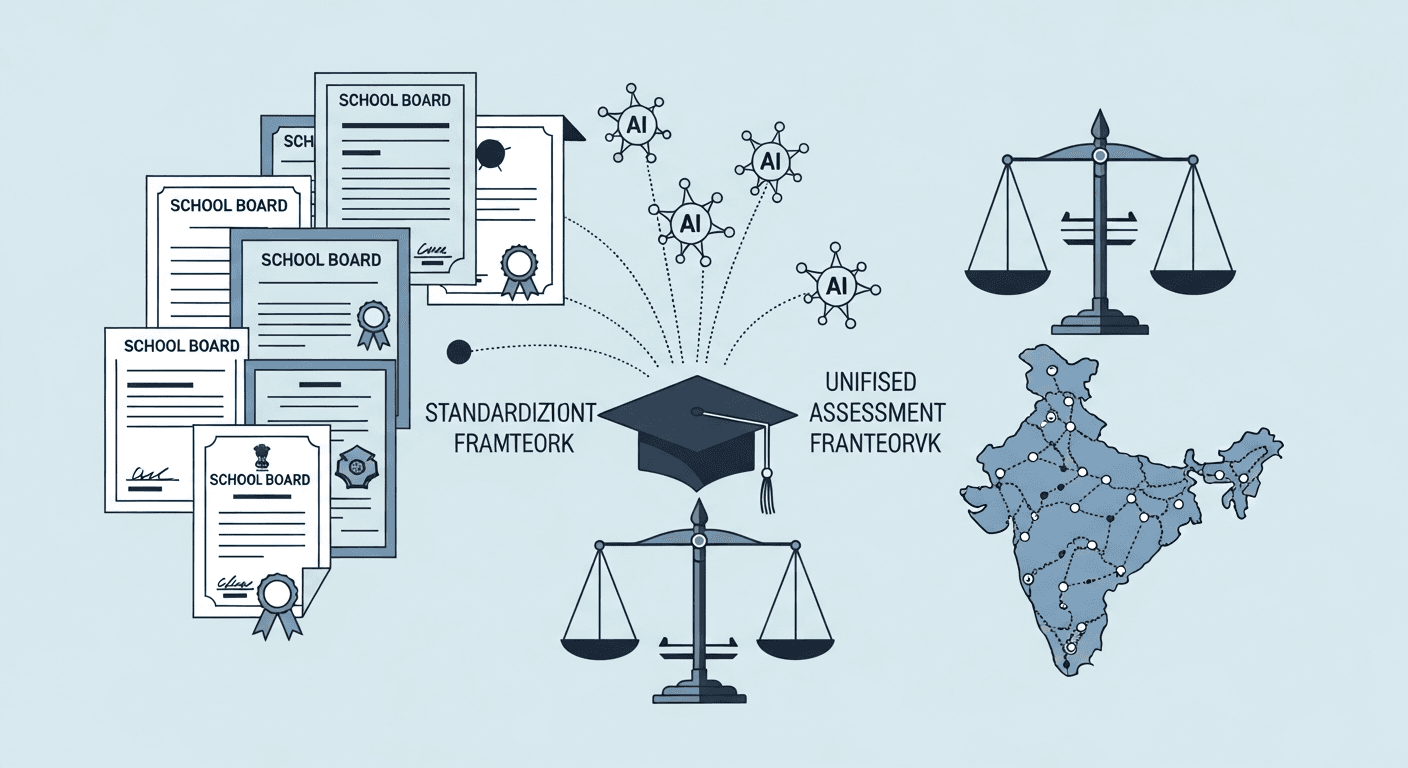
The Fragmentation Problem PARAKH Was Built to Solve
India's school examination system comprises over 60 state and union territory boards, each operating under its own syllabus, marking scheme, and assessment philosophy. A student scoring 95% in one board may have answered questions of considerably different difficulty from a student scoring 95% in another. Universities receiving admissions from across states have long had to navigate this inconsistency, applying normalisation practices that are informal, often opaque, and legally contested.
PARAKH — Performance Assessment, Review and Analysis of Knowledge for Holistic Development — is the body established under NCERT in pursuance of the National Education Policy 2020 to address this fragmentation. Its mandate is explicit: set norms, standards, and guidelines for student assessment across all recognized school boards in India, guide national and state achievement surveys, and monitor learning outcomes.
PARAKH has now constituted a formal expert committee to move from standard-setting in principle to standardization in practice. The committee is specifically tasked with developing a mechanism to enable equivalence across board examination results — allowing a student's grade from a state board in Meghalaya to be meaningfully compared with one from a board in Rajasthan when both are applying to the same central university.
What the Expert Committee Is Working On
The PARAKH expert committee is working across three interconnected workstreams:
1. Common Assessment Standards
The committee is developing a framework of learning standards — what a student should be able to demonstrate at the Class 10 and Class 12 levels in core subjects. These standards do not replace board syllabi but provide a reference frame against which board assessments can be mapped. Boards that align their examinations to these standards produce results that are more comparable across geographies.
This is analogous to how international qualification bodies operate. The International Baccalaureate, for instance, uses standardized rubrics and moderation processes that make a 7 in Biology in Mumbai comparable to a 7 in Biology in Stockholm. PARAKH is attempting something structurally similar at the national level within India.
2. AI-Assisted Assessment Tools
PARAKH is developing AI-based tools for assessment support and outcome measurement. The partnership with the Educational Testing Service (ETS), a US-based measurement body responsible for examinations including the GRE and TOEFL, brings international benchmark-setting expertise into the framework.
These tools are not replacing human examiners. They are being designed to support:
3. Board Equivalence Guidelines
By March 2026, PARAKH had targeted full parity across board results, eliminating mark curtailments that some universities apply to adjust for perceived grading inflation in certain boards. The practical realization of this target depends on how quickly individual state boards cooperate with the standardization framework. Progress has been uneven, but the institutional architecture for standardization is now in place in a way it was not two years ago.
Why This Matters for Universities
Universities are the primary institutional audience for board examination results. They are also the institutions most directly affected by the inconsistency PARAKH is trying to solve.
Admissions and Merit Lists
Central universities, state universities with large multi-board intakes, and national-level institutions currently manage board mark variability through cutoff adjustments and normalisation formulae that are institution-specific and, in some cases, court-challenged. PARAKH's standardization framework, if implemented successfully, would reduce the need for these workarounds.
For admissions offices, a PARAKH-standardized result would carry verifiable information about the difficulty and learning standard against which it was assessed. This is meaningfully different from the current situation, where a board's historical grading pattern is often the only context available.
NIRF and Accreditation Data
The NIRF ranking framework includes a Graduation Outcomes parameter that considers the quality of incoming students alongside the quality of graduating students. Universities that can demonstrate they admit students from academically rigorous backgrounds, and that those students achieve strong outcomes, score better on this parameter.
PARAKH's standardization will eventually produce publicly verifiable equivalence data. Universities that align their admissions processes with PARAKH-equivalent results — rather than raw board marks — will be better positioned to demonstrate the rigour of their admissions in NIRF and NAAC documentation.
Internal Assessment Consistency
NEP 2020's shift toward continuous, competency-based assessment requires universities to design internal assessments that align with learning outcomes. PARAKH's learning standards framework provides a reference for what those outcomes should look like at the entry level. Universities that have already adopted digital evaluation platforms are better positioned to align their assessment rubrics with PARAKH standards, because digital platforms make rubric-based evaluation operationally tractable at scale.
The Practical Timeline for Institutions
PARAKH's standardization work will not produce immediate changes to how board results are used. The expert committee's recommendations will need to be piloted, refined through state board cooperation, and eventually institutionalized through regulatory notification. A realistic horizon for meaningful equivalence data is 2027–2028.
What institutions should do now:
| Action | Rationale |
|---|---|
| Map your admissions data by board of origin | Understand how many of your incoming students come from which boards, and how their performance at your institution correlates with their board scores |
| Align internal assessment rubrics with NEP learning outcomes | PARAKH's framework will converge with NEP competency standards; institutions already using outcome-aligned rubrics will need less adjustment |
| Ensure your evaluation records are digitally stored and queryable | PARAKH compliance will eventually require demonstrating that your institution's own assessments meet equivalence and learning outcome standards |
| Engage your IQAC on PARAKH's assessment norms | The Internal Quality Assurance Cell should be tracking PARAKH developments as part of its NAAC evidence portfolio — specifically Criterion 1 (Curricular Aspects) and Criterion 2 (Teaching-Learning and Evaluation) |
What PARAKH's Work Does Not Change
It is worth being clear about what PARAKH's standardization initiative does not affect, at least in the near term.
State boards retain autonomy over their syllabi, examination design, and result declaration processes. PARAKH does not have regulatory authority to compel board compliance — it operates through guidance, standards publication, and cooperative agreements. Boards that choose not to align with PARAKH's framework will not face immediate sanction, though their results may eventually carry lower equivalence weight in university admissions.
The standardization also does not address the paper leak vulnerabilities, evaluation errors, and result delays that affect the operational reliability of state board examinations. PARAKH's mandate is assessment quality and learning outcomes, not examination security. Those remain the responsibility of individual boards and, for central examinations, the NTA and its successor institutions.
The Long-Term View
PARAKH represents a structural shift in how India thinks about assessment quality. For most of the past 75 years, board examinations have been treated as sovereign — each board's results carrying face value within its jurisdiction, with minimal external accountability for the standards underlying them.
The NEP 2020 framework changes this. PARAKH is the institutional mechanism for that change. Its expert committee's standardization work, however gradual, will ultimately reshape the information environment in which university admissions, institutional rankings, and accreditation decisions are made.
Universities that understand this trajectory — and that build the internal assessment infrastructure to demonstrate quality at every stage of the student journey — will be better positioned when PARAKH-equivalent results become the standard for admissions documentation.
For institutions currently running paper-based evaluation, the connection is direct. If incoming student quality will eventually be verifiable through standardized board equivalence data, institutions need comparable data quality for their own internal assessments. Digital evaluation platforms provide that data quality. Paper-based systems cannot.
---
Related Reading
Ready to digitize your evaluation process?
See how MAPLES OSM can transform exam evaluation at your institution.