NTA's 22-Employee Agency: The Staffing Crisis Behind India's Exam Security Failures
With only 22 permanent employees and 138 outsourced staff conducting 18 national examinations for crores of students, India's National Testing Agency was always structurally vulnerable. The NEET-UG 2026 cancellation makes that visible.
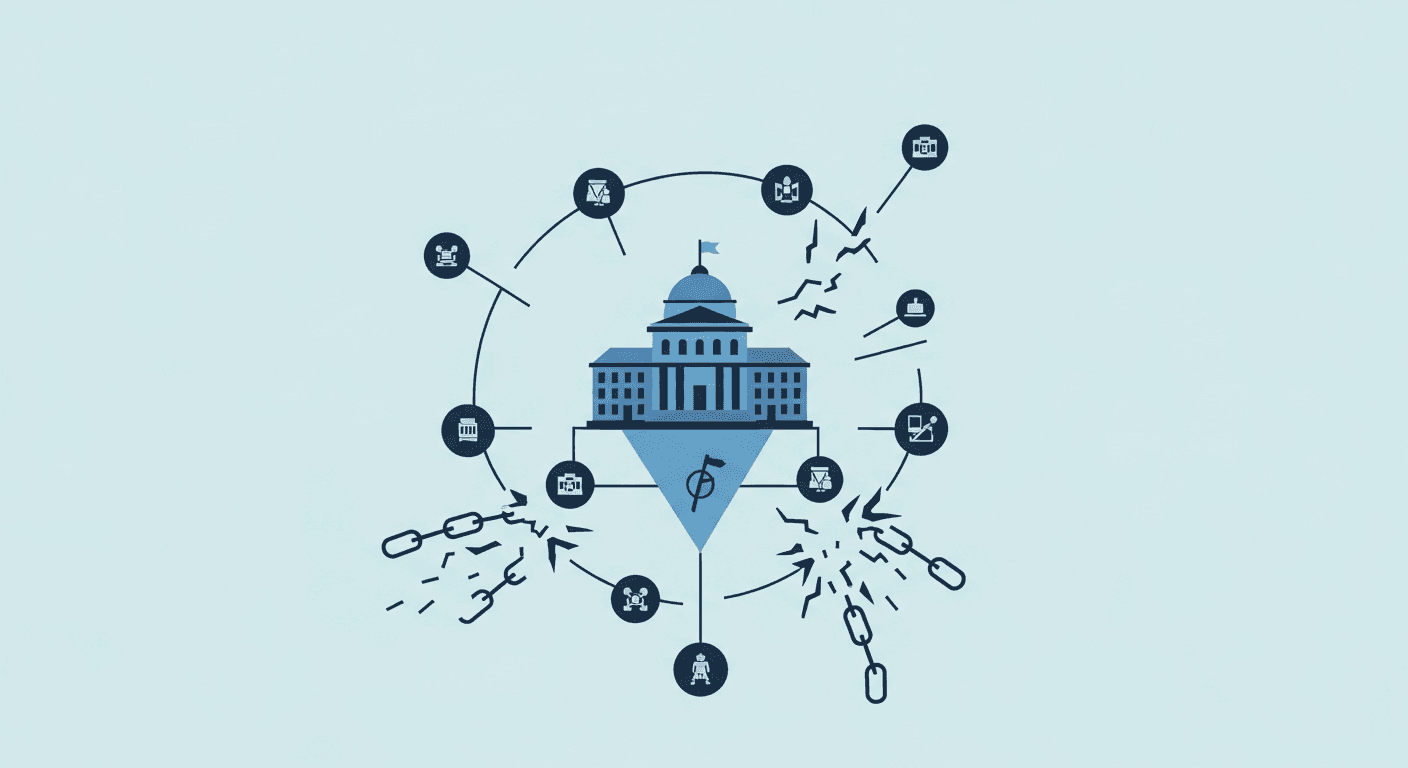
A National Agency Running on Borrowed Staff
When the NEET-UG 2026 examination was cancelled on May 12, 2026 — nine days after 22 lakh candidates sat for it — the immediate focus fell on the question paper leak. A "guess paper" containing over 400 questions had circulated on WhatsApp and Telegram groups roughly 42 hours before the exam. Approximately 120–140 of those questions matched the actual paper.
What attracted less attention was a structural detail buried in an investigative report: as of December 2024, the National Testing Agency operated with just 22 employees on deputation, 38 contract staff, and 138 outsourced personnel. That is a total workforce of fewer than 200 people conducting 18 national examinations annually across 5,500 exam centres in 550 cities.
A subsequent 2026 report found that 50 percent of the senior posts created as part of post-2024 reform measures remain vacant. Three directors general have served in quick succession between 2024 and 2026, each tenure too short for institutional memory to accumulate. The result is an agency that relies almost entirely on external vendors for the most sensitive parts of its work: question paper printing, logistics and distribution, centre management, biometric verification, and results processing.
Why Outsourced Vendor Networks Create Unownable Risk
There is nothing inherently wrong with outsourcing non-core functions. But examination security is not a non-core function. And when every link in the chain — from paper setting to printing, from courier to centre manager — belongs to a different vendor with its own staff, incentives, and oversight gaps, accountability becomes impossible to assign.
The NEET-UG 2026 investigation illustrates this precisely. The CBI probe has traced the guess paper to a point somewhere in the printing and distribution chain — not inside NTA's own systems. When asked about this in the Parliamentary Standing Committee hearing on May 19, 2026, the NTA Director General stated that the paper "was not leaked through their system." That may be technically accurate. The problem is that the system the NTA is responsible for extends well beyond its own computers, and the agency has no permanent employees stationed in most of those extended nodes.
This is the geometry of fragmented accountability: a central agency with no end-to-end visibility, surrounded by vendors who each control a slice of a sensitive chain, and none of whom hold ultimate responsibility for system-wide security.
Two Different Problems, Often Conflated
The current NEET 2026 crisis has pushed one specific solution into public discourse: shift the examination from pen-and-paper to Computer-Based Testing (CBT). Education Minister Dharmendra Pradhan has confirmed that NEET will move to CBT mode from 2027. This is a meaningful reform. CBT eliminates physical question papers, removes the printing-and-courier chain, and makes it structurally harder to leak exam content before the sitting.
But CBT addresses the exam conduct problem. It does not address the exam evaluation problem.
These are two distinct parts of the examination lifecycle:
India's university and board examination system handles both. CBSE's On-Screen Marking rollout for Class 12 in 2026 digitised the evaluation chain — answer sheets are scanned, uploaded to a secure platform, and marked digitally by evaluators working remotely on encrypted copies. This addresses a completely different set of risks: evaluator bias, totalling errors, answer script tampering, and revaluation fraud.
NEET's paper leak happened in the conduct chain. Universities that have paper-based evaluation face risks in the evaluation chain. The distinction matters because each requires different technology, different process controls, and different institutional owners.
The Evaluation Chain Has Its Own Vulnerabilities
Even setting aside NEET-style paper leaks, traditional answer book evaluation in Indian universities creates multiple points of vulnerability.
Physical answer books travel from exam halls to evaluation centres. They pass through multiple hands, are counted and recounted manually, and are stored in facilities with varying security standards. Evaluators mark in batches, totals are tallied by hand or by pen-and-paper forms, and completed books are returned through the same physical chain. At each transition, there is opportunity for loss, damage, or — in documented cases — manipulation.
A 2026 investigation into the MDSU Ajmer evaluation centre breach found that answer sheets had been tampered with after evaluation was complete. Rajasthan state board has since taken corrective steps, but the incident illustrates that the evaluation chain itself carries security risk entirely separate from the conduct chain.
Digital evaluation of answer scripts — scanning and marking through a platform — removes almost every physical transition point. Once a book is scanned at an inwarding station, it exists only as an encrypted file. The original is archived without further handling. Evaluators access question-specific bundles rather than complete books, preserving anonymity. All actions are logged.
What Structural Reform Requires
The Parliamentary Standing Committee, the Supreme Court petitions, and the Radhakrishnan Committee recommendations all point in a similar direction: NTA needs either to be fundamentally restructured or replaced with a more autonomous, better-staffed body.
Three directions are under active consideration:
Permanent cadre creation. The thin deputation model means NTA expertise walks out the door whenever a deputed officer's term ends. Creating a dedicated examination service cadre — analogous to what UPSC or SSC have — would build institutional memory.
Disaggregated vendor responsibility. Rather than single mega-contracts covering multiple functions, smaller, auditable contracts with clearly defined security obligations and real liability could reduce the no-man's-land between vendor boundaries.
End-to-end digital accountability. Adopting CBT for exam conduct and platform-based digital evaluation for marking — within a system where every action is logged, timestamped, and auditable — creates a chain of custody that is machine-readable, not just paper-documented.
The 50 percent vacancy rate in senior NTA posts is not a detail that can be fixed by technology alone. But technology that creates audit trails, eliminates anonymous physical handoffs, and assigns every action to an authenticated user makes it significantly harder for a fractured, understaffed organization to be exploited.
The Broader Institutional Lesson
NEET-UG 2026 is the most visible failure, but it is not an isolated event. The NTA has faced controversy in consecutive examination cycles since 2024. Each time, the investigation traces back to the same structural gap: a central agency with too few permanent staff, too much dependence on uncoordinated vendors, and no end-to-end view of its own supply chain.
For universities and examination boards observing this from outside the NTA system, the lesson is clear. Examination security is not a function you can outsource to a vendor ecosystem and assume it is handled. It requires owned infrastructure, defined accountability at every stage, and a digital record of every action that is independently auditable.
CBSE's Class 12 OSM rollout achieved exactly that for the evaluation stage. The state boards and universities that have adopted similar platforms report that their exposure to answer script manipulation, evaluator misconduct, and result fraud has dropped substantially — because every action in the marking chain is now traceable back to a person, a timestamp, and a device.
Whether NTA is restructured, replaced, or reformed, the institutions that conduct exams for their own students — the universities, affiliated colleges, and state boards — cannot wait for national policy to resolve before securing their own evaluation chains.
---
Related Reading
Ready to digitize your evaluation process?
See how MAPLES OSM can transform exam evaluation at your institution.