NEET Cancelled, CUET Postponed: India's Double Exam Shock of May 2026
In a single fortnight, two of India's largest national examinations were disrupted — NEET-UG cancelled after a paper leak, CUET-UG May 28 exams postponed after a holiday date change. The cascade effects on admissions, evaluation timelines, and 22 lakh students reveal a structural lesson about examination system resilience.
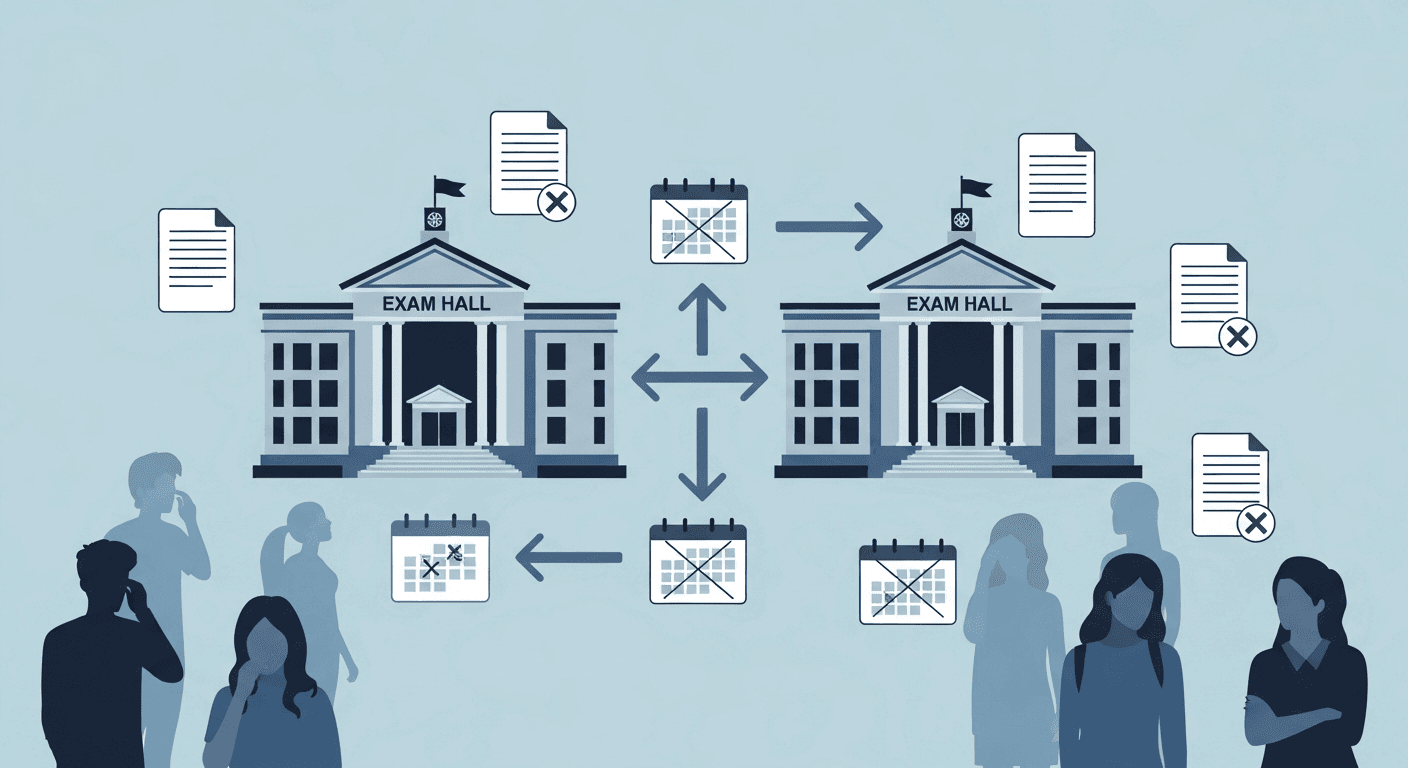
Fourteen Days That Disrupted 25 Lakh Students
Between May 3 and May 24, 2026, India's examination infrastructure absorbed two significant shocks in rapid succession.
On May 3, the NEET-UG 2026 examination was conducted across 5,000+ centres for 22.79 lakh registered candidates. Within days, whistleblowers reported that PDFs of the question paper had circulated in advance, with approximately 120 to 140 questions matching the actual paper. The Rajasthan Special Operations Group began investigating a multi-state racket. On May 12, the National Testing Agency cancelled the examination entirely. A re-exam was scheduled for June 21.
On May 24, with the NEET re-exam still weeks away, NTA issued a fresh notice: the CUET-UG examinations scheduled for May 28 were postponed. The reason was a last-minute government decision to reschedule the Bakrid (Eid-ul-Azha) national holiday, which conflicted with exam operations and exam centre staff logistics. Revised dates were to be announced.
Neither disruption was trivial. Together, they affected more than 25 lakh students across medical, undergraduate, and central university admissions — and placed India's examination governance under scrutiny that will shape policy for years.
The Direct Cascade: Medical Admissions Pushed Into the Unknown
The most immediate consequence of the NEET-UG cancellation is the downstream delay in admissions. The NEET result, under normal circumstances, is the trigger for MBBS and BDS counselling across 706 medical colleges — government and private — plus BVSc, nursing, and pharmacy admissions in most states.
Maharashtra, one of the largest states for medical admissions, was among the first to signal the problem. The state's Higher and Technical Education Ministry warned that the re-exam's June 21 date would push MBBS counselling well into July or August, affecting not only medical colleges but also engineering and pharmacy programmes whose Common Entrance Test (CET) admissions had been scheduled to conclude by June-end. The cascades compound: delayed MBBS counselling means delayed release of medical college seats, delayed pharmacy admissions, and a compressed academic calendar for every institution that had planned a June start.
For universities and colleges that had scheduled faculty induction, hostel assignments, and orientation programmes around a June admission date, the re-exam date requires a full revision of the academic calendar.
The CUET Postponement: A Different Failure Mode
The CUET postponement represents a different category of disruption. No fraud was involved. The examination was postponed because the government changed a public holiday date and NTA's operations — including exam centre staffing, invigilation logistics, and student travel arrangements — could not absorb the conflict at 96 hours' notice.
This is a systemic fragility: when examination operations depend on physical infrastructure, physical staff presence, and national calendar alignment, any exogenous shock — a holiday change, a local curfew, a weather event — requires postponement. The flexibility simply does not exist to adapt quickly.
For the students with examination slots on May 28, the postponement means altered preparation schedules, rebooked travel, and exam centre logistics to be redone when revised dates are announced. For universities using CUET scores for undergraduate admissions, it means delayed shortlists, delayed offer letters, and a compressed counselling window.
The Structural Issue: Paper-Based, Location-Specific Examination Design
Both disruptions share a root cause in the architecture of India's major national examinations: they require millions of candidates to be physically present at geographically distributed examination centres on a specific date, with a single physical question paper secured through a distribution chain involving thousands of intermediaries.
The NEET-UG paper leak followed a by-now-familiar pattern. A multi-state racket obtained physical question papers before the examination and sold access to candidates for fees reportedly ranging from Rs 30 to 50 lakh per candidate. The vulnerability is structural: the point at which a physical question paper travels from a printing facility to an examination centre is an interception point. It has been exploited in 2015, 2024, and now 2026.
The CUET postponement is the inverse problem: when physical operations cannot proceed, neither can the examination. There is no digital fallback.
Education Minister's Response: NEET Goes CBT From 2027
On May 15, Union Education Minister Dharmendra Pradhan confirmed that NEET-UG will shift to Computer-Based Test (CBT) format from 2027 onwards. This is a structural response to a structural problem.
Under CBT, question papers are not printed or distributed physically. Candidates receive encrypted question sets at their terminals at the start of the examination window, with questions drawn from a large question bank. Even if individual questions are compromised, the randomisation and dynamic selection make prior knowledge of specific questions less decisive. Responses are recorded digitally, transmitted in real time, and evaluated without physical answer scripts.
The CBT model also changes the evaluation pipeline entirely. NEET is an MCQ examination — there are no handwritten answer sheets to scan, evaluate, or store. The evaluation is automated, accurate, and instantaneous. The OMR scanning step, which introduces its own error rate, is eliminated. The physical storage of crore-scale answer books is eliminated.
What This Means for the Answer Script Evaluation Pipeline
For universities that conduct their own entrance examinations — and for those managing end-semester and year-end evaluations for enrolled students — the CBT announcement for NEET and the broader direction of examination reform carry a specific implication.
The risk profile of handwritten answer script evaluation remains high in two areas:
Delivery security: Physical question papers can be intercepted. Digital, encrypted question delivery with session-specific keys is structurally more secure.
Evaluation pipeline resilience: Physical scripts can be lost, damaged, or delayed. Digital scripts, once scanned and stored on secure servers, are not subject to physical failure modes. Evaluation can continue from any authorised location, without requiring evaluators to travel to a centralised camp.
For universities still conducting paper-based evaluation with physical answer books — collected, transported, sorted, and distributed to evaluators at centralised camps — the May 2026 disruptions are a stress test they have not yet taken. A transport failure, a flood, a logistics breakdown at the receiving centre: these are failure modes that exist in the physical evaluation pipeline and that digital evaluation eliminates or significantly mitigates.
The Evaluation Calendar Compression Problem
There is one more downstream consequence worth tracking. The NEET re-exam on June 21 means results will likely arrive in late July at the earliest. MBBS admissions, which normally begin in June, will be compressed into a shorter window. For medical colleges, this means evaluation of internal assessments, practical examinations, and continuous evaluation — which normally run on a structured semester calendar — will face scheduling pressure as academic years begin late.
Institutions that have moved their internal evaluation to digital systems can absorb this compression better. Evaluators can work from wherever they are, without requiring a specific location or date. Marks can be entered, verified, and released within hours. Institutions that still depend on physical evaluation camps, answer book transport, and manual mark entry face a harder problem when the academic calendar is compressed from both ends.
The Institutional Takeaway
Neither the NEET cancellation nor the CUET postponement was caused by internal evaluation processes at universities. But both create downstream pressures that will be absorbed differently depending on how prepared institutions are to operate flexibly under a compressed, shifted calendar.
The May 2026 double disruption is an external stress test. Institutions that treat it as only an admissions problem — to be managed by the admission office — are missing the evaluation dimension. When admissions shift, academic sessions shift, evaluation dates shift, and result timelines shift. The institutions that can absorb that shift without quality loss are the ones whose evaluation infrastructure is digital, auditable, and location-independent.
That infrastructure is not a future investment. The exam calendar just moved it to the top of the list.
Related Reading
Ready to digitize your evaluation process?
See how MAPLES OSM can transform exam evaluation at your institution.