NEET 2026 Paper Leak Fallout: How India's Medical Colleges Are Managing a 4-Month Academic Calendar Shock
The NEET UG 2026 paper leak and June 21 retest have pushed MBBS admissions to August-September, potentially starting the new academic session 4 months late. Here is what 700+ medical colleges are facing and what structural changes are needed.
A Timeline That Was Never Supposed to Happen
On May 3, 2026, 22.7 lakh NEET UG candidates sat down to write India's most high-stakes undergraduate entrance examination. By May 12, the exam had been cancelled following discovery of a significant overlap between a pre-circulated guess paper and the actual question paper. On June 21, those candidates — plus adjustments for cancellations and additions — sat the examination again under military-grade security conditions.
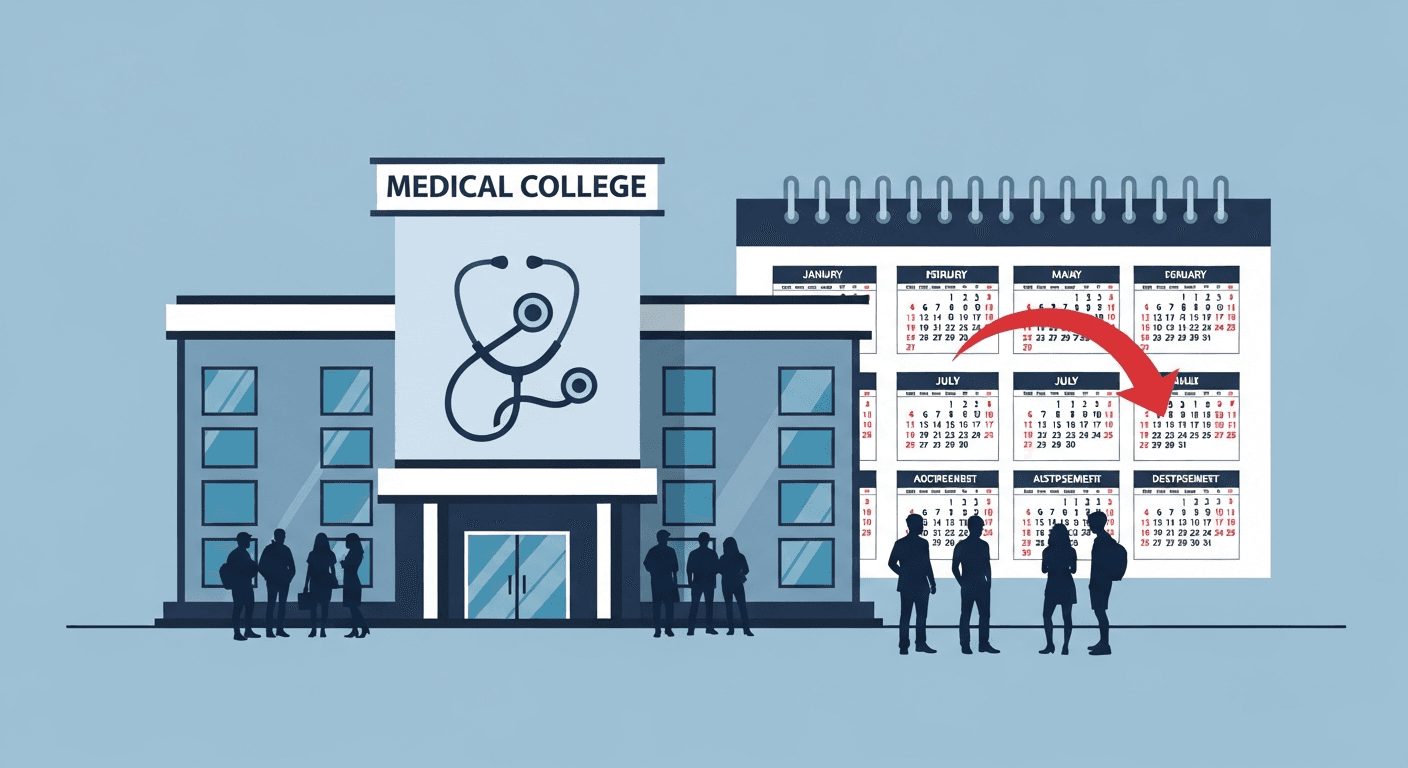
Results are expected in the second week of July 2026. MCC counselling — which determines who gets into which government MBBS seat — is expected to begin in August. By the time a first-year MBBS student joins their assigned college, it will likely be October or November 2026.
For India's 706 medical colleges offering 1,09,145 MBBS seats, this is not just an inconvenience. It is a structural operational crisis with implications for accreditation, clinical training compliance, and the quality of medical education for the incoming batch.
The Normal Academic Calendar vs. 2026 Reality
In a normal year, the NEET timeline runs as follows:
| Milestone | Normal Year | 2026 |
|---|---|---|
| NEET UG exam | First Sunday of May | May 3 (cancelled) + June 21 (retest) |
| Results declaration | Early June | Second week of July (expected) |
| MCC Round 1 counselling | Late June | August-September (expected) |
| College joining | July-August | October-November (projected) |
| First semester end-term | December | February-March 2027 |
A 4-month delay at the beginning of the academic year does not translate into a simple 4-month shift in the entire calendar. It creates a compression problem at every subsequent stage of the MBBS curriculum, with the most severe effects felt in clinical training schedules and batch cohort management.
The Double-Batch Problem
Some medical colleges will face a situation with no direct precedent in recent history: a 2026-27 first-year batch joining in October or November while the 2025-26 first-year batch — which joined under a relatively normal timeline last year — is completing its own first year.
This creates simultaneous demand for:
The National Medical Commission (NMC) sets minimum requirements for student-faculty ratios, laboratory capacity per enrolled student, and clinical contact hours. A double-batch situation strains these ratios in ways that NMC inspection teams will scrutinize closely, particularly for colleges already operating near minimum compliance thresholds.
NAAC and Accreditation Implications for Medical Colleges
Medical colleges that are currently in an active NAAC accreditation cycle will find the 2026-27 academic calendar disruption appearing in their evidence portfolio under multiple criteria.
Criterion 2 — Teaching, Learning and Evaluation
Attendance and academic engagement records will show a shortened academic year for the 2026-27 batch. Internal assessment schedules will be compressed. Year-end examination timelines may conflict with NAAC Self-Study Report submission windows that have fixed deadlines.
Under the Binary Accreditation framework, institutions must meet minimum performance thresholds on quantitative process indicators. A college that shows academic sessions starting 3-4 months late in its data must provide a documented contextual explanation — and evidence that teaching quality was maintained despite the disruption.
Criterion 6 — Governance, Leadership and Management
NAAC's Criterion 6 requires evidence of institutional response to crises. How a medical college managed the 2026 NEET disruption — communication with waitlisted students, revised academic plans, faculty redeployment decisions, and infrastructure allocation under a double-batch scenario — becomes part of the governance evidence record.
Colleges that documented their crisis response formally, with date-stamped communications and administrative records, will be better positioned than those that managed the situation informally without a written record.
NABH and Clinical Training Compliance
For medical colleges whose attached teaching hospitals hold NABH accreditation, the clinical training implications are equally significant. First-year MBBS students begin clinical orientation through hospital ward postings in their early months. A compressed first year reduces the clinical exposure time available before year-end examinations, potentially creating gaps in the minimum contact hours that NMC requires for clinical subjects.
The JEE Advanced Contrast
It is impossible to discuss the 2026 NEET calendar disruption without noting the contrast with JEE Advanced. JEE Advanced 2026 was conducted on May 18, 2026. Results were declared by IIT Roorkee on June 1 — fourteen days later. JOSAA counselling proceeded immediately, and IIT joining is on track for July as planned.
The difference is not incidental. JEE Mains is conducted as a Computer-Based Test, generating an electronic record of every candidate's responses at the point of submission. JEE Advanced, while paper-based, publishes scanned response sheets publicly for every candidate within 72 hours of the exam — making any post-exam alteration immediately detectable.
NEET's vulnerability lies in its physical paper distribution infrastructure: 5,440 centres in 2026, with question papers transported physically across the country through a multi-tier logistics chain. That distribution chain was the point of exploit. A centralized digital examination model eliminates this attack surface entirely.
The policy discussion about NEET's migration to a Computer-Based Test format is now active, with parliamentary scrutiny of the NTA and a structural overhaul committee formally constituted. Until that transition occurs, the paper-based NEET system remains vulnerable to the same logistical attack surface that the 2026 paper leak exploited.
What Medical Colleges Must Do Now
For medical colleges absorbing the 2026-27 academic calendar disruption, the immediate operational priorities are:
1. Communicate the Revised Timeline Proactively
Students who qualified in the May 3 examination and expected to join in July have been in an information vacuum for nearly three months. Official communication from colleges about projected joining dates, provisional admission processes, and document verification timelines reduces attrition to foreign medical universities and manages institutional reputation during the delay.
2. Pre-Plan for the Double-Batch Scenario
If the 2026-27 batch joins in October or November while the 2025-26 batch is completing its first year, infrastructure allocation — laboratory slots, hostel rooms, clinical training rotations — must be planned and documented in advance. Ad hoc management of a double-batch situation under NMC observation is a compliance risk.
3. Engage the NMC and Affiliating University Early
The NMC has precedent for accommodating calendar disruptions in extraordinary circumstances. COVID-era calendar extensions established a framework for compressed academic years that still meet minimum contact hour requirements. Early formal communication with the NMC and affiliating university about the 2026-27 calendar is preferable to seeking retrospective accommodation after an inspection.
4. Document Everything for Accreditation Purposes
Every institutional decision made in response to the 2026 NEET disruption should be formally recorded: board resolutions, communications to students, faculty meeting minutes, revised academic calendars. NAAC and NBA peer teams are trained to assess institutional governance quality through crisis response documentation. The 2026 disruption, handled well and documented thoroughly, becomes evidence of institutional resilience.
The Deeper Structural Question
India's medical education calendar has been disrupted by the NEET paper leak, but the underlying structural question is more fundamental: why does the country's gateway examination to medical education still depend on physical paper transport through a multi-tier distribution chain that a few criminal actors can compromise?
The 2026 retest was conducted successfully — with IAF aircraft transporting papers, 2 lakh security officials deployed, and Telegram blocked nationally. It worked. But the cost of that security apparatus — financial, logistical, and in terms of national attention — is not sustainable as the default model for an examination that 22 lakh students take every year.
The calendar shock that 706 medical colleges are absorbing in 2026 is the direct consequence of an examination infrastructure that has not kept pace with the scale and stakes of what it is asked to do.
Related Reading
Ready to digitize your evaluation process?
See how MAPLES OSM can transform exam evaluation at your institution.