NAAC MBGL Level 4 and 5: The Examination Evidence Only Digital Systems Can Generate
Fewer than 3% of Indian institutions will ever qualify for NAAC MBGL Level 4 or 5. The examination data evidence required at these levels is structurally impossible to produce from a manual evaluation workflow.
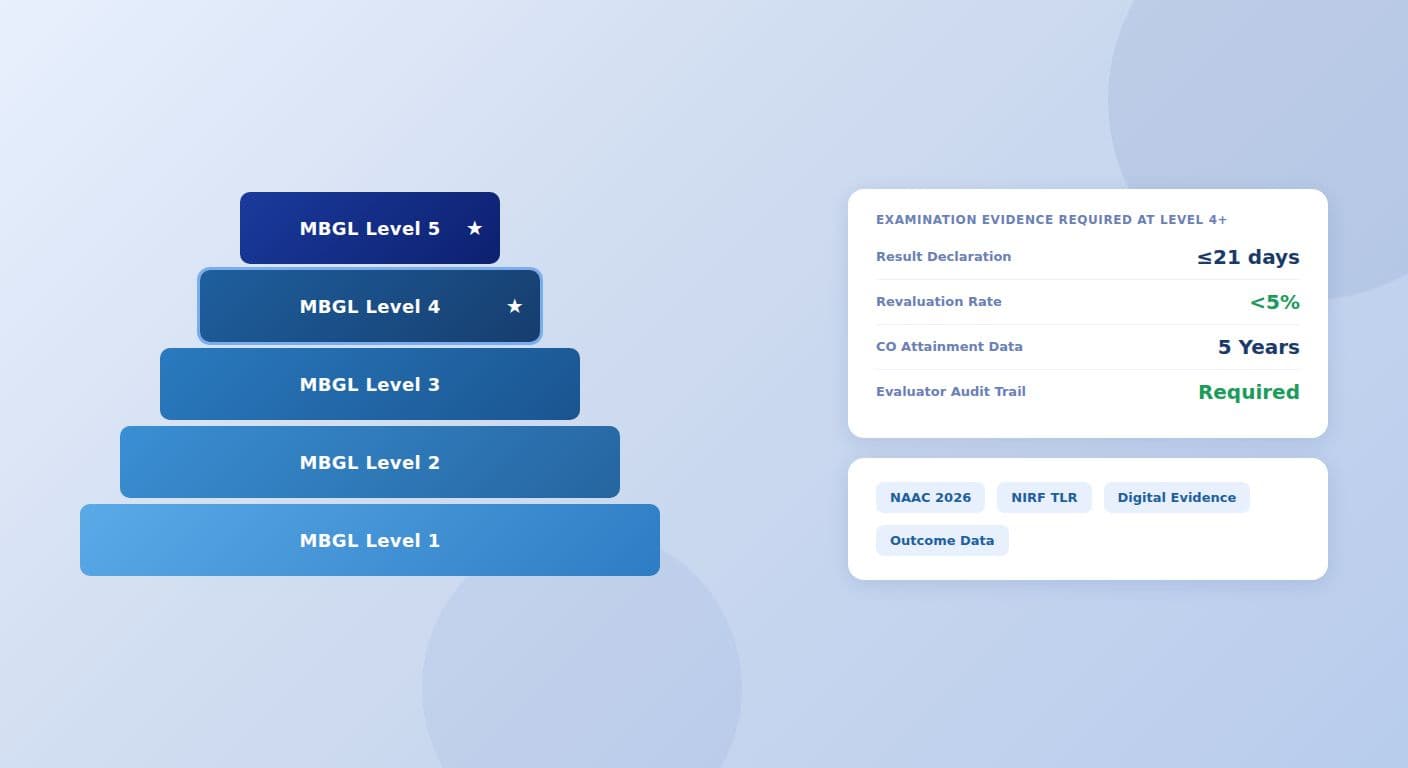
The MBGL Framework Changes the Nature of the Accreditation Race
When NAAC replaced its letter-grade system (A++, A+, A, B++...) with the Binary Accreditation and Maturity-Based Graded Level (MBGL) framework, it did more than rebrand a rating system. It restructured the competitive landscape of Indian higher education into a progressive ladder where each rung requires demonstrably more sophisticated institutional governance than the one below.
Under the old system, an institution could earn an A grade by scoring well across seven criteria while having pockets of genuine weakness. The NAAC peer team's subjective assessment of documents and interactions allowed for diplomatic averaging. Under the MBGL framework, the process is more rigorous: AI-assisted data validation, stakeholder surveys, and the "One Nation One Data Platform" cross-verify institutional claims against external datasets. Gaming the system through document preparation alone is substantially harder.
The five MBGL levels create a competitive differentiation framework that will increasingly determine funding eligibility, student preference, faculty recruitment success, and regulatory latitude. Levels 4 and 5 represent institutional excellence of a kind that only a small fraction of India's 45,000+ higher education institutions will achieve. Understanding what distinguishes these levels—and specifically, what role examination data plays—is essential for any institution with serious accreditation ambitions.
What Each MBGL Level Requires
NAAC has structured the MBGL levels around progressive evidence of governance maturity, student outcomes, research culture, and community engagement. A simplified overview:
| MBGL Level | Characterisation | Key Differentiators |
|---|---|---|
| Level 1 | Basic accreditation | Minimum standards met; processes documented |
| Level 2 | Systematic institution | Processes systematised; data collected and analysed |
| Level 3 | Progressive institution | Outcomes tracked; continuous improvement demonstrated |
| Level 4 | Excellence institution | Benchmarked against national and global peers; innovation in processes |
| Level 5 | Transformative institution | Sector leadership; demonstrated impact on broader higher education ecosystem |
The jump from Level 3 to Level 4 is where most serious institutions will find the examination evidence requirement becomes decisive. Level 3 requires showing that outcomes are tracked and improvements made; Level 4 requires demonstrating that those outcomes are benchmarked and that the institution's processes are innovative relative to comparable institutions. Level 5 requires influence beyond the institution itself.
Why Examination Data Is Central at Levels 4 and 5
NAAC evaluates institutions across governance, student outcomes, research, teaching-learning quality, and sustainability. Examination and assessment processes appear explicitly under Criterion 2 (Teaching, Learning and Evaluation) but provide data that flows into Criterion 1 (Curricular Aspects), Criterion 5 (Student Support and Progression), and Criterion 6 (Governance and Leadership).
At Level 4, NAAC evaluators expect to see:
Outcome attainment data with trend analysis. An institution must show not just that it tracks course outcomes (CO) and programme outcomes (PO), but that attainment levels have changed over time in response to specific interventions. This requires structured examination data at the question level—not just aggregate pass percentages.
Evaluation consistency metrics. Level 4 institutions are expected to demonstrate statistical control over their evaluation processes. This means: inter-evaluator reliability measures, moderation frequency and outcomes, revaluation-to-appeal escalation rates, and longitudinal trends in evaluation quality. None of this data is producible from a manual evaluation workflow where marks are recorded on paper and reconciled by hand.
Turnaround benchmarking. A Level 4 institution should be able to show its result declaration timeline relative to comparable institutions and improving over time. "We declare results in 21 days after examination" is a governance performance claim. It requires reliable, timestamped data to substantiate.
Grievance resolution rates and timelines. Student outcome indicators at Level 4 include the institution's responsiveness to academic grievances. Percentage of grievances resolved within 7 days, average resolution time, proportion escalated to court challenges—these are indicators NAAC's AI-assisted process can cross-validate against RTI disclosures and court records.
At Level 5, an institution is expected to be producing insights that inform other institutions and the broader sector. Examination data analytics—patterns of student performance across cohorts, identification of curriculum sections where CO attainment is consistently low, correlation between evaluation approaches and learning outcomes—is the kind of structured, longitudinal data that supports this level of contribution.
The Evidence Gap in Manual Workflows
Manual examination workflows generate marks, but they do not systematically generate the structured data that NAAC's higher MBGL levels require. Specifically, manual evaluation cannot reliably produce:
An institution applying for MBGL Level 4 assessment in 2028 needs five years of clean, structured examination data. The institutions that begin collecting that data in digital form in 2023-2024 will be able to demonstrate trajectories. Those that begin in 2026 will have partial evidence. Those that continue with manual workflows may be unable to substantiate Level 4 claims at all.
Specific Metrics That Distinguish Level 4 Institutions
Based on the NAAC framework's emphasis areas and the data patterns that emerge from institutional assessments, the following examination metrics are likely to characterise Level 4 institutions:
Result declaration speed: 15-25 days from last examination date to result publication. The national average for affiliated university colleges is 45-75 days. Institutions consistently achieving sub-30-day turnaround represent demonstrable process excellence.
Revaluation-to-revision rate: Of students who apply for revaluation, what percentage receive a mark change? Institutions with very low rates (below 5%) have evaluation processes with high initial accuracy. Those with very high rates (above 30%) have a quality control problem. A Level 4 institution can show this rate and its trend over years.
First-time evaluator error rate: How often is a marked script returned for remarking due to arithmetic errors, missed questions, or incomplete evaluation? A digital evaluation platform tracks this automatically. Manual processes do not.
CO attainment by semester and year: Curriculum design at Level 4 institutions responds to attainment data. If 40% of students in a specific course consistently fall below the CO attainment threshold for a particular outcome, the institution should be able to show that it identified this, investigated causes, and implemented curriculum or pedagogy adjustments.
The NIRF Parallel
India's National Institutional Ranking Framework (NIRF) scores institutions on five parameters, with Teaching, Learning and Resources (TLR) weighted at 30% and Graduation Outcomes (GO) weighted at 20%. Both parameters are substantially influenced by the quality and verifiability of examination and assessment processes.
TLR rewards institutions that demonstrate full-time equivalent teaching engagement, faculty workload appropriateness, and outcome-linked assessment. GO rewards timely graduation rates, placement outcomes, and higher study progression rates. An institution that declares results quickly enables students to meet application deadlines for higher education and employment. One that delays damages both GO scores and, measurably, student outcomes.
Institutions in the 201-500 NIRF band that want to break into the top 200 often find that examination process improvements produce faster ranking gains than research output increases, simply because research output takes time to publish and index while process improvements produce measurable outcome gains within a single examination cycle.
Building Toward Level 4: A Structured Approach
Institutions currently at MBGL Level 2 or 3 pursuing Level 4 should identify examination-related evidence gaps as a priority:
The Window Is Narrowing
India's accreditation ecosystem is accelerating. The new NAAC framework has been active since February 2025. Institutions that complete their first binary accreditation cycle in 2025-2026 and begin their first MBGL cycle in 2026-2027 are setting trajectories now. The competitive gap between digital-native examination systems and manual ones compounds annually because digital systems produce usable data from day one.
By 2028, when the first cohort of institutions applies for MBGL Level 4 assessment under the new framework, the examination evidence dimension will separate institutions with three years of structured digital data from those with none. That gap will be visible to NAAC assessors, to students choosing institutions, to recruiters, and to regulators.
Related Reading
Ready to digitize your evaluation process?
See how MAPLES OSM can transform exam evaluation at your institution.