MP Board's Rs 200 Error Penalty: Accountability Without Infrastructure
Madhya Pradesh's move to fine evaluators Rs 200 per confirmed marking error is an unusually direct attempt to enforce evaluation quality. What it gets right, what it misses, and what a systemic approach looks like.
An Unusual Accountability Mechanism
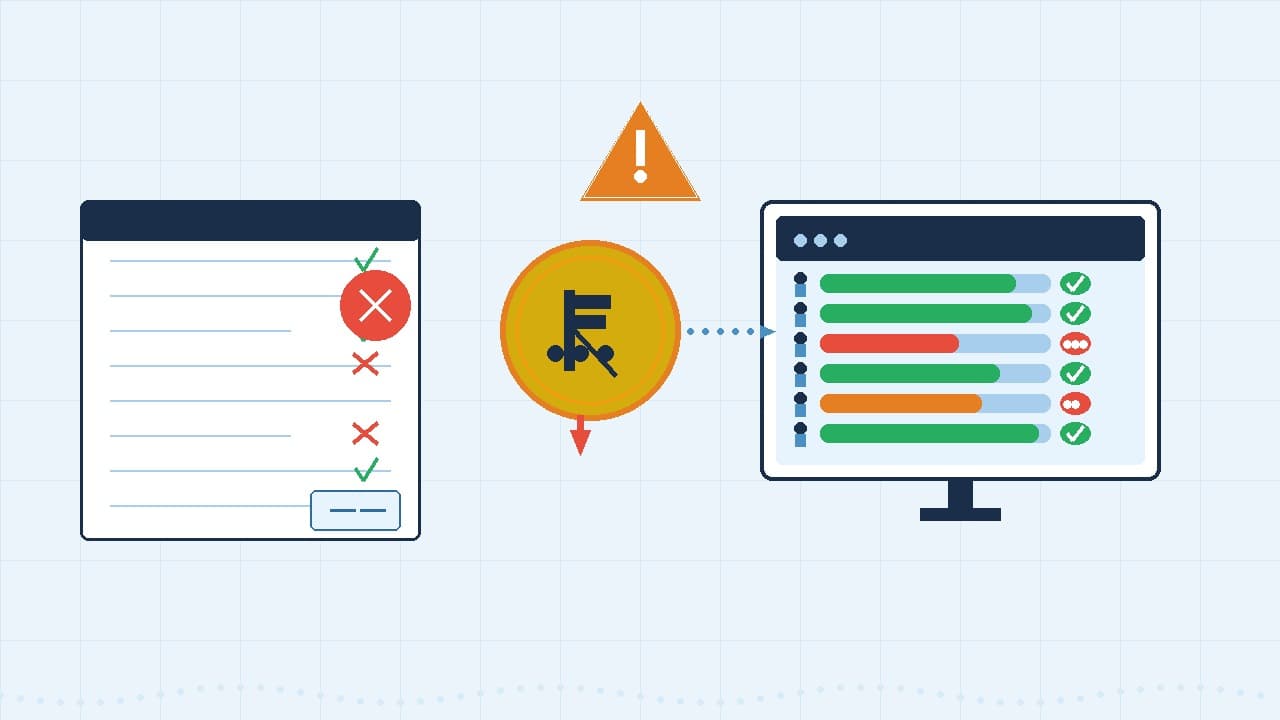
In April 2026, as Madhya Pradesh Board of Secondary Education (MPBSE) evaluators worked through examination scripts across the state — with nearly 40,000 answer books checked in Indore alone — the board quietly operationalised a new rule: a financial penalty of Rs 200 for every confirmed marking error.
The subjects under evaluation included Physics, Economics, and Higher Secondary English — descriptive, judgment-intensive papers where evaluator discretion is high and errors are harder to detect automatically than in objective examinations.
MPBSE's penalty is, as far as publicly reported measures go, one of the more direct accountability mechanisms any Indian board has deployed for examination evaluation. It is also an acknowledgement that marking errors are common enough to warrant structural deterrents, not just internal training or post-hoc scrutiny.
Understanding what this penalty can and cannot accomplish reveals something important about the underlying evaluation quality problem in India — and why the solution requires more than better incentives.
The Scale of the Evaluation Error Problem in India
Marking errors in board examinations are not isolated incidents. They are a documented, recurring phenomenon.
India processes several hundred million answer scripts annually across CBSE, state boards, and universities. The evaluation workforce is drawn from working teachers who correct papers under time pressure, often far from their home districts, with variable training in the specific marking scheme for each year's paper.
Studies and court filings related to re-evaluation petitions consistently show that in paper-based physical evaluation systems, tabulation errors — where marks on individual questions are added incorrectly — are the single most common category of error. These are not judgment errors about how many marks a particular answer deserves. They are arithmetic errors: a student scores 4 + 5 + 3 + 4 on four questions, and the total is recorded as 14 instead of 16.
A second category — question-level marking errors, where an answer is assessed incorrectly against the marking scheme — is harder to detect and more consequential. These errors are corrected through re-evaluation processes, but re-evaluation eligibility and cost barriers mean that only a fraction of affected students ever apply.
What the Rs 200 Penalty Is Attempting to Address
MPBSE's penalty mechanism targets evaluator attention. The theory is that financial consequences for errors will make evaluators more careful — cross-checking totals, re-reading answers before marking, slowing down when a script requires judgment.
There is some behavioural validity to this approach. Evaluators working under time pressure and honorarium-based payment structures have weak incentives to invest additional effort in accuracy. A small financial penalty that bites into what is already a modest per-script honorarium could, at the margin, shift attention.
The board has also paired the penalty with digital monitoring of daily evaluation progress at centres, which provides supervisory visibility into output rates and flags outliers — evaluators who are marking unusually fast or slow.
The Structural Limits of Penalty-Based Quality Enforcement
The Rs 200 penalty confronts three problems that financial penalties cannot solve.
Detection is the prerequisite for enforcement. A penalty for confirmed marking errors only operates on errors that are caught. In physical, paper-based evaluation, the detection infrastructure is thin: head examiners conduct spot checks, a sample of scripts is rescrutinied, and complaints trigger additional review. The vast majority of scripts are never independently verified. An error that is not detected earns no penalty. Evaluators who mark carelessly but whose errors happen to fall below the detection threshold face no consequences under this system.
Penalties can invert incentives at the margin. An evaluator concerned about the Rs 200 penalty per error has an incentive to adopt conservative marking practices — awarding round numbers, avoiding borderline assessments, marking closer to what the head examiner is known to expect. This minimises the probability of being flagged for error. It does not necessarily result in more accurate evaluation; it may result in less discriminating evaluation that is harder to challenge.
Errors from ambiguous marking schemes are not the evaluator's fault alone. Some marking errors originate in marking scheme ambiguity — where the official answer key does not adequately specify how partial answers should be assessed. Penalising evaluators for inconsistencies that stem from poorly specified marking schemes shifts accountability in the wrong direction.
What Digital Evaluation Addresses That Penalties Cannot
The structural alternative to penalty-based enforcement is verification-by-design: building evaluation systems where errors are caught before results are published, not after.
On-screen marking platforms address the evaluation error problem through several mechanisms that operate regardless of evaluator incentives:
Automatic tabulation. Marks entered per question are computed by software. Tabulation errors — the most common category in physical evaluation — become impossible. The system cannot add incorrectly. This single feature eliminates a category of error that penalty systems can only discourage.
Mandatory double valuation. Digital evaluation platforms can require that every script, or a statistically meaningful sample, is independently evaluated by two evaluators whose identities are concealed from each other. Where scores diverge beyond a set threshold, a third evaluator — typically a senior examiner — resolves the difference. This is not a retrospective check; it is a structural feature of the evaluation process.
Minimum time enforcement. Software can reject a submitted evaluation that falls below a minimum time threshold per page or per script. An evaluator who clicks through answers without reading them is flagged for supervisor review. No equivalent mechanism exists in physical evaluation.
Statistical anomaly detection. When one evaluator's average marks for a particular question diverge significantly from the cohort average, the system flags it. Systematic leniency or severity — consistent biases that are invisible in individual script review — become detectable at the dataset level.
Complete audit logs. Every mark entry, every modification, every login is timestamped and recorded. The audit trail provides evidence for dispute resolution and enables post-hoc quality analysis that informs evaluator training.
The Common Ground
MPBSE's experiment and digital evaluation's structural approach share a premise: evaluation quality requires active enforcement, not passive expectation. The difference is where enforcement is applied.
Penalty systems operate after the fact, on detected errors, through individual accountability. They rely on detection infrastructure that is currently thin. They are limited by the difficulty of catching errors in high-volume physical evaluation.
Digital systems operate at the point of evaluation, on every script, through process design. They eliminate categories of error entirely (tabulation), make other categories structurally detectable (systematic bias), and create evidentiary records that support all downstream quality processes.
Neither approach alone is complete. Financial accountability for evaluators is not inherently wrong — professionals in quality-sensitive roles often operate under performance frameworks that include accountability for errors. But accountability without the infrastructure to detect and prevent errors is incomplete.
Where Boards Are Heading
MP Board's penalty experiment is notable because it signals official acknowledgment that the current evaluation quality enforcement infrastructure is inadequate. States that implement such measures are recognising a problem that has existed for decades.
The more consequential shift comes when boards invest in evaluation platforms that build quality into the process rather than enforcing it retrospectively. CBSE's 2026 OSM rollout for Class 12 is the largest single deployment of this model in India's history. Punjab Board has moved to digital evaluation for senior secondary. The trajectory, across both central and state systems, is toward process-based quality assurance.
For administrators at institutions that conduct their own evaluations — autonomous colleges and universities — the lesson from both MPBSE's penalty system and CBSE's OSM rollout is the same: the question is not whether to invest in evaluation quality infrastructure, but what kind of investment delivers results.
Penalties fix blame. Infrastructure prevents errors.
---
Related Reading
Ready to digitize your evaluation process?
See how MAPLES OSM can transform exam evaluation at your institution.