Karnataka's Evaluation Error Reckoning: Why the Numbers Demand a Digital Audit Trail
From 2,777 wrong marks in PU exams to 72,000 SSLC students seeking scanned scripts, Karnataka's manual evaluation system has left a documented trail of errors — and a clear case for digital accountability infrastructure.
The Numbers That Were Never Supposed to Be Public
In a response tabled on the floor of the Karnataka Legislative Council, the state's Primary and Secondary Education Minister revealed a figure that should have prompted urgent reform: across three academic years — 2019, 2020, and 2021 — a total of 2,777 Pre-University (PU) students received incorrect marks in their board examinations.
The breakdown was granular. In 2019 alone, 1,006 candidates had a mark difference of more than six upon revaluation; 66 had a smaller discrepancy. In 2020, the numbers worsened: 1,540 students had differences exceeding six marks upon reassessment. In 2021, the count dropped to 31 — attributed largely to reduced examination volumes during the pandemic period.
Nearly 3,000 documented evaluation errors in three years, from a single board covering only the Pre-University certificate programme.
The accountability response? Four evaluators were penalised.
The Scale Problem With Manual Evaluation
Karnataka's Pre-University examinations — equivalent to Class 11 and 12 across the rest of India — involve close to a million students annually. Each student writes multiple papers across multiple subjects. The total volume of answer scripts assessed each season runs into tens of millions of pages, evaluated by a workforce of teachers marking alongside their regular teaching responsibilities, under time pressure, at central valuation camps.
Under these conditions, evaluation errors are not aberrations. They are predictable outputs of a structurally stressed system.
The more instructive observation is that the 2,777 figure represents only confirmed errors — errors that were discovered because a student applied for revaluation, paid the associated fee, and waited for a result. Students who believe their marks are wrong but do not apply — because of the cost, the narrow application window, or simple lack of awareness — are not counted. The true incidence of marking error in a manual system of this scale is necessarily higher than any revaluation data can capture.
Nine Faculty Suspended — Then What?
More recent Karnataka data adds a different dimension. Following a departmental inquiry into erroneous PU evaluation, nine faculty members were suspended for marking errors that fell outside acceptable variance.
What makes this notable is not the scale of the penalty — nine suspensions from a workforce numbering in the thousands is a vanishingly small rate — but the fact that individual faculty members were identified at all. For most of India's examination evaluation history, accountability for wrong marks has been essentially non-existent. Marks were awarded, scripts were locked away, and the process was considered closed.
The suspensions signal that Karnataka's examination authorities are beginning to create a traceable link between individual evaluator decisions and institutional consequences. But this link can only be maintained if there is a recoverable record — a log that connects each mark on each paper to the specific evaluator who awarded it, with a timestamp.
Manual evaluation camps do not produce this record. Digital evaluation systems do.
Without digital attribution, the process for identifying an erroneous evaluator requires reconstructing which faculty member evaluated which stack of scripts from a camp attendance register, cross-referencing the register against valuation entry logs, and then locating the physical scripts — a process that can take weeks and frequently produces incomplete results. The nine suspensions likely required exactly this kind of manual investigation.
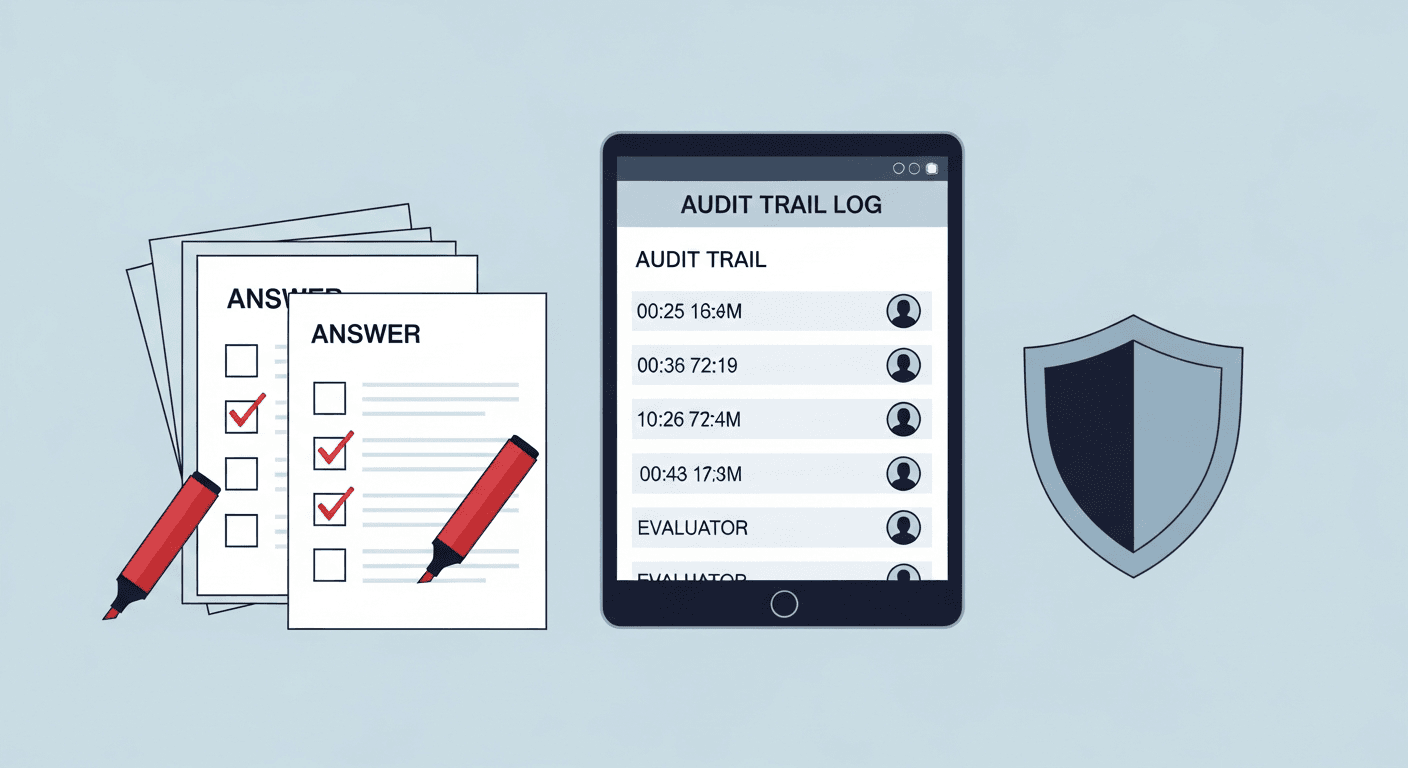
In a digital evaluation system, the audit trail is generated automatically. Every mark, every session, every question, and every evaluator ID is recorded at the point of entry. Identifying systematic error patterns — an evaluator who consistently undermarks long-answer questions, or who marks scripts from a particular college significantly lower than other evaluators — becomes a data query rather than a detective exercise.
72,000 SSLC Students Ask to See Their Own Scripts
The most revealing recent data point from Karnataka is also the most recent. When Karnataka announced that SSLC students could apply to access their scanned answer scripts, over 72,000 students filed requests to see their own papers.
That number represents not just dissatisfied students but a fundamental shift in how students and parents understand their rights in relation to examination outcomes. A generation that has watched CBSE's OSM controversy unfold publicly — reading news reports of students finding someone else's handwriting on their answer sheets, downloading blurred scans, discovering unmarked pages — now expects that their own papers can be seen, verified, and if necessary challenged.
The demand to view scanned scripts is only meaningful if the scripts have actually been scanned and are recoverable. For SSLC, Karnataka has at least some scanning infrastructure in place for post-result verification. The critical question is whether that infrastructure will extend to cover the full evaluation cycle — not just making scripts available after results, but embedding the digital record into the evaluation process itself.
Mangalore University's announcement in June 2026 that it is implementing digital evaluation for PG examinations from this month points in exactly this direction. The scanning and digitisation that currently happens for revaluation purposes at the post-result stage can instead be built into the evaluation pipeline from the beginning, making the record richer and the accountability stronger.
What an Audit Trail Actually Changes
The contrast between manual and digital evaluation accountability is most clearly visible in a side-by-side comparison of what happens when a student's marks are disputed.
In a manual evaluation model:
A script goes from examination hall to valuation camp. An evaluator marks it with a pen. The marks are totalled and entered into a register by a separate data-entry operator. The register is later entered into a computer. Each step is a point at which errors can be introduced — and at which there is no automatic log of who entered what, when, or based on what original mark. If a student disputes the marks, reconstruction requires locating the physical script, comparing the pen marks to the register entry, and verifying the register entry against the digital record. Gaps at any step make the reconstruction incomplete.
In a digital evaluation model with audit trail:
Every page view, every mark awarded, every section total, and every final submission carries a timestamp and an evaluator identifier stored in the system. If a student's marks are disputed, the system produces a complete record: which evaluator viewed which page, when, for how long, and what score was assigned at each question. The second evaluator in a revaluation sees exactly what the first evaluator marked, and can compare rather than evaluate from scratch.
The practical difference is not just accountability after the fact. It is prevention before the fact. Evaluators who know their marking is recorded, timestamped, and reviewable exhibit measurably different behaviour — more consistent marking, fewer questions left unmarked, less variance from the marking scheme — than evaluators working in anonymous paper-based environments.
The Institutional Accountability Gap
Karnataka's four penalties for 2,777 errors represents a penalty rate of approximately 0.14 percent. The gap is not a Karnataka-specific failure — it reflects a structural reality of manual evaluation.
You cannot penalise what you cannot trace. And you cannot trace what is not recorded.
This is why the combination of events in Karnataka across recent months tells a coherent story even though the data points come from different levels of the education system:
| Event | System Level | Accountability Gap Revealed |
|---|---|---|
| 2,777 wrong marks, 4 penalties | Pre-University Board | Evaluator identity not recoverable at scale |
| 9 faculty suspended for erroneous evaluation | Pre-University Board | Individual attribution required weeks of investigation |
| 72,000 SSLC students request scanned scripts | Secondary Board | Scans exist but not embedded in evaluation pipeline |
| Mangalore University launches digital evaluation for PG | State University | First step toward embedded accountability |
These are not unrelated events. They are different expressions of the same structural deficit: an evaluation system that produces outcomes without producing records.
What Other State Boards Can Take From This
Karnataka's documented experience offers a clear picture of the institutional risk that accumulates when the transition to digital evaluation is deferred.
The argument for digital evaluation is frequently made in terms of speed or cost — faster results, lower printing costs, reduced evaluator travel. Those are real benefits. But the more durable argument, especially as student expectations of transparency escalate and regulatory requirements for audit trails tighten, is accountability.
An examination board that can answer the question "which evaluator gave that student 45 marks in Chemistry, and why" — not after weeks of investigation but in minutes from a system query — is operating in a fundamentally different accountability environment from one that cannot.
Karnataka's 72,000 students seeking scanned scripts are telling the system exactly what they expect. The institutions that build the infrastructure to meet that expectation will retain credibility as the CBSE OSM controversy continues to redefine what students across India consider acceptable from an examination board.
Related Reading
Ready to digitize your evaluation process?
See how MAPLES OSM can transform exam evaluation at your institution.