From Mumbai to London: What India's Assessment Tech Earning Global Recognition Means
A bootstrapped Mumbai platform operating across 35 countries has been shortlisted for the 2026 International e-Assessment Awards in the UK. The recognition signals something larger about India's digital examination industry.
An Indian Platform on a London Stage
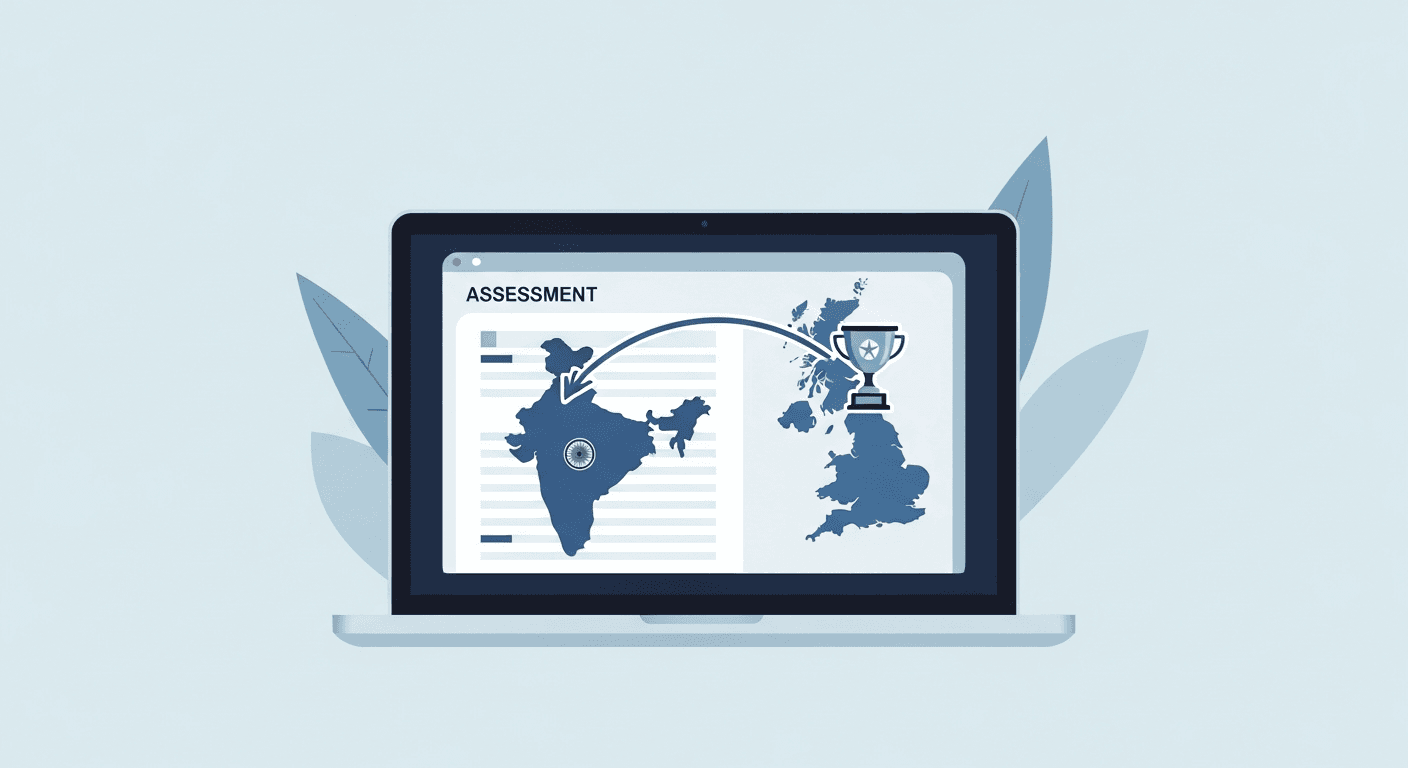
In June 2026, a Mumbai-based assessment technology company will stand on a stage in London as a finalist for the International e-Assessment Awards — one of three shortlisted in the Best International Implementation category.
The company, ExamOnline, was founded in 2009, has never taken venture capital, and today delivers assessment sessions across 35 countries including the United States, United Kingdom, Germany, Saudi Arabia, Singapore, and Australia. The Awards Gala is on June 9, 2026, organised by the e-Assessment Association (eAA), the UK's benchmark body for digital examination quality.
The recognition matters not because it is about one company. It matters because of what it signals about the assessment technology industry India has been quietly building for the past decade and a half.
What the e-Assessment Awards Actually Measure
The eAA's Best International Implementation category tests for something specific: deployment at scale across multiple jurisdictions, each with different regulatory requirements, connectivity conditions, and assessment formats. To be shortlisted, a platform must demonstrate multilingual capability, compliance with international data standards including GDPR and ISO 27001 and ISO 9001, resilience under variable connectivity conditions, and verifiable assessment integrity at high volumes.
These are not abstract requirements. They describe precisely the conditions that Indian examination infrastructure has been navigating every day for decades:
India did not enter this space from a position of strength in digital infrastructure. It built capability because the problem demanded it.
Why India's Constraints Became Competitive Advantages
Assessment technology developed in Western markets was largely designed for high-bandwidth, single-language, relatively small-cohort environments. UK national examinations have approximately 800,000 GCSE candidates annually. India's NEET examination alone has 22 lakh — nearly three times that figure — in a single day.
The engineering challenges this creates are not incremental versions of what Western platforms solved. They are categorically different problems.
Scale: Processing 98 lakh answer sheets in a single evaluation cycle, as CBSE did in 2026, requires concurrency management, load distribution, and data integrity verification at a level that no examination body outside India has needed to develop. The 1.5 lakh simultaneous portal hits that stressed CBSE's infrastructure during result processing is a stress-test benchmark that commercial enterprise platforms rarely face.
Multilingualism: India's examination ecosystem requires not just interface localisation but active handling of multilingual answer content — answer sheets written in Tamil, Telugu, Marathi, Hindi, Gujarati, Kannada, and dozens of other languages processed through the same evaluation pipeline.
Offline capability: Indian platforms have been building for low-bandwidth and partially offline workflows since the early 2010s — not as a premium feature but as a baseline requirement for affiliated college examination centres in semi-urban and rural locations. This turns out to be directly relevant for assessment deployments in sub-Saharan Africa, rural Europe, and South and Southeast Asia — the same markets that many global assessment bodies are now trying to reach.
Cost efficiency: Indian markets demand enterprise-grade quality at pricing that reflects purchasing power parity. This constraint has forced Indian assessment platforms into efficiency architectures that make them highly competitive in price-sensitive international markets where Western platforms are often unaffordable.
The Scale of India's Digital Assessment Market
India's digital assessment market — spanning examination platforms, on-screen marking systems, online proctoring, and result processing infrastructure — is growing at more than 20 percent compound annually, driven by structural pressure. Paper-based examination infrastructure is becoming operationally unsustainable at the volumes Indian universities operate.
State boards alone process tens of millions of answer books per semester cycle. CBSE's 2026 OSM rollout, which scanned 98 lakh answer sheets and resulted in 13,000 re-evaluations — a 0.013 percent re-evaluation rate — represents a precision engineering achievement that, when documented and published, becomes a commercial credential in international markets.
The CBSE implementation built more than a result. It built a reference case.
What This Means for Indian Institutions
ExamOnline's finalist status is a data point in a broader trend. Indian assessment technology, built under extreme constraint to serve the world's largest examination ecosystem, is reaching a level of maturity that is globally validated.
For examination controllers and registrars at Indian universities, the practical implication is this: the digital assessment technology you choose is now an institutional quality signal, not just an operational choice.
International accreditation frameworks — QS, Times Higher Education, Washington Accord for engineering — increasingly look at examination infrastructure quality as a proxy for institutional governance. The credibility and auditability of examination records matters for:
A digital audit trail that is verifiable, timestamped, and exportable in standard formats is worth considerably more than an equivalent paper record when international partners are making decisions about your institution.
The Infrastructure Gap That Still Exists
Despite this progress, only a fraction of India's approximately 1,000 universities and 40,000 colleges have fully transitioned to digital evaluation. Most state-affiliated universities still process answer sheets manually or in hybrid formats, carrying the associated risks of variability, delay, and integrity risk at scale.
The ExamOnline finalist announcement, and the broader international recognition of Indian assessment capability, is a useful calibration point. It tells institutions still on paper-based evaluation that the industry has solved the problems they are worried about. The connectivity challenges, the multilingual workflows, the concurrent load problems — these are engineering problems that India's assessment technology companies have already worked through.
The platform capability exists. The question is whether your institution is using it.
On June 9, 2026, an Indian platform will find out whether it wins in London. Either way, the shortlisting itself confirms what practitioners in India's examination sector have known for some time: the solutions India built for Indian examinations are good enough for the world.
Related Reading
Ready to digitize your evaluation process?
See how MAPLES OSM can transform exam evaluation at your institution.