CBSE's Zero-Tolerance Section Format: Why Digital Evaluation Is Now Non-Negotiable
CBSE's 2026 rule that answers in wrong answer-sheet sections receive zero marks — even if correct — exposes a critical gap that only digital on-screen marking can reliably close.
A Quiet Rule Change With Sweeping Consequences
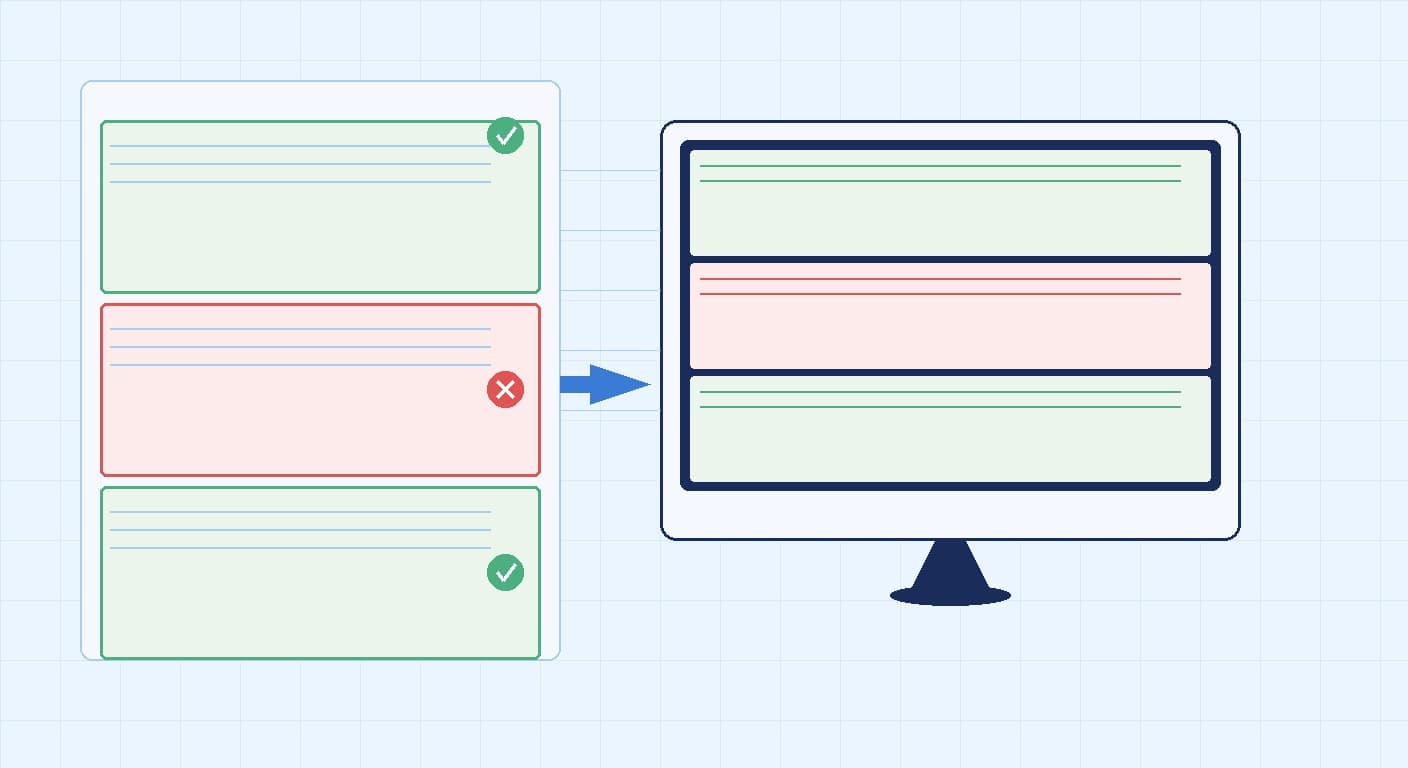
When CBSE announced structural changes to the Class 12 answer booklet ahead of the 2026 board examinations, most attention focused on the shift to on-screen marking (OSM) itself. A parallel change received far less coverage: the board introduced a strict section-specific format for Science and Social Science answer sheets, paired with a zero-tolerance policy. Answers written in the wrong designated section receive no marks — regardless of whether the response is correct.
For Science stream students, the answer booklet is now divided into three clearly delineated sections: Section A for Biology, Section B for Chemistry, and Section C for Physics. Responses written even one section away from their designated area are treated as unattempted. CBSE confirmed that this penalty is not correctable during marks verification or revaluation. The decision stands.
The ripple effects for evaluation methodology are significant. And they reveal exactly why human-only, paper-based evaluation is structurally unsuited to the examination scale India now operates at.
Why the Rule Exists
The section-specific format is a direct consequence of OSM workflow architecture. When answer sheets are scanned and uploaded to an evaluation portal, each examiner typically receives a subset of questions — sometimes a single question number — across thousands of answer books. This question-level distribution is what makes OSM faster and more statistically consistent than centralized manual evaluation.
For question-level distribution to work, the system must reliably identify which part of a scanned page corresponds to which question. Clearly demarcated sections make automated segmentation tractable. When students write answers for Physics in the Biology section, the system — or the evaluator assigned to that segment — either misses it or flags it as out-of-scope.
CBSE's zero-tolerance rule formalizes what was already an operational constraint of OSM architecture. The rule does not arise from administrative cruelty; it arises from the structural requirements of digital question-level evaluation.
Where Manual Evaluation Falls Short
In traditional paper-based evaluation, a teacher marking a physical answer book has the full context of the student's responses in front of them. An experienced evaluator might notice a misplaced Physics answer in the Biology section and still award marks — applying discretionary judgment. This might feel humane, but it introduces a serious consistency problem at scale.
Consider what happens when 15 lakh answer books are distributed across thousands of evaluation centres. Whether a misplaced answer is recognised and marked depends entirely on the individual examiner's attentiveness that day. One student gets marks; another, with an identical answer in the wrong section, does not. In a high-stakes examination, this inconsistency is a significant fairness failure.
OSM eliminates that variability. When an evaluator is assigned question 3(b) across a batch of 200 answer scripts, they see only the segment designated for that question. There is no mechanism to accidentally evaluate a response in the wrong zone — and no mechanism to selectively extend leniency. The policy is enforced uniformly because the system architecture enforces it.
What This Means for Students Sitting Exams
The practical consequence for students is that format compliance is now as important as content quality. A student who writes a textbook-perfect response to a Physics question in the Chemistry section of their answer book will receive zero for that question. No appeals process corrects this; no re-evaluation reverses it.
CBSE began communicating this requirement through affiliated schools ahead of the 2026 examinations, and mock tests included format compliance as a graded element. Yet confusion persisted. Social media carried numerous accounts after the May 2026 result declaration of students discovering that correctly answered questions had been awarded zero marks due to section errors.
This is a legitimate systemic concern. The transition period, where students have spent years writing answers in any available space and are suddenly required to follow rigid spatial rules, creates a structural risk that deserves policy attention. Some education stakeholders have called for a phased compliance approach — warnings and partial credit in early years, full penalty only after a defined transition window.
The Scanning Quality Dimension
Section-specific evaluation also exposes another dependency that institutions often underestimate: scanning quality. When an answer sheet is scanned at low resolution, or with poor contrast, section boundaries become ambiguous in the digital image. An evaluator reviewing a blurry scan cannot always determine whether an answer is in Section A or Section B.
CBSE's 2026 cycle surfaced this problem. Student complaints about blurred scans, missing pages, and ambiguous section boundaries were among the most commonly cited issues in post-result forums. Several high court petitions referenced scanning quality failures as grounds for re-evaluation requests.
The lesson for institutions implementing or evaluating OSM platforms is clear: scanning infrastructure is not a cost to minimise. The minimum standard should be 200 dpi colour scans for answer sheets with structured sections, with automated quality checks before pages are uploaded for evaluation. Institutions that treat scanning as a clerical afterthought will inherit the same problems CBSE encountered.
Implications for Affiliated Universities
CBSE's section-specific format applies to secondary education. But several affiliating universities — particularly those that introduced OSM in 2025 and 2026 — have adapted similar structural conventions for their own answer booklets without always communicating the operational logic to students or faculty.
The risk of adopting format rules without building the corresponding communication infrastructure is that the penalty lands on students who were never clearly informed. Good examination governance requires that format rules be explained in the examination instructions, demonstrated in mock tests, and reinforced by evaluators during preparation periods — not just announced in circulars.
For evaluation coordinators managing the transition from paper to digital, it is worth building a pre-examination checklist that explicitly covers:
The Larger Principle
CBSE's zero-tolerance rule is not an aberration. It is a signal that digital evaluation systems impose structural requirements that ripple upstream — into how answer books are designed, how students are prepared, and how scanning infrastructure is procured and maintained.
For institutions still running hybrid evaluation models, where some papers are evaluated manually and others digitally, the section-specific format issue is a preview of the governance decisions they will face at scale. The sooner those decisions are made deliberately — with student communication, faculty training, and infrastructure investment — the fewer unintended zeroes land on answer books that deserved marks.
---
Related Reading
Ready to digitize your evaluation process?
See how MAPLES OSM can transform exam evaluation at your institution.